
Last updated June 2026 by Steve Jarrell, The Longleaf Group at eXp Realty
Most relocation content about Charlotte is a sales pitch. The weather is great, the jobs are plentiful, the barbecue debate is charming, now sign here. I make my living helping people move to this region, so it might seem strange that I keep a guide to the reasons not to move to Charlotte NC. But after years of doing this, I can tell you the unhappiest clients I have ever had were not the ones who knew the downsides and moved anyway. They were the ones nobody warned.
So this is the conversation I have in the car between showings, written down. The traffic numbers are real, from the 2025 congestion scorecards. The tax math is the actual FY 2025-26 rates. The transit timeline is what passed at the ballot box in November 2025 and what it does and does not promise. If you read all of it and still want to come, you will land here with your eyes open, and you will probably love it. If one of these tradeoffs is a dealbreaker for you, far better to find out now than two months after closing.
For context on the other side of the ledger, my guide to relocating to Charlotte covers what is pulling roughly 20,000 net new residents into the city every year. This page is deliberately the counterweight.
What This Guide Covers
- Reasons Not to Move to Charlotte NC: The Quick List
- Traffic: The Numbers Behind the Complaints
- The Transit Fix Is Real, and It Will Take Decades
- Cost Creep: Taxes, Water Bills, and the 2027 Revaluation
- The School Assignment Maze
- Heat, Humidity, and the Pollen Question
- More Reasons Not to Move to Charlotte NC
- Three Buyer Scenarios: When the Cons Actually Bite
- Who Moves Here and Thrives Anyway
- Frequently Asked Questions
16 min read | By Steve Jarrell, The Longleaf Group at eXp Realty | Updated September 2026
The Short Answer
Traffic is the real one. Charlotte is car-dependent by design, ranked 18th worst in the country for congestion, with rush-hour drivers losing 49 hours a year. Sales tax rose to 8.25% in Mecklenburg after November 2025’s transportation vote, and utility bills went up too. The cost of living is still below the national average — but that is the honest trade you are making.
The honest reasons to skip it:
- The TomTom 2025 index measured Charlotte’s congestion at 34.8%, with rush-hour drivers losing 49 hours over the year
- INRIX ranked metro Charlotte the 18th worst city in the country for congestion, with average speeds around 30 miles per hour in the heaviest windows
- Charlotte’s Walk Score is 26 out of 100 — squarely car-dependent — and 76.6% of workers drive alone
- Voters approved a one-cent transportation sales tax in November 2025 by roughly 52 to 48, raising the county rate from 7.25 to 8.25% and projected to generate about $19.4 billion over 30 years
- Combined property tax inside the city is roughly 76.7 cents per $100 for FY2025-26: Mecklenburg County at 49.27 cents plus the City of Charlotte
- Charlotte Water’s FY26 budget added roughly $5.47 a month for the typical customer plus about 67 cents for stormwater; the 2026 cost of living index sits around 95.7 against a national 100
Reasons Not to Move to Charlotte NC: The Quick List
If you only have two minutes, these are the seven tradeoffs that actually send people back home or push them to a different metro. One, traffic that costs the average driver 49 hours a year and a transit system that will take decades to catch up. Two, growth that outruns the infrastructure, with the city adding more people than any other city in America between July 2024 and July 2025. Three, rising carrying costs: a 2027 property revaluation on deck, water bills stepping up, and a new full penny of sales tax as of 2026.
Four, a school assignment system in Charlotte-Mecklenburg Schools that confuses nearly every relocating parent I work with. Five, summers that sit near 90 degrees for weeks with serious humidity. Six, a flat, landlocked geography where both the mountains and the beach are real road trips. Seven, an economy still concentrated in banking and finance, which is great in good years and nerve-racking in bad ones.
None of these are secrets, but the details underneath them decide whether they matter for your situation. Let’s go through them one at a time with the current numbers.
Traffic: The Numbers Behind the Complaints
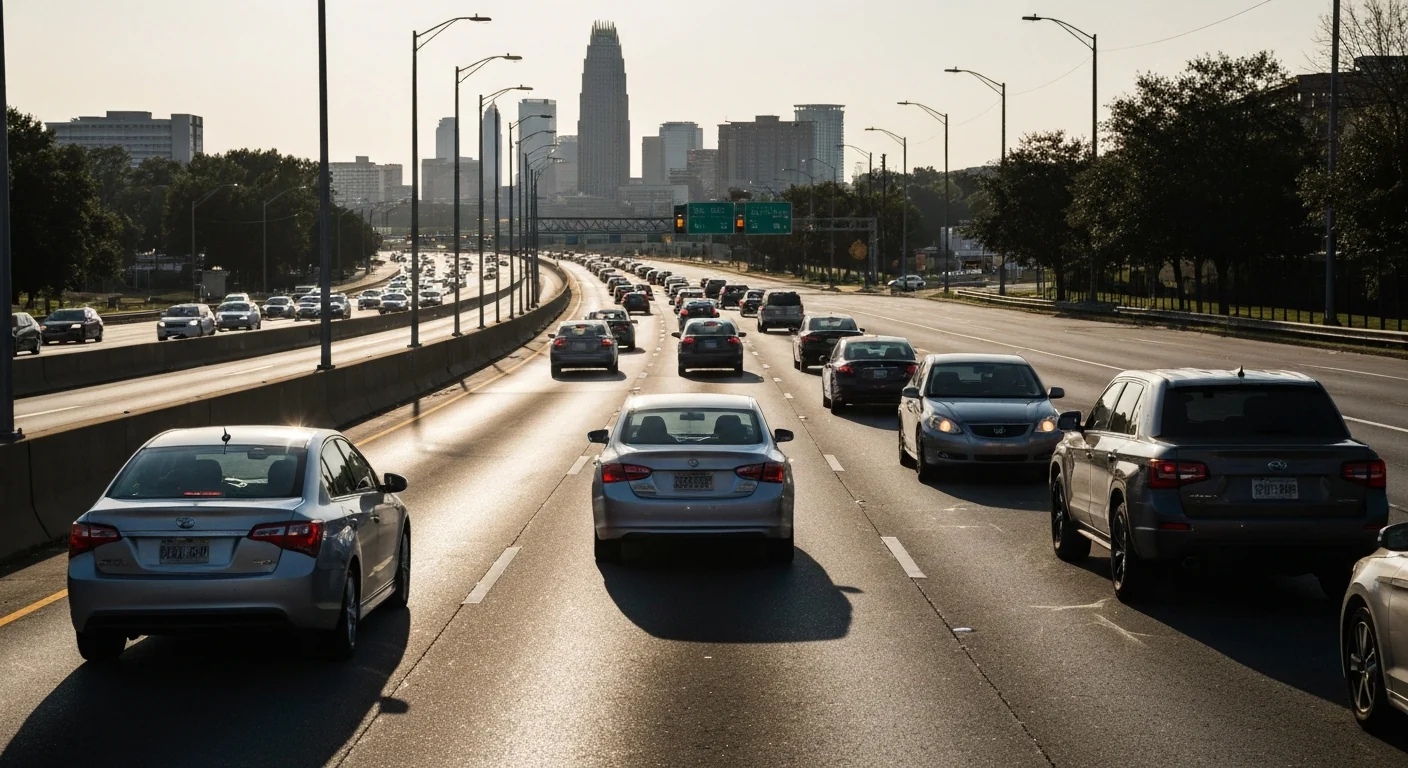
Charlotte traffic is not New York or Atlanta, and locals who have lived in either will tell you so with a smirk. But it is real and it is getting worse, not better. The TomTom 2025 Traffic Index measured Charlotte’s congestion level at 34.8%, with rush hour drivers losing 49 hours over the year, up more than an hour from 2024. INRIX’s 2025 scorecard ranked metro Charlotte the 18th worst city in the country for congestion, with average speeds dropping to around 30 miles per hour during the heaviest commute windows.
The geography of the pain matters more than the averages. I-485, the outer beltway, runs construction projects somewhere along its loop more or less permanently. I-77 north toward Lake Norman is the single most notorious corridor, where the Express Lanes use dynamic pricing: short hops can cost under a dollar in light traffic, but peak period trips along the full corridor can run into double digits. South of town, the two lane roads through Waxhaw, Weddington, and Marvin were laid out for farm traffic and now carry subdivision volumes, which is why I tell every buyer the same thing: drive your exact commute at 7:30 on a weekday morning before you write an offer. My breakdown of real drive times from the south suburbs to Uptown gives corridor by corridor numbers.
The car dependence is structural, not a habit. Charlotte’s overall Walk Score is 26 out of 100, squarely in car dependent territory, and 76.6% of workers drive alone. Studies have ranked the metro among the half dozen most car dependent in the nation. If you are coming from a city where you walked to dinner and took a train to work, this is the single biggest lifestyle change, and no neighborhood except a handful in the urban core will spare you from it.
The exceptions are worth naming, because they are where my walkability refugees end up. Dilworth, Plaza Midwood, NoDa, and South End along the Blue Line are the only sizable pockets where daily life works without a car, and they price accordingly, with smaller homes commanding figures that buy twice the square footage eight miles south. Ballantyne and the Waverly and Rea Farms corridors offer a suburban compromise: you still drive, but dinner, groceries, and the gym sit five minutes away instead of twenty. What does not exist here is the in-between city, the streetcar suburb where a modest house comes with a walkable main street. Buyers who want that combination at a Charlotte price discover it is the one product this market does not stock, and it is better to know that before the house hunt starts than after the fortieth listing.
The Transit Fix Is Real, and It Will Take Decades
Here is the good news and the catch in one paragraph. In November 2025, Mecklenburg County voters approved a one cent transportation sales tax by a margin of roughly 52 to 48, raising the county sales tax from 7.25 to 8.25%. The measure is projected to generate about $19.4 billion over 30 years, split 40% to rail, 40% to roads, sidewalks, and bike infrastructure, and 20% to modernizing the bus system. The rail money is earmarked for the Red Line commuter rail from Uptown to Huntersville and Davidson, the Silver Line connecting Charlotte Douglas International Airport toward Bojangles Coliseum, a Blue Line extension toward Pineville, and Gold Line streetcar expansion. The bus share funds higher frequencies, shelters at roughly 2,000 stops, and new microtransit zones.
That is a generational investment, and I voted with the majority. But if you are moving here in 2026 expecting to ride a train to the airport, read the fine print: full build out is measured in decades, not years. You will pay the extra penny of sales tax starting now, and the congestion relief arrives in phases stretching far beyond any normal homeownership horizon. Buy your house for the commute that exists today, not the one on the planning maps. If a rail line does eventually land near you, treat it as appreciation upside, never as a promise.
Cost Creep: Taxes, Water Bills, and the 2027 Revaluation
Charlotte still prices below the national average overall. The city’s 2026 cost of living index sits around 95.7 against a national baseline of 100, with housing roughly 15% below the U.S. average. The Redfin median sale price was about $415,000 in May 2026, up around 2% year over year, and average rent runs just under $2,000 a month and has actually drifted down slightly year over year thanks to a wave of new apartment supply. Against the coastal metros sending us most of our transplants, Charlotte remains a bargain. That part of the pitch is true.
What the pitch leaves out is the direction of travel on everything around the mortgage. The combined property tax burden inside the city is roughly 76.7 cents per $100 of assessed value for FY 2025-26, with Mecklenburg County at 49.27 cents and the City of Charlotte at 27.41 cents. The county’s next revaluation is scheduled for 2027, and values have climbed substantially since the last one in 2023. Even when rates get adjusted toward revenue neutral, owners in fast appreciating neighborhoods learned in 2023 that individual bills can jump far beyond the average. If you buy in 2026, budget for a step up in your escrow payment in 2027 or 2028 rather than being surprised by it.
The utility line is creeping too. Charlotte Water’s FY26 budget added roughly $5.47 per month for the typical water and sewer customer plus about 67 cents for stormwater. Households served by the private Carolina Water Service in some surrounding areas face an approved 40% rate increase phased over three years. And as of 2026 the sales tax inside Mecklenburg is 8.25% thanks to the transit referendum. None of these alone changes a buying decision. Stacked together, they are why I tell relocating buyers to budget the all-in monthly cost, not the mortgage payment the online calculator shows.
The School Assignment Maze
This is the section that generates the most phone calls. Charlotte-Mecklenburg Schools assigns students to a home school based on address, but layered on top is a School Choice lottery for magnet and specialized programs. For the 2026-27 school year, that lottery window ran from October 13 through December 5, 2025, months before many relocating buyers had even picked a neighborhood. Starting with the 2027-28 school year, CMS is restructuring its magnet offerings into six kindergarten through twelfth grade pathways covering arts, Montessori, world languages, STEM, International Baccalaureate with learning immersion and talent development, and early colleges.
The practical problem is timing. If you close on a house in March, the lottery for the coming fall has already run, and the magnet seat you read about may not be available until the following year. The home school assigned to your address is the only guarantee, so verify it directly with CMS for the specific address before you go under contract, and treat everything else as a bonus. Boundaries also shift as the district manages growth, so a quick call to confirm there is no pending reassignment study for your neighborhood is ten minutes well spent. South Charlotte addresses feed several of the district’s strongest schools, and the Union County districts just south post some of the best ratings in the state, which is a major reason buyers concentrate there. I keep a current guide to Union County schools for south Charlotte buyers if schools are driving your search.
Heat, Humidity, and the Pollen Question
July in Charlotte averages highs around 88 to 89 degrees, and recent Julys have logged 22 to 26 days at 90 or above in that single month. Some full years have stacked close to 60 days at 90 plus. The number on the thermometer undersells it, because Piedmont humidity makes an 89 degree afternoon feel well past 95. From mid June through mid September, you live the way Phoenix lives in summer: morning errands, midday air conditioning, evening porch. If your vision of relocation involves hiking at noon in July, the Carolinas will re-educate you quickly.
The pollen, on the other hand, is half myth. Every April a yellow film of pine pollen coats every car in the region and the photos go viral. It looks apocalyptic and it washes off. In the Asthma and Allergy Foundation of America’s 2026 Allergy Capitals report, Charlotte ranked 56th out of the 100 largest U.S. cities, which is middle of the pack, not a top ten allergy disaster. Allergy sufferers should take the spring seriously here, but the dramatic pollen reputation outruns the data. The heat is the real adjustment; the pollen is mostly a car wash bill.
More Reasons Not to Move to Charlotte NC
The geography is flat and landlocked. Charlotte sits a solid two hours from the Blue Ridge escarpment and three or more from a proper beach. You can reach both, and people do constantly, but neither is in your daily life. There is no skyline backdrop of mountains, no coastal breeze. What you get instead is one of the best urban tree canopies in the country, and lakes: Norman, Wylie, and Wateree all within an hour. If daily access to dramatic scenery is a core need, Asheville, Greenville, or the coast will fit you better than any Charlotte zip code.
The culture is transplant culture. Native Charlotteans are effectively a minority in their own city after decades of inbound migration. You will meet more people from New Jersey, New York, Ohio, and California than from the Carolinas in many south Charlotte neighborhoods. The upside is that nobody cares where you went to high school and newcomers integrate fast. The downside is that buyers arriving in search of deep Southern tradition find a banking city with Southern weather. Which one you wanted decides whether this is a pro or a con.
The economy leans hard on one industry. Charlotte is the second largest banking center in the United States, anchored by Bank of America headquarters and major Wells Fargo and Truist operations. Finance pays the region’s bills, fills the office towers, and writes a lot of the relocation checks. Diversification is improving, with health care, energy, fintech, and manufacturing growing, but when banking sneezes, Charlotte still catches the cold faster than a metro with five anchor industries. If you work in financial services, this concentration is exactly why you are moving here. If you do not, it is worth understanding that the region’s economic weather correlates with one sector.
The airport is a hub, with hub tradeoffs. Charlotte Douglas International handled 53.6 million passengers in 2025, its second busiest year ever, and preliminary rankings placed it sixth in the world for aircraft operations. For travelers this is a gift: nonstop flights everywhere American Airlines goes. For homeowners under the approach paths on the west and south sides, it is a noise consideration that listing photos will not disclose. Check the flight tracks for any address west of uptown or near the airport corridor, ideally by standing in the yard at different hours, before you fall in love with the house. Details are at the official CLT airport site.
Three Buyer Scenarios: When the Cons Actually Bite
Abstract tradeoffs are easy to wave away, so let me make them concrete with three composites built from real conversations this year.
The cross-town commuter. A couple buys in Huntersville for the lake access while one of them works in Ballantyne, a diagonal crossing of the entire metro. On paper the drive is 35 minutes. In practice it is an hour each way with I-77 tolls that climb steeply at peak, call it $15 to $25 on the worst days if they use the Express Lanes both directions, or the hour and a quarter general purpose slog if they do not. That is 400 plus hours a year in the car, the single most common regret I hear. The fix was never about Charlotte; it was buying in the same quadrant as the job. The south suburbs would have given them a 20 minute commute and a different life.
The magnet school plan that missed its window. A relocating buyer closes in March 2026 counting on a language immersion magnet for the fall. The lottery for 2026-27 closed the previous December, the program is full, and the assigned home school was never part of their research. They spend a year on a waitlist they did not know existed. Nothing about that school year was bad, but nothing about it matched the plan they moved with. Sixty minutes of verification before the offer would have changed the house they bought.
The budget set in $2026. A buyer stretches to the top of their approval on a fast appreciating neighborhood inside the city, with an escrow payment calculated on the current assessment. The 2027 revaluation lands, the assessed value steps up to market, and the monthly payment follows it the next year. They are fine, but the margin they thought they had is gone, and the kitchen renovation slides two years. Anyone buying in Mecklenburg County in 2026 should run their payment against a realistic post-revaluation number, not the seller’s current tax bill.
Who Moves Here and Thrives Anyway
After all of that, here is the inconvenient fact for this article’s headline: Charlotte added 20,731 residents between July 2024 and July 2025, the largest numeric gain of any U.S. city, pushing the population to about 964,784, while the 14 county metro has added more than 289,000 people since 2020 and now tops three million. People are voting with their moving trucks, and most of them stay happy. The ones who thrive share a profile. They commute inside their own quadrant of the metro instead of crossing it daily. They picked their neighborhood around their actual weekly life, not around a brochure. They treated the heat as beach trip fuel and the banking economy as their employer rather than a risk. And they ran the full monthly budget, including the 2027 revaluation, before they signed.
The unhappy ones almost always violated one of those rules, usually the commute. If you want the granular version of where leavers go and why, my companion piece on why people are leaving Charlotte for the South Carolina suburbs walks through the tax and school math across the state line, and my top ten regrets list collects the mistakes I see most. Read those two and this page, and you will know more than 90% of buyers landing at CLT with a relocation packet.
Frequently Asked Questions
What are the biggest reasons not to move to Charlotte NC?
The tradeoffs that matter most in 2026 are traffic congestion that costs rush hour drivers about 49 hours a year, car dependence with a Walk Score of just 26, rising carrying costs ahead of the 2027 property revaluation, a confusing school choice lottery in CMS, hot and humid summers with 20 plus days over 90 degrees in July alone, distance from both mountains and beach, and an economy concentrated in banking and finance.
Is Charlotte NC traffic really that bad?
By national standards it is significant and worsening. TomTom’s 2025 index put congestion at 34.8% with 49 hours lost to rush hour over the year, and INRIX ranked Charlotte the 18th worst U.S. metro for congestion. The pain is corridor specific: I-77 north, I-485 construction zones, and the two lane roads of southern Union County are the hot spots, while commutes within one quadrant of the metro are usually manageable.
Did Charlotte pass the transit sales tax, and what does it fund?
Yes. In November 2025, Mecklenburg County voters approved a one cent transportation sales tax roughly 52 to 48, raising the sales tax to 8.25%. It is projected to raise about $19.4 billion over 30 years, allocated 40% to rail including the Red Line and Silver Line, 40% to roads, sidewalks, and bike lanes, and 20% to the bus system. Full build out will take decades.
Is Charlotte NC expensive to live in?
Charlotte’s overall cost of living index is about 95.7, roughly 4% below the national average, with housing about 15% below. The median home sale price was around $415,000 in May 2026 and average rent just under $2,000. The caution is direction: water rates, the new transit sales tax, and the 2027 county revaluation are all pushing monthly costs upward.
How bad is pollen season in Charlotte?
Visible, but overrated as a health ranking. The spring pine pollen coats cars in yellow for a few weeks each April. In the AAFA 2026 Allergy Capitals report, Charlotte ranked 56th out of the 100 largest U.S. cities, middle of the pack nationally. The summer heat and humidity are a bigger lifestyle adjustment than the pollen for most transplants.
Is the CMS school lottery hard for relocating buyers?
The hard part is timing. The School Choice lottery for the 2026-27 year ran from October 13 to December 5, 2025, before many relocating buyers had chosen a neighborhood, and magnet restructuring into six K-12 pathways begins in 2027-28. The reliable move is to verify the assigned home school for the exact address with CMS before going under contract and treat magnet access as a possible bonus, not a plan.
About the Author
Steve Jarrell is a real estate agent with The Longleaf Group at eXp Realty, serving South Charlotte, Union County, and the surrounding suburbs on both sides of the state line. He gives relocating buyers the unvarnished version of the Charlotte market, including the parts the brochures skip. Reach him at 704-774-7170 or steve@jarrellhomes.com.
Want the Full Picture Before You Decide on Charlotte?
I will walk you through the tradeoffs for your specific commute, budget, and school needs, including the neighborhoods where the downsides barely apply.
704-774-7170 | steve@jarrellhomes.com | thelongleafgroup.com
 |
Free · 26-Page Insider Guide Which South Charlotte Town Is Right for You? Towns, villages, and cities compared, NC vs SC taxes and schools, and the 5 mistakes out-of-state buyers make. Everything you’d want a local to tell you before you move. Get the free guide → |