
Last updated June 2026.
If you are researching new construction Charlotte NC, the question you are really asking is some version of this: with builders advertising rate buydowns and closing cost credits everywhere I look, is 2026 actually a good time to buy a new build, and how do I walk into a sales office without getting taken advantage of?
I am Steve Jarrell with The Longleaf Group at eXp Realty. I live in Weddington and work the new construction corridors of South Charlotte and Union County every week, which means I spend a lot of time in model homes, design centers, and builder contracts. I also spent a decade running a real estate marketing technology company before becoming an agent, so I have seen how builders market homes from the inside. The short answer to the question above: 2026 is one of the most buyer-favorable new construction environments this market has seen in years, but the leverage only helps you if you know where it is. The sales office will not point it out for you.
This guide covers who is actually building in the Charlotte area right now, what incentives look like in mid 2026 with real numbers, how builder contracts differ from the standard North Carolina purchase form, the inspection phase most buyers skip and regret, and how to spend your design center budget without donating money to the builder. Everything here reflects the market as of June 2026.
What This Guide Covers
- The 2026 Builder Landscape for New Construction in Charlotte NC
- Builder Incentives in 2026: What Is Actually on the Table
- Builder Types, Quality Levels, and Realistic Timelines
- The Builder Contract Is Not the Form You Know
- Inspections for New Construction in Charlotte NC: Do Not Skip Pre-Drywall
- Design Center Math: Upgrades Worth Buying and Upgrades to Skip
- Selling Your Current Home First, HOAs, and Other Practical Logistics
- Frequently Asked Questions About Buying New Construction in Charlotte NC
16 min read | By Steve Jarrell, The Longleaf Group at eXp Realty | Updated September 2026
The Short Answer
The 2026 new-construction market has shifted toward buyers: 61% of builders are offering incentives with average price reductions deepening to 6%, and spec inventory is up. The number to focus on is not the base price but the design center, because that spending rolls into the purchase price and you pay interest on it for 30 years. Get a pre-drywall inspection.
What to know before you sign:
- As of May 2026, 61% of builders were offering incentives with the average price reduction deepening to 6%; NAHB reported 67% in December 2025
- David Weekley Homes is offering 1% of the loan amount toward closing costs through its preferred lender on Charlotte-area purchases for all of 2026
- PulteGroup announced in March 2026 it is opening seven metro Charlotte communities totaling more than 1,400 homes across four counties
- Same builder, twenty minutes apart: Riverstone in Monroe starts around $299,000 while Forest Creek in Waxhaw starts around $483,000 — nearly $185,000 driven mostly by land cost and school assignment
- Charlotte-area permits ran roughly 16% below the prior year by spring 2025 while resale inventory climbed; the regional median in April 2026 was around $411,000
- A pre-drywall inspection runs roughly $250 to $450 — and remember design center spending rolls into the purchase price, so you pay interest on that backsplash for 30 years
The 2026 Builder Landscape for New Construction in Charlotte NC
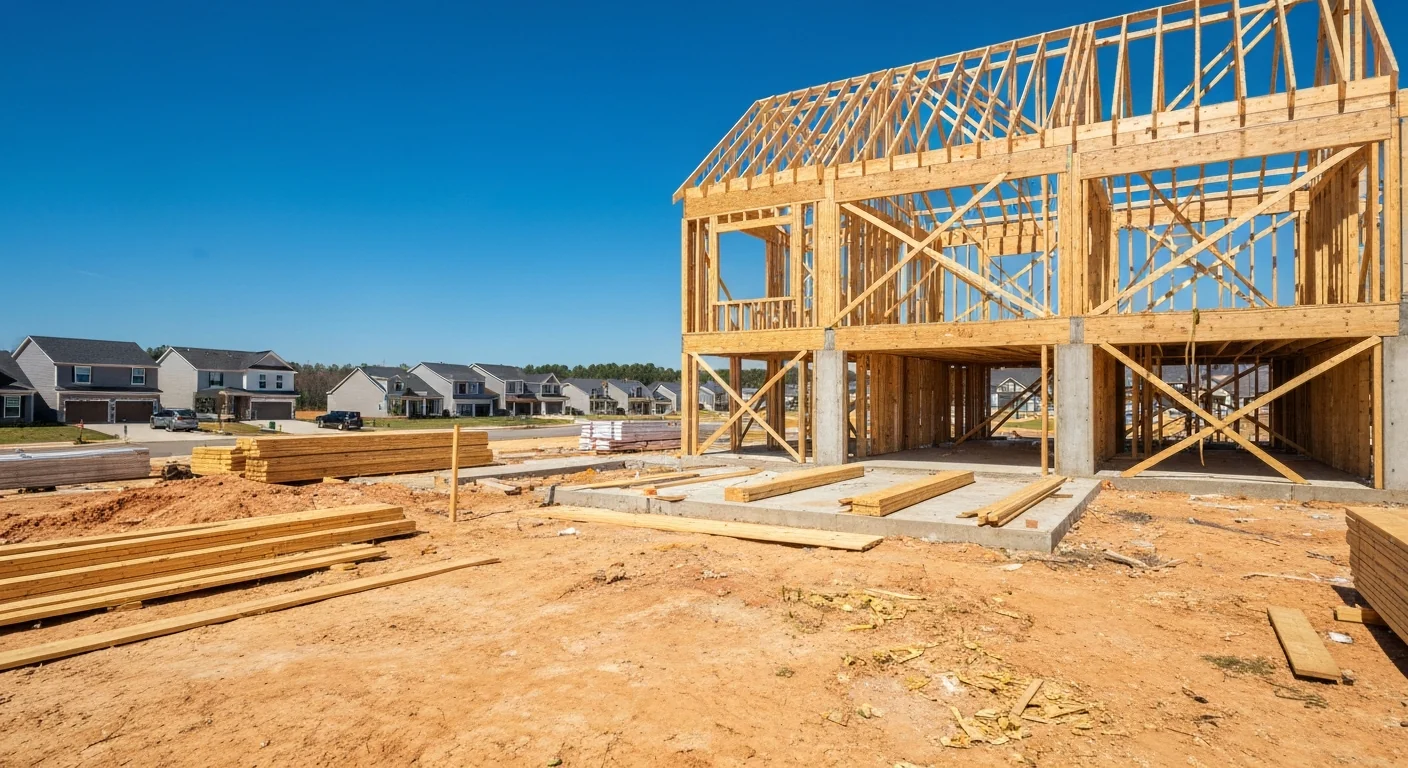
The Charlotte metro remains one of the most active new construction markets in the Southeast, but the map of where homes are being built has shifted. Land inside Mecklenburg County is scarce and expensive, so the volume has pushed out to Union County and the surrounding ring: Monroe, Indian Trail, Wesley Chapel, Waxhaw, and across the state line into Fort Mill and Indian Land. If you want a new single-family home at an attainable price point, you are very likely shopping that ring, not Charlotte proper.
Here is who is active as of mid 2026. The national production names are all here: D.R. Horton, Lennar, PulteGroup, M/I Homes, Taylor Morrison, and David Weekley Homes, alongside two large Carolinas-based builders, True Homes and Eastwood Homes, that build heavily in Indian Trail, Monroe, and the broader Union County corridor. PulteGroup announced in March 2026 that it is opening seven new metro Charlotte communities totaling more than 1,400 homes across Mecklenburg, Union, Cabarrus, and Gaston counties. Two of those Union County examples show the price spread well: Riverstone in Monroe starts around $299,000, while Forest Creek in Waxhaw starts around $483,000. Same builder, twenty minutes apart, and nearly $185,000 of difference driven mostly by land cost and school assignment.
At the top of the market, Toll Brothers is building The Bluffs at Wesley Chapel, a small Union County enclave of 12 homes running 3,900 to 5,200 square feet and priced from just over $1 million, and has announced a luxury townhome community near SouthPark planned to open in late 2026 starting in the mid $900,000s. The point of naming all of this is simple: the builder roster and the product range in this market are deep, and the right builder for you depends entirely on budget, timeline, and how much customization you actually want.
One more piece of context that matters for negotiation: supply. Charlotte area permitting eased through 2025, with permits running roughly 16% below the prior year by spring 2025, while resale inventory has been climbing. Builders are sitting on more finished spec homes than they were two years ago, and the regional median sale price in April 2026 came in around $411,000, essentially flat year over year. Flat prices plus standing inventory is exactly the combination that makes builders deal. If you are comparing specific submarkets, I keep dedicated guides updated for new construction in Monroe NC and new construction in Waxhaw NC.
Builder Incentives in 2026: What Is Actually on the Table
Nationally, the National Association of Home Builders reported that 67% of builders were offering sales incentives in December 2025, the highest share of the post-pandemic period, with average price reductions running around 5%. The May 2026 reading still showed 61% of builders offering incentives, with the average price reduction deepening to 6%. You can track the monthly numbers yourself through the NAHB/Wells Fargo Housing Market Index. Charlotte is following the national pattern, and in some price bands exceeding it.
Here is what I am seeing locally in mid 2026, with named examples. M/I Homes has advertised buydown rates as low as 3.875% on select Charlotte-area FHA loans through its in-house lender, plus up to 5% in paid closing costs on select quick move-in homes tied to hard contract and closing deadlines. David Weekley Homes is offering 1% of the loan amount toward closing costs through its preferred lender on Charlotte-area purchases for all of 2026. Against a market backdrop where the Freddie Mac 30-year fixed average sat at roughly 6.5% in the first week of June 2026 (you can check the current weekly average at Freddie Mac’s Primary Mortgage Market Survey), a builder-funded buydown into the 4s or low 5s is real money. On a typical Union County purchase, that kind of rate gap can mean several hundred dollars a month.
Now the part the sales office will not volunteer. Almost every one of these incentives is structured around the builder’s fiscal calendar. The big production builders are publicly traded companies, and those “must close by June 30” or “must close by December 31” deadlines line up with quarter ends because the division president has homes to clear off the books before the quarter closes. The deepest spec home discounts in this market consistently show up in the final three weeks of a quarter, on finished homes that have been standing for 60 days or more. If you have flexibility on timing, shop the standing inventory list in mid June, mid September, or mid December and ask directly what it would take to close before the deadline. I have watched that one question unlock five figures of additional incentive that was never advertised.
Two cautions. First, most incentives are conditioned on using the builder’s affiliated or preferred lender. Sometimes that lender’s underlying terms are genuinely competitive, sometimes the incentive quietly pays for itself in a higher rate or fees. Always get a same-day quote from one outside lender so you can compare the true cost. Second, incentives on to-be-built homes are usually thinner than on standing inventory. The builder has no carrying cost on a home that does not exist yet, so they have less reason to deal.
Builder Types, Quality Levels, and Realistic Timelines
Not all builders are created equal, and neither are their price points. Every builder in North Carolina has to meet the state building code, but code is a minimum standard, not a quality benchmark. Finishes, framing tolerances, insulation detail, and how a builder handles warranty calls vary enormously between a value-engineered production home and a true custom build.
| Builder Category | Customization | Typical Price Point | Estimated Build Time |
|---|---|---|---|
| Custom | Choose and design everything: floor plan, materials, fixtures. | $$$$ | 12 to 18 months |
| Semi-Custom | Select from pre-approved options (cabinets, tile, elevations). | $$$ | 6 to 9 months |
| Spec (Production) | Home is built to the builder’s plan; minimal or no changes. | $$ | Move-in ready to 3 to 6 months |
A few practical notes on those rows. Custom builds in Union County routinely run past 12 months once you account for design, permitting, and selections, so have a housing plan that survives delays. Semi-custom is the sweet spot for buyers who want structural choices without a year of decisions. Spec homes are where the 2026 deals live, for the quarter-end reasons covered above. And one verification step almost nobody does: any builder doing work over $40,000 in North Carolina must hold a state general contractor license, and you can look up any builder’s license status and history for free at the North Carolina Licensing Board for General Contractors. Two minutes on that site tells you whether the small builder you are considering is licensed, in what classification, and whether there is any disciplinary record.
The Builder Contract Is Not the Form You Know
If you have bought a resale home in North Carolina, you signed the standard Offer to Purchase and Contract, a form negotiated over decades to balance buyer and seller interests, with a due diligence period that lets you walk for any reason. Builder contracts are nothing like that. Every production builder uses its own proprietary purchase agreement, written by the builder’s attorneys, for the builder’s benefit. Expect 30 to 60 pages, and expect the terms to lean the builder’s way on almost every page.
The specific items I flag for buyers most often:
- Deposits are usually non-refundable. Builder deposits and design center deposits often run well into five figures on a to-be-built home, and most contracts make them non-refundable outside a narrow financing exception. Know exactly which scenarios get your money back before you sign.
- Verbal promises do not exist. Most builder contracts state explicitly that nothing outside the written agreement is binding. If the sales rep promised a fence allowance, a fridge, or a closing date, it goes in writing or it never happened.
- The builder controls the timeline. Contracts typically give the builder generous extension rights for weather, labor, and materials while holding you to firm deadlines on deposits and selections. Ask what compensation, if any, applies when the builder runs long.
- Price escalation and substitution clauses. Some agreements allow the builder to substitute materials of “equal or better quality” at their sole discretion, and some older forms allowed cost escalation. Read for both.
- The sales agent works for the builder. Friendly, helpful, and contractually obligated to the other side. That is not cynicism, it is just agency law.
Here is the local detail that costs unrepresented buyers real money: builder registration policies. Most Charlotte-area builders will only recognize and compensate your agent if the agent registers with you on or before your first visit to the community. Walk into a model home alone on a Saturday, sign the visitor sheet, and many builders will refuse to let you add representation afterward. That means the buyer who wandered in casually has just given up the one professional who would have reviewed that 50-page contract, negotiated the incentive package, and scheduled independent inspections, at no cost to them, since the builder pays the buyer agent compensation. Bring your agent to the very first visit, even the casual one. It is the cheapest insurance in real estate.
Inspections for New Construction in Charlotte NC: Do Not Skip Pre-Drywall
The most expensive sentence in new construction is “it’s a brand new home, why would I pay for an inspection?” County code inspections happen, yes. Mecklenburg County’s code enforcement office and Union County’s inspection division check the home at required milestones for code compliance. But a county inspector is verifying minimum code on a heavy daily workload, not performing quality control for you. Code-compliant and well-built are not the same thing.
Independent third-party inspections should happen at three points:
- Pre-drywall inspection. This is the one buyers skip and regret. It happens after framing, electrical, plumbing, and HVAC rough-ins are complete but before insulation and drywall seal everything in. It is the only moment in the home’s life when the structure and systems are fully visible. Routine finds include over-notched and over-drilled studs, missing nail plates over wiring, poorly sealed or crushed HVAC ducts, drain lines with incorrect slope, and missing fire blocking. In the Charlotte area a pre-drywall inspection runs roughly $250 to $450. Fixing a framing or duct problem at this stage costs the builder a work order. Finding it two years after closing costs you drywall, paint, and a fight.
- Final inspection before the walk-through. A full top-to-bottom inspection of the finished home, done before your builder walk-through so every item lands on the punch list while the builder still wants your signature at closing.
- 11-month warranty inspection. Most builders provide a 1-2-10 style warranty: one year on workmanship, two years on mechanical systems, ten years on major structural elements. An inspection in month 11 documents everything the workmanship warranty still covers, right before that first-year coverage expires.
Builders in this market are used to third-party inspections and the reputable ones accommodate them without friction. If a builder resists an independent pre-drywall inspection, treat that as the loudest possible signal about what the inspection would have found.
Design Center Math: Upgrades Worth Buying and Upgrades to Skip
The design center is where a carefully budgeted purchase quietly grows by tens of thousands of dollars, one tile selection at a time. The model home you toured is the most upgraded version of that floor plan the builder can legally show you. Always ask for the “included features” sheet so you know what the base price actually buys, then apply one rule: pay the builder for things that are structural or buried in walls, and handle cosmetic items yourself after closing.
Worth paying the builder for: structural additions like a covered porch, a third-car garage, or a finished bonus room; extra windows; rough-in plumbing for a future bath; upgraded insulation; taller ceilings; and cabinet-grade changes that are miserable to retrofit. These are cheap to do during construction and expensive forever after.
Usually better after closing, from your own contractor:
- Decorative lighting and ceiling fans
- Backsplashes and accent tile
- Designer paint colors
- Closet systems and garage storage
- Smart home accessories and security systems
- Window treatments, which builders price at a startling premium
Design center markups on cosmetic items commonly run double what an independent installer charges after closing. There is also a financing angle worth knowing: design center spending gets rolled into the purchase price, which means you are paying interest on that backsplash for 30 years. One exception cuts the other way, though. If a builder is offering a design center credit as part of an incentive package, spend it freely. Incentive dollars you do not use simply go back to the builder.
Selling Your Current Home First, HOAs, and Other Practical Logistics
Most Charlotte-area builders require your existing home to be sold, not merely under contract, before they will execute a purchase agreement on a to-be-built home. That single policy drives more new construction logistics than anything else. The two workable paths: sell first and rent short-term while the home is built, which gives you a clean contingency-free position, or negotiate a lease-back with your buyer so you stay in your current home past closing and move once. On a spec home that is already finished, this constraint mostly disappears, which is one more underrated argument for standing inventory.
On the carrying-cost side, plan for the homeowners association. Essentially every new construction community in this market comes with a mandatory HOA, and the dues range widely depending on amenities. Ask for the HOA documents and the fee schedule before you write the deposit check, and ask who controls the HOA. In a new community the builder typically controls the association until buildout, which means the rules and budget can change before residents take over. Buyers shopping the South Carolina side of the metro should also ask about any special tax district assessments on top of HOA dues, since those show up on the tax bill rather than the HOA statement.
Finally, weigh the location tradeoff carefully. New construction in this metro generally means a newer, farther-out address. A resale home in an established area like Ballantyne buys you mature trees, settled infrastructure, and a shorter commute in exchange for older finishes. I wrote a full breakdown of that tradeoff in my guide to the pros and cons of living in Ballantyne, and it is worth reading before you commit to a 35-minute drive for the sake of a brand-new kitchen.
Frequently Asked Questions About Buying New Construction in Charlotte NC
Do I need my own real estate agent to buy new construction in Charlotte NC?
Yes, and the timing matters more than most buyers realize. The on-site sales agent represents the builder, not you. Your own agent reviews the builder’s proprietary contract, negotiates incentives, and coordinates independent inspections, and the builder typically pays the buyer agent compensation. The catch is registration policy: most Charlotte-area builders only recognize your agent if the agent accompanies or registers with you on the first visit to the community. Bring your agent to the very first model home visit, even a casual one.
What incentives are Charlotte builders offering in 2026?
As of mid 2026, common packages include mortgage rate buydowns, with advertised local examples as low as 3.875% on select FHA loans through builder-affiliated lenders, closing cost credits of 1% of the loan amount up to 5% of the price on select quick move-in homes, and design center credits. Nationally, NAHB reported 67% of builders offering incentives in December 2025 and 61% in May 2026, with average price reductions of 5 to 6%. The deepest discounts cluster on finished spec homes near builder fiscal quarter ends in June, September, and December.
Should I use the builder’s preferred lender?
Often yes, but only after comparison shopping. Most builder incentives are conditioned on using the builder’s affiliated or preferred lender, and the packages can be genuinely strong. The risk is that the incentive quietly pays for itself through a higher rate or added fees. Get a written quote from at least one outside lender on the same day, compare the full cost including the incentive, and then decide. The comparison quote also gives you negotiating leverage with the builder’s lender.
What inspections should I get on a new construction home?
Three independent inspections: a pre-drywall inspection after rough-ins but before insulation and drywall, which runs roughly $250 to $450 in the Charlotte area and is the only chance to see the structure and systems exposed; a full final inspection before your builder walk-through; and an 11-month warranty inspection before the one-year workmanship coverage expires. County code inspections are a minimum standard check, not quality control performed on your behalf.
Is a builder’s contract negotiable?
The form itself rarely changes, but the deal terms around it absolutely do. Production builders will seldom rewrite their purchase agreement, which their attorneys drafted to protect them. What is negotiable: price on standing inventory, closing cost credits, rate buydowns, design center credits, lot premiums, and included upgrades. Everything promised must be written into the agreement or an addendum, because most builder contracts state that verbal representations are not binding.
How long does it take to build a new home in the Charlotte area?
Custom homes typically run 12 to 18 months from design through completion, semi-custom homes about 6 to 9 months, and production spec homes range from move-in ready to roughly 3 to 6 months if the home is already framed. Builder contracts usually give the builder extension rights for weather, labor, and materials, so build a buffer into your housing plan rather than scheduling movers around the first date the sales office mentions.
Do Charlotte builders require me to sell my current home before signing?
For to-be-built homes, most Charlotte-area builders require your current home to be fully sold, not just under contract, before executing a purchase agreement. The standard solutions are selling first and renting during construction, or negotiating a lease-back with your buyer so you move only once. Finished spec homes usually avoid this requirement entirely, since the builder can close on a normal resale-style timeline.
About the Author
Steve Jarrell is a licensed real estate agent in North and South Carolina with The Longleaf Group at eXp Realty. He lives in Weddington, works the new construction corridors of South Charlotte and Union County every week, and spent a decade leading a real estate marketing technology company before becoming an agent, which is why this guide leans on verified current data and contract-level detail instead of recycled talking points.
Shopping New Construction Around Charlotte?
Builder incentives, contracts, and inspection windows all reward buyers who walk in prepared. Let’s talk through the communities you are considering, what the builders are really offering right now, and how to protect yourself before you sign anything.
Schedule a Call With Steve704-774-7170 | steve@jarrellhomes.com | thelongleafgroup.com
 |
Free · 26-Page Insider Guide Which South Charlotte Town Is Right for You? Towns, villages, and cities compared, NC vs SC taxes and schools, and the 5 mistakes out-of-state buyers make. Everything you’d want a local to tell you before you move. Get the free guide → |