
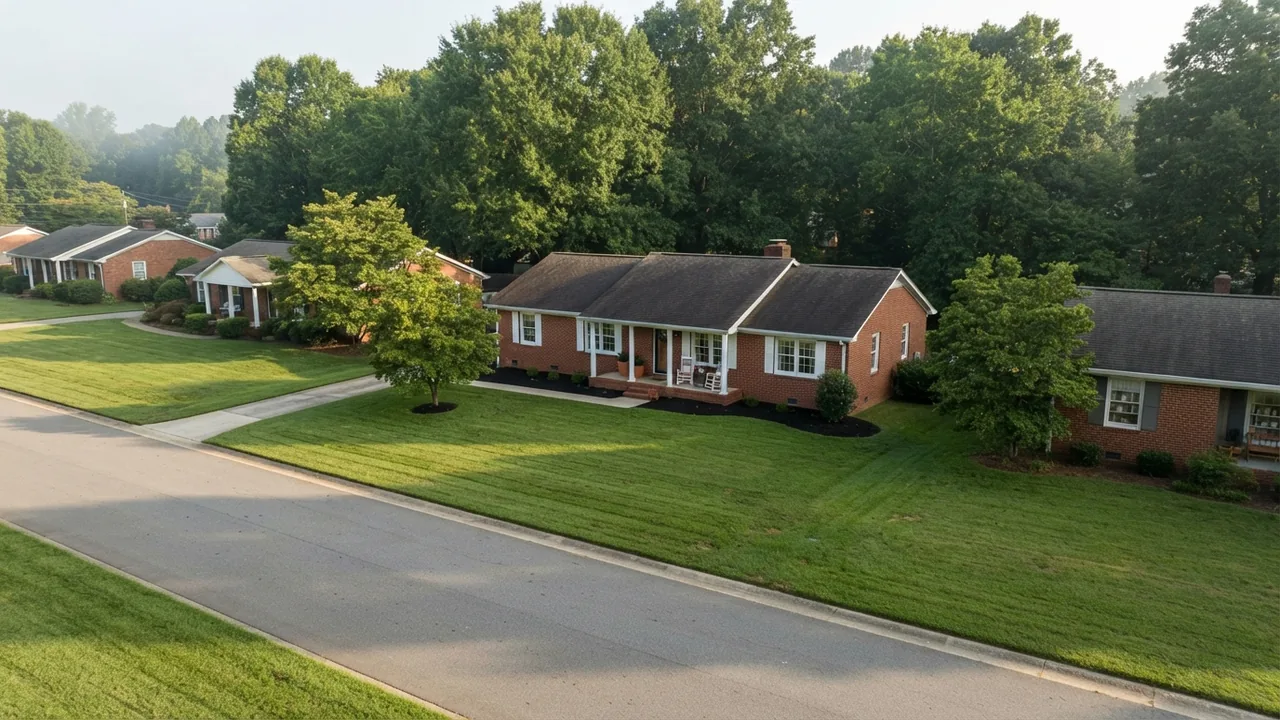
Inside the Monroe city limits, the combined property tax rate is $0.8742 per $100 of assessed value: $0.4342 to Union County and $0.4400 to the City of Monroe. Cross the line into unincorporated Union County and the county rate is the same $0.4342, with a fire district rate of between $0.0000 and $0.0719 on top of it. Those are the rates on the books for the 2025-2026 tax year, published by the North Carolina Department of Revenue, and confirmed as current by the City of Monroe.
So the same house, at the same assessed value, can cost you roughly $1,544 more a year in tax depending on which side of a line you can’t see from the street. Below you’ll find what that second bill buys, how utilities, trash and law enforcement change, and what stays exactly the same on both sides of the Monroe city limits. I’m Steve Jarrell, I lead The Longleaf Group at eXp Realty, and I write these because this question comes up on nearly every Union County tour.
13 min read | By Steve Jarrell, The Longleaf Group at eXp Realty | Updated September 2026
Free · 26-Page Insider Guide
Weighing a city address against a county one?
Towns compared, NC vs SC taxes and schools side by side, and the 5 mistakes out-of-state buyers make.
What This Guide Covers
- What changes inside Monroe city limits?
- The property tax math on both sides of the Monroe city limits
- What your city tax bill actually buys inside Monroe city limits
- What buying outside the Monroe city limits looks like
- What does not change on either side of the line
- Frequently asked questions about Monroe city limits and Union County
What changes inside Monroe city limits?
Four things change when your address sits inside the Monroe city limits. You pick up a second property tax bill from the city. Your electricity and natural gas can come from the city itself rather than from a cooperative or a propane truck. Your water and sewer come from the city instead of a well and a septic system. And your trash gets collected on a city contract. Law enforcement changes too, from the Union County Sheriff’s Office to the Monroe Police Department.
You’re not choosing between two towns here. You’re choosing between two jurisdictions inside the same county, often on the same road, feeding the same schools. That’s what makes it so easy to miss when you’re shopping from another state.
The Short Answer
An address inside the Monroe city limits carries a second tax bill and a full set of city services. An address outside it, in unincorporated Union County, carries the county rate plus a fire district rate and leaves utilities, trash and water to you.
Key numbers, Monroe and Union County, 2025-2026 tax year (sources: NC Department of Revenue, City of Monroe):
- Union County rate: $0.4342 per $100 of assessed value
- City of Monroe rate: $0.4400 per $100, on top of the county rate
- Combined inside the city: $0.8742 per $100
- Union County fire district rates outside the city: $0.0000 to $0.0719 per $100 across 18 districts
- Annual gap on a $400,000 assessed value: about $1,472 to $1,760
- Downtown Monroe addresses add another $0.1600 per $100
Here is the part that catches people. The tax value is set the same way on both sides of the line, so two houses a quarter mile apart, at the same assessed value and with the same school assignment, can carry combined rates of $0.8742 and $0.4342 per $100. That’s not a market difference. It’s a jurisdiction difference, and it shows up in your escrow every month for as long as you own the place. If I were writing an offer on anything near the edge of town, I’d pull the county tax record and read the municipality field first.
Talk to a local broker
Not sure which side of the Monroe city limits your short list is on?
Send me the addresses and I will tell you what each one carries for tax, utilities and services before you tour them.
Schedule a 15-Minute Introductory Call →704-774-7170 · steve@jarrellhomes.com · thelongleafgroup.com
The property tax math on both sides of the Monroe city limits
For the 2025-2026 tax year, Union County levies $0.4342 per $100 of assessed value countywide, and the City of Monroe levies $0.4400 per $100 on addresses inside the Monroe city limits, for a combined $0.8742. Those figures come from the North Carolina Department of Revenue rate schedule, and the city states the same 44.0 cent rate on its own tax information page.
Run it on a $400,000 assessed value. Buy inside the Monroe city limits and you owe $3,496.80 a year. Outside them, in unincorporated Union County with the Unionville fire district rate of $0.0540, you owe $1,952.80. That’s a gap of $1,544.00 a year, or $128.67 a month. Land in the Providence fire district, which levies $0.0000, and the outside number drops to $1,736.80 while the gap widens to $1,760.00.
Same house. Different line. Different bill.
Monroe’s municipal rate is the second highest in Union County. Only Marshville, at $0.4700, is higher. Waxhaw sits at $0.2900, Wingate at $0.2500, Stallings at $0.1890, Indian Trail at $0.1700, Marvin at $0.0563, Weddington at $0.0350 and Wesley Chapel at $0.0225. Hemby Bridge levies nothing at all. Because of that spread, “Union County taxes” isn’t a single number, and the town line matters more here than it does in most places.
One more line to know about. Addresses inside the downtown district carry an extra $0.1600 per $100, which takes the combined rate to $1.0342. Worth asking about by address if you’re looking at anything near Main Street.
| Measure | Inside Monroe city limits | Unincorporated Union County |
|---|---|---|
| County rate per $100 | $0.4342 | $0.4342 |
| Municipal rate per $100 | $0.4400 | None |
| Fire district rate per $100 | None, city fire service | $0.0000 to $0.0719 |
| Combined rate per $100 | $0.8742 | $0.4342 to $0.5061 |
| Annual tax, $400,000 assessed | $3,496.80 | $1,736.80 to $2,024.40 |
| Electricity | City of Monroe Energy Services | Cooperative or investor-owned utility, confirm by address |
| Natural gas | City of Monroe | City gas reaches some areas, propane elsewhere |
| Water and sewer | City of Monroe | County water or private well and septic |
| Trash and recycling | Weekly city collection, recycling every other week | Private hauler or county drop-off |
| Law enforcement | Monroe Police Department | Union County Sheriff’s Office |
| Public schools | Union County Public Schools | Union County Public Schools |
What your city tax bill actually buys inside Monroe city limits
Short version: a utility company. Monroe is one of a small number of North Carolina towns that runs its own electric and natural gas systems, and that’s the single biggest thing sitting alongside your city tax bill inside the Monroe city limits.
Monroe has distributed electricity since January 1900. Today it runs six distribution substations, 296 miles of distribution line and 19.5 miles of transmission line, with a summer peak load of 134 megawatts, and it holds an ownership share in the Catawba nuclear plant through its membership in NCMPA #1. The American Public Power Association has designated it a Reliable Public Power Provider. All of that is on the city’s own electric department page.
Natural gas started in 1957 and now serves roughly 13,000 customers, per the city’s natural gas page. Here’s the wrinkle worth knowing: that gas system reaches past the city line into Wingate, Marshville and Unionville, so city gas and the Monroe city limits aren’t the same map. Don’t assume one from the other.

Trash is the everyday one. The city contracts with Waste Pro for weekly garbage, bulk and yard waste collection, with recycling picked up every other week. Each household gets one 96-gallon green cart for garbage and one 96-gallon black cart for recycling. Those details are on the city solid waste page, and the practical point is that inside the Monroe city limits you don’t shop for a hauler.
Water and sewer come from the city too, which cuts both ways. City water means no well pump and no septic field. It also means city water rules: Monroe moved to Stage 2 mandatory water restrictions on July 6, 2026 and stepped back to Stage 1 voluntary conservation on July 27, 2026 after rainfall refilled its reservoirs. Coming from somewhere that never restricts outdoor watering, you’ll want to plan around that.
Law enforcement inside the line is the Monroe Police Department, with a non-emergency line at 704-289-1591. Fire service comes from the city, which is why city addresses carry no separate fire district rate.
Monroe is not the only place around here where a line on a map moves the tax bill. The same question comes up across in Mecklenburg County, where I walked through how the town line works in Mint Hill and what it changes on a tax bill.
What buying outside the Monroe city limits looks like
Outside the Monroe city limits, in unincorporated Union County, you drop the $0.4400 city rate and pick up a fire district rate instead. There are 18 fire districts in the county, and the rates run from $0.0173 in the Griffith Road district to $0.0719 in the Wingate district, with Providence at $0.0000. Sandy Ridge is $0.0267, Wesley Chapel $0.0304, Stack Road $0.0440, Jackson $0.0446 and Unionville $0.0540. Which one you land in is set by the property, not by you.
Utilities become yours to solve rather than the city’s. Electricity outside the city system usually comes from a cooperative or an investor-owned utility, and the big cooperative here is Union Power Cooperative, headquartered on North Rocky River Road in Monroe and reporting 91,396 member accounts across five counties. Confirm the provider for the specific address rather than assuming, because those boundaries don’t follow the town line neatly.
Water is the one that surprises out-of-state buyers most. Plenty of unincorporated parcels run on a private well and a septic system, which means a pump, a pressure tank, a drain field and a maintenance schedule that’s yours now. Never had either? Read our guide to well and septic in Weddington, which walks through the same systems you’d inherit here. Trash you arrange yourself, either with a private hauler or by hauling it to a county drop-off site. Law enforcement is the Union County Sheriff’s Office.
What you get in exchange is land and quiet. Lot sizes outside the towns run larger, and the tax savings are real money every single year. There’s the trade, stated plainly: more acreage and a lower bill, against more things you’ll maintain yourself.
The cheaper tax bill outside the Monroe city limits isn’t free money, and I wouldn’t treat it that way. Take the roughly $1,544 a year you save on a $400,000 assessed value and start subtracting: a private hauler instead of weekly city pickup, a well pump that eventually needs replacing, a septic field that needs pumping on a schedule, and a fire district rate that can add $0.0719 per $100 back onto the county rate. Often the math still lands well outside the line, and the savings are worth having. What I wouldn’t do is assume it lands there without running it for the actual address.
Talk to a local broker
Run the county-versus-city number before you fall for the house
A quick call with a broker who works Union County every week, and who will do the arithmetic with you.
Book a 15-minute call →What does not change on either side of the line
Three things stay the same whichever side of the Monroe city limits you buy on, and knowing them up front saves a lot of worry.
Schools do not change. Both addresses are zoned by Union County Public Schools, the countywide district that reports serving approximately 40,000 students at 53 schools with about 5,000 staff. Your specific school assignment depends on the attendance boundary for that address, not on whether the address sits in a town. Anyone who tells you the city schools here are different from the county schools is describing a different state.
Your tax value doesn’t change either. Union County assigns the value on every property in the county, municipalities included, which the City of Monroe states directly in its guidance on who sets property values. The county last reappraised on the 2025 cycle, and the state’s sales assessment ratio for Union County came in at 0.9985, meaning assessed values are tracking within about a sixth of a percent of what property is actually selling for. So the number your rate gets multiplied against is set the same way for both houses. Only the rate moves.
County services don’t change. The sheriff, the county water utility, the register of deeds, the county parks and the county health department serve you either way, because you’re paying the county rate either way. A city rate buys an extra layer on top, not a replacement.
Finding out which one an address is in takes one phone call. The Union County Tax Administration assessment division answers address-specific questions at 704-283-3746, and the municipality shows on the county tax record for the parcel. Do that during due diligence, not after. Still deciding between Monroe and the towns north of it? our Monroe community page and the South Charlotte communities hub lay out how the towns compare, and the Monroe cost of living breakdown puts the tax number next to everything else you’ll pay here.
Frequently Asked Questions About Monroe City Limits and Union County
How much more property tax do you pay inside Monroe city limits?
For the 2025-2026 tax year you pay $0.4400 per $100 of assessed value more, because the City of Monroe rate is levied on top of the $0.4342 county rate for a combined $0.8742. On a $400,000 assessed value that’s $3,496.80 a year inside the Monroe city limits against $1,736.80 to $2,024.40 outside them, depending on the fire district. That gap runs roughly $1,472 to $1,760 a year.
Can you get City of Monroe electric and natural gas outside the city limits?
Sometimes, and that’s exactly why you should check by address. The city has run electric service since 1900 and natural gas since 1957, and as of 2026 the gas system serves roughly 13,000 customers reaching past the city line into Wingate, Marshville and Unionville. City utility service and the Monroe city limits are two different maps, so confirm the provider for the specific property before you assume either one.
Does a house outside Monroe city limits have well and septic?
Many do, but not all. Unincorporated Union County parcels may be on county water, on a private well, on septic, or on some combination of the three. Buy inside the Monroe city limits and you’re on city water and city sewer. Ask for the water source and the wastewater system on the disclosure, and if it’s well and septic, budget for a pump, a pressure tank and a drain field you’ll maintain yourself.
Who picks up the trash outside Monroe city limits?
You arrange it yourself. Within the Monroe city limits the city contracts with Waste Pro for weekly garbage, bulk and yard waste, with recycling every other week and one 96-gallon cart for each. Outside them you either hire a private hauler or take household waste to a county drop-off site, and that cost comes straight out of the tax savings.
Does the Monroe Police Department or the Union County Sheriff cover your address?
The Monroe Police Department covers addresses inside the Monroe city limits, and the Union County Sheriff’s Office covers unincorporated Union County. Monroe’s non-emergency number is 704-289-1591. An address inside the line also gets city fire service, which is why it carries no separate fire district rate, while county addresses pay a fire district rate of between $0.0000 and $0.0719 per $100 across the county’s 18 districts.
How do you find out if a Monroe NC address is inside the city limits?
Pull the county tax record for the parcel and read the municipality field, or call the Union County Tax Administration assessment division at 704-283-3746 and ask by address. A city line shows on the tax bill itself if there is one. Do it during due diligence, because as of the 2025-2026 tax year the answer’s worth roughly $1,544 a year on a $400,000 assessed value.
About the Author
Steve Jarrell is a REALTOR and broker, and the Team Lead of The Longleaf Group at eXp Realty, which he co-leads with his wife Amanda. He lives in Weddington, works Union County most days of the week, and holds licenses in both North Carolina and South Carolina, so jurisdiction questions like the Monroe city limits one are a normal part of his week rather than a curiosity. Before real estate he joined VisualTour as President, led its rebrand to Paradym and led the company to its acquisition by Constellation Software in 2020.
The Longleaf Group is an eXp ICON Team and a RealTrends Verified Top Team by Volume, with 170+ five-star reviews. Want a second set of eyes on a specific Monroe address before you write an offer? Call 704-774-7170 or email steve@jarrellhomes.com.