

If you are weighing a move from Raleigh to Charlotte, you are not comparing a new state, a new tax system, or a new climate. You are comparing two North Carolina cities that share an income tax rate, a humid subtropical summer, and a barbecue rivalry, but feel surprisingly different once you live in them. I am Steve Jarrell, a south Charlotte resident and licensed real estate agent with The Longleaf Group at eXp Realty, and I work with people moving from Raleigh to Charlotte often enough to know exactly where the surprises hide.
This guide is the head-to-head comparison I wish every Triangle transplant had before they started looking. We will walk through cost of living, what your housing dollar actually buys, the tax differences that catch people off guard, schools, jobs, the airport, weather, lifestyle, and the submarkets where Raleigh buyers tend to feel most at home. I will be straight with you about what you will love about Charlotte and what you might miss about Raleigh.
17 min read | By Steve Jarrell, The Longleaf Group at eXp Realty | Updated August 2026
What This Guide Covers
- The quick verdict: who this move actually fits
- Cost of living: Raleigh vs Charlotte compared
- Housing and what your dollar buys
- Taxes compared: income, property, and sales
- Schools compared: WCPSS vs CMS and Union County
- Jobs, the economy, and the airport
- Weather, lifestyle, and pace
- Differences people from Raleigh do not expect
- Where Raleigh buyers tend to land in south Charlotte
- How the move actually works with a local agent
- Frequently asked questions
The Short Answer
Raleigh and Charlotte cost about the same to buy into — the city medians are within roughly $10,000 of each other — and the state income tax is identical because North Carolina is flat. What actually changes is the property tax rate, the school district you land in, and the shape of the job market. It is a lateral move on price and a real move on everything else.
Key numbers right now:
- City of Charlotte and City of Raleigh trade at almost the same median, roughly $415,000 to $425,000
- State income tax is flat and identical in both: 4.25% for 2025, 3.99% for 2026
- On a $450,000 home the Charlotte bill runs about $475 a year less than the Raleigh bill
- Sales tax: Wake and Mecklenburg both at 7.25%, but Mecklenburg rises to 8.25% effective July 1, 2026
- Wake County Public School System is North Carolina’s largest, with more than 161,000 students and over 200 schools
The Quick Verdict on Moving From Raleigh to Charlotte
Moving from Raleigh to Charlotte is a lateral move on cost and climate but a real shift in pace and identity. You keep North Carolina’s flat income tax, you get a bigger airport and a deeper professional sports scene, and in many south Charlotte submarkets you can actually lower your property tax bill compared to the City of Raleigh. What you trade is the Triangle’s college-town and research culture for Charlotte’s faster, finance-driven big-city energy, and you give up Raleigh’s quick two hour run to the North Carolina coast.
For a relocating buyer who wants top-ranked schools, more house and land for the money, and an easy drive to either the mountains or the beach, moving from Raleigh to Charlotte pays off most in the south Charlotte and Union County suburbs. That is the same conclusion I reach with most Triangle transplants I work with, and the rest of this guide shows the numbers behind it.
Already decided Charlotte is the move?
Let’s talk through your Raleigh-to-Charlotte timeline, the sell-there-buy-here logistics, and which south Charlotte submarkets fit your list. No pressure, just a local who does this every week.
Schedule a 15-Minute Introductory Call
704-774-7170 | steve@jarrellhomes.com | thelongleafgroup.com
Cost of Living: Raleigh vs Charlotte Compared
Here is the reassuring part of moving from Raleigh to Charlotte: your overall cost of living barely moves. Both cities sit near or just below the national average, and they are far closer to each other than either is to the Northeast, California, or South Florida metros that also feed Charlotte.
As of mid-2026, cost-of-living trackers put Raleigh roughly 5% to 6% below the national average and Charlotte within a few points of par, somewhere between 4% under and 2% over depending on the source and the neighborhood. In plain terms, Raleigh looks a hair cheaper on paper, mostly because of housing, but the gap is small enough that day-to-day life, groceries, utilities, gas, will feel about the same in both places.
When you are moving from Raleigh to Charlotte, the real cost differences are not in the index. They show up in three places: what you pay for a home in a given school zone, what your property tax bill looks like county by county, and how much you spend commuting in Charlotte’s heavier traffic. Those are the line items worth studying, and we will hit each one below.
Housing and What Your Dollar Buys
Housing is where moving from Raleigh to Charlotte gets interesting, because the headline city numbers are close but the suburb-by-suburb story is where you actually make your decision. Both metros have cooled slightly from their peak, with median prices flat to modestly down year over year as of spring 2026.
| Market (spring 2026) | Median sale or list price |
|---|---|
| City of Raleigh | About $425,000 |
| Wake County | About $481,000 |
| City of Charlotte | About $415,000 |
| Mecklenburg County | About $468,000 |
| Union County NC (Weddington, Waxhaw, Marvin) | About $498,000 |
| York County SC (Fort Mill, Indian Land) | About $424,000 |
The takeaway: the City of Charlotte and the City of Raleigh trade homes at almost the same median, around $415,000 to $425,000. Once you move into the sought-after suburbs, prices climb in both metros. In the Triangle that means Cary, Apex, and Holly Springs. Around Charlotte it means Union County towns like Weddington, where the median runs well over $1 million because the inventory is large homes on an acre or more, and Waxhaw and Marvin, which carry strong premiums for their school zones.
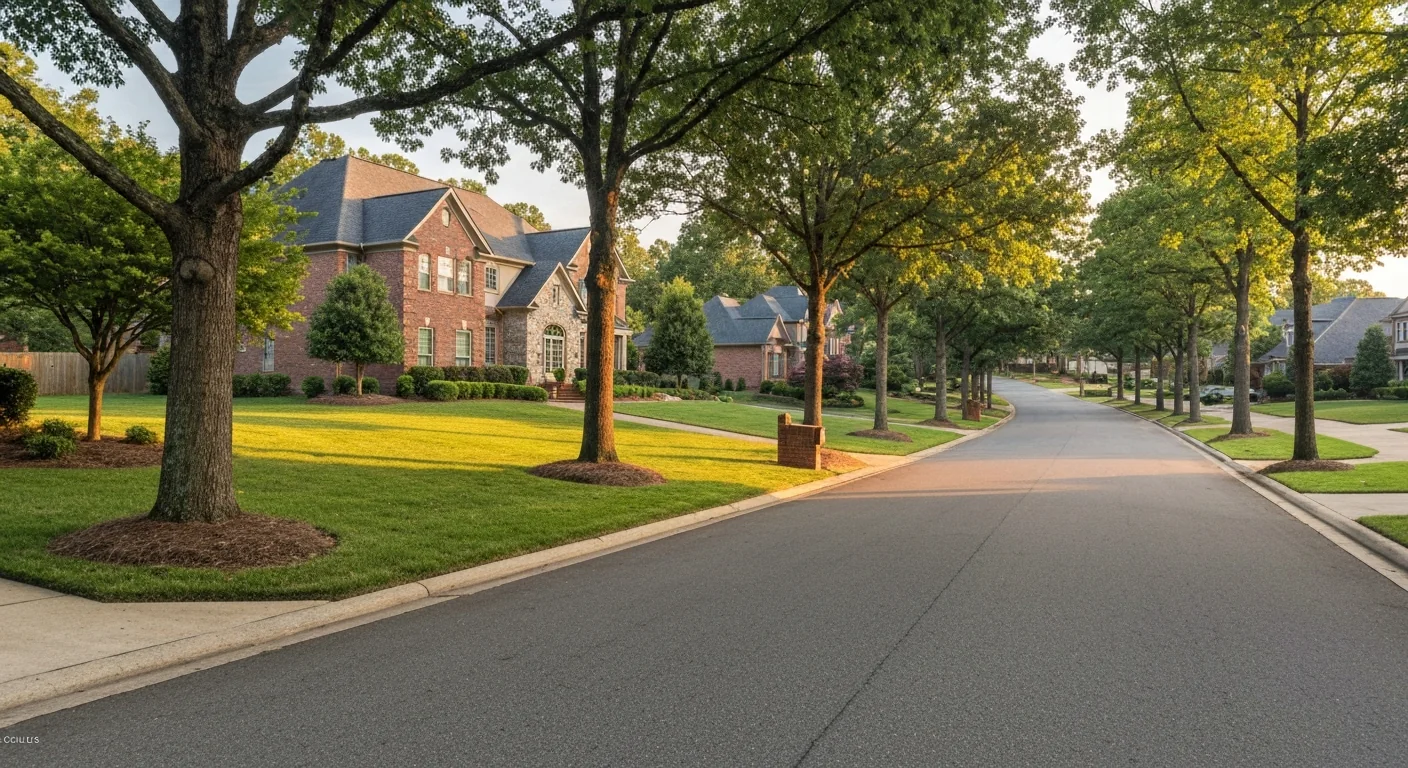
If you are coming from a Cary or Apex price point, the closest equivalents in feel and schools are Weddington, Marvin, and Waxhaw on the North Carolina side and Fort Mill on the South Carolina side. If you want newer construction and a little more breathing room in your budget, Indian Trail, Indian Land, and Fort Mill stretch your dollar further than the inner-ring Mecklenburg suburbs. The point of moving from Raleigh to Charlotte is rarely to save money on the house itself. It is to get the right house in the right school zone with a tax and commute picture that works.
Taxes Compared: Income, Property, and Sales
This is the section that surprises Triangle movers the most, so read it closely. When people relocate to Charlotte from New Jersey or California, the headline is the income tax cut. The tax math of moving from Raleigh to Charlotte is different: there is no income tax change at all, because you are staying in North Carolina.
State income tax stays the same
North Carolina charges a flat individual income tax that applies statewide. According to the North Carolina Department of Revenue, the rate is 4.25% for tax year 2025 and drops to 3.99% for 2026, with further reductions possible if state revenue targets are met. That rate is identical in Raleigh and Charlotte. Your paycheck withholding does not change when you cross from Wake County into Mecklenburg County. For a state-to-state mover that number is the whole story. For you, it is a non-event, which is good news: one less variable to plan around.
Property tax can actually drop
Here is the part most people moving from Raleigh to Charlotte never see coming. Your property tax bill can go down, depending on which county you land in. Property tax in North Carolina is set per $100 of assessed value, and the combined city plus county rate inside Raleigh is higher than inside Charlotte.
| Jurisdiction (FY 2025-26) | Combined rate per $100 | Est. bill on a $450,000 home |
|---|---|---|
| City of Raleigh (Wake County) | About $0.8721 | About $3,924 |
| City of Charlotte (Mecklenburg County) | $0.7668 | About $3,451 |
| Town of Fort Mill (York County SC) | ~0.95% effective | About $4,270 |
| Union County NC (unincorporated) | $0.4342 | About $1,954 |
On a $450,000 home, the difference between a City of Raleigh bill and a City of Charlotte bill is roughly $475 a year in Charlotte’s favor. Move out to Union County, where many of the best South Charlotte school zones sit, and the county rate is far lower, though you trade some city services for that. South Carolina’s York County uses a 4% owner-occupied assessment ratio that produces a low effective rate too. The headline: for a Raleigh homeowner, Charlotte is not a tax penalty, and the right suburb can be a meaningful tax savings.
Sales tax and the state-line wrinkle
Sales tax is close. Wake County and Mecklenburg County both sit at 7.25% as of 2025. One thing to plan for: Mecklenburg’s combined sales tax is set to rise to 8.25% effective July 1, 2026, after voters approved a transportation measure. York County, South Carolina runs around 7%. None of these will reshape your budget, but they matter if you are comparing the Mecklenburg side of the line to the South Carolina side, where Fort Mill and Indian Land sit in a different state with its own income, property, and sales tax rules. That state-line choice is unique to the Charlotte metro and something no Triangle map prepares you for.
Not sure whether the NC or SC side of Charlotte fits you?
The tax and school differences across the state line are real, and they change which towns make your short list. I help Raleigh buyers map their priorities to the right county before they ever tour a home.
Schedule a 15-Minute Introductory Call
704-774-7170 | steve@jarrellhomes.com | thelongleafgroup.com
Schools Compared: WCPSS vs CMS and Union County
If you have school-age children, schools may be the deciding factor in moving from Raleigh to Charlotte, and the way assignment works is genuinely different between the two metros. Coming from the Triangle, you are used to one giant countywide system. In Charlotte, you have a choice of systems depending on where you buy.
Wake County Public School System is the largest district in North Carolina, with more than 161,000 students and over 200 schools. It assigns students by geographic node and runs an extensive choice program of magnet and year-round schools, with an annual application window that typically opens in the fall. Many Raleigh residents are used to the year-round calendar and the lottery-style choice process.
Charlotte-Mecklenburg Schools serves about 140,000 students across roughly 180 schools and also offers magnet options, with assignment tied to home address. The bigger draw for many relocating buyers, though, is just south of the county line. Union County Public Schools is one of North Carolina’s top-performing districts, and Union County school zones are a major reason Triangle transplants choose Weddington, Marvin, and Waxhaw. Marvin Ridge High School is regularly ranked the number one public high school in the Charlotte area and among the top ten in the state, with proficiency rates around 93% in math and 95% in reading.
The most important thing I tell every buyer moving from Raleigh to Charlotte: school assignment is by exact address, and boundaries change. Do not assume a neighborhood feeds a specific school. Verify the assignment for the precise home before you make an offer, and verify it again with the district. I do this with every client because a single street can sit on a boundary line.
Jobs, the Economy, and the Airport
The economic identity is the clearest contrast you weigh when moving from Raleigh to Charlotte. Raleigh is research, technology, and education. Charlotte is banking, energy, and corporate headquarters. Neither is better in the abstract; it depends on your field.
The Triangle’s engine is Research Triangle Park, home to more than 385 companies and over 55,000 workers, fed by NC State, Duke, and UNC. Tech, biotech, and life sciences dominate, with major campuses for SAS, and growing footprints from Apple, Google, and Microsoft. Charlotte, by contrast, is the second-largest banking center in the country. Bank of America and Truist are headquartered here, with major operations for Wells Fargo, Ally, and others, supporting more than 100,000 financial services jobs. Add Duke Energy, Honeywell, Lowe’s, and the NASCAR and motorsports cluster, and you have a different but equally deep job market.
The airport is the upgrade you will feel immediately. Raleigh-Durham International is a solid mid-size airport serving around 15.5 million passengers a year with roughly 80 nonstop destinations. Charlotte Douglas International is in a different tier entirely. It is a fortress hub for American Airlines, moving close to 59 million passengers a year with nearly 200 nonstop destinations. If you travel for work or have family scattered across the country, the jump from RDU to CLT is one of the most practical wins of moving from Raleigh to Charlotte. You will find more nonstop options and more daily frequency to almost anywhere.
Weather, Lifestyle, and Pace
Weather is close to a wash, which is another reason moving from Raleigh to Charlotte feels familiar. Both cities have a humid subtropical climate: hot, humid summers, short mild winters, four real seasons, and the occasional ice event rather than heavy snow. Raleigh runs a touch cooler on average, and Charlotte’s denser core can feel a few degrees warmer on summer afternoons because of the urban heat-island effect. You are not changing climates by moving from Raleigh to Charlotte. You are changing zip codes within the same one.
Pace and culture are where you will notice the move. Raleigh carries a college-town energy, slower and more academic, shaped by three major universities and a research economy. Downtown Raleigh is compact, complemented by walkable pockets like North Hills and Five Points. Charlotte feels more like a big city. Uptown is a true skyline of glass towers, the pace is faster, and the culture leans corporate and professional. The sports identity flips too: the Triangle lives for college basketball rivalries, while Charlotte is a pro sports town with the Panthers in the NFL, the Hornets in the NBA, Charlotte FC in MLS, and the heart of NASCAR right up the road.
Geography shifts your weekends. From Raleigh, the North Carolina coast is close, with Wilmington about two to two and a half hours away. From Charlotte, the mountains win: Asheville is roughly two to two and a half hours, and the beach is a bit farther, with Myrtle Beach and Wilmington both around three and a half to four hours. If beach trips are your priority, that is a genuine tradeoff to weigh. If you would rather be near the Blue Ridge, Charlotte is the better base.
Differences People From Raleigh Do Not Expect
Because both cities are in North Carolina, people assume moving from Raleigh to Charlotte will feel like moving across town. Most of it does. But a handful of differences catch Triangle transplants off guard, and knowing them ahead of time saves headaches.
- Traffic is heavier. Charlotte consistently ranks among the more congested mid-size metros, well ahead of Raleigh. I-485, I-77, and I-85 at rush hour are a step up from I-40 and I-540. Where you buy relative to where you work matters more here.
- You can move to a different state. The Charlotte metro straddles the North Carolina and South Carolina line. Fort Mill and Indian Land are South Carolina with their own taxes and school district. Nothing in the Triangle prepares you for choosing between two states inside one commute.
- Your property tax may fall, not rise. As shown above, the City of Raleigh’s combined rate is higher than Charlotte’s, and Union County’s is much lower. Most movers expect the bigger city to cost more in taxes. It often does not.
- Sales tax is climbing in Mecklenburg. The county rate rises to 8.25% in July 2026, a small but real consideration if you are comparing the NC and SC sides.
- The airport changes how you travel. Going from RDU to a major hub like CLT means more nonstops and easier connections, a quality-of-life upgrade frequent flyers feel right away.
- HOAs and well or septic still apply. Just like the Triangle’s newer suburbs, many South Charlotte communities have HOAs, and some larger-lot properties in Union County run on well and septic rather than city utilities. Always confirm before you fall for a listing.
Where Raleigh Buyers Tend to Land in South Charlotte
This is where my work as a relocation specialist actually starts. Once we know your priorities, the map of moving from Raleigh to Charlotte narrows quickly to a handful of submarkets. Here is how I match Triangle buyers to South Charlotte submarkets.
If you are coming from Cary, Apex, or North Raleigh and want top schools plus space: look at Weddington, Marvin, and Waxhaw in Union County. These are the larger-lot, top-school-zone suburbs that feel like the Triangle’s most sought-after towns, with the bonus of a lower county tax rate. Weddington in particular trades in larger homes on an acre or more, so budget accordingly.
If you want newer construction and a lower tax base: cross the line to Fort Mill or Indian Land in South Carolina, or stay in North Carolina with Indian Trail. These markets give you more square footage and newer builds for the money, which appeals to buyers used to the Triangle’s newer-home supply.
If you want walkability and a shorter Uptown commute: Ballantyne and Matthews put you closer to the city with established amenities, more like living in North Hills than out in the country. They suit professionals who want the south Charlotte school and lifestyle access without the longest drive to the office.
The mistake I see Raleigh buyers make is choosing a town off a map before they understand how schools, taxes, and commute interact here. The right answer for moving from Raleigh to Charlotte is almost always a specific neighborhood, not a whole town, and that is exactly what I help narrow down.
How the Move Actually Works With a Local Agent
Relocating between two cities is as much logistics as it is house hunting, and that is true of moving from Raleigh to Charlotte even though the distance is short. The hardest part is rarely finding a home you like. It is sequencing the sale of your Triangle house with the purchase here, deciding whether you need temporary housing, and running an out-of-area home search without burning weekends driving I-85 back and forth.
This is the work I do with relocating buyers every week. We map your timeline, talk through whether to sell first or buy first, line up video tours and neighborhood drive-throughs so you are not flying blind, and verify school assignments and HOA rules before you write an offer. If you would rather start with video, I cover this same Raleigh-versus-Charlotte decision in my 2026 Charlotte or Raleigh relocation guide on my YouTube channel, where I walk through the tradeoffs the way I would on a first call. You can also read more about how I work with buyers and the rest of the team at The Longleaf Group.
Frequently Asked Questions About Moving From Raleigh to Charlotte
Is Charlotte more expensive than Raleigh?
Barely, and not in every category. When you are moving from Raleigh to Charlotte, overall cost of living is close, with Raleigh running slightly cheaper on paper, mostly because of housing. But the City of Charlotte’s median home price is actually a touch lower than Raleigh’s, and Charlotte’s combined property tax rate is lower than the City of Raleigh’s. Move to Union County and your property tax can drop significantly. The bigger cost difference is time and gas spent in Charlotte’s heavier traffic.
Do I pay different state income tax moving from Raleigh to Charlotte?
No. Both cities are in North Carolina, which has a flat statewide income tax of 4.25% for 2025 and 3.99% for 2026. Your income tax does not change. The only way to change your income tax in the Charlotte area is to buy across the state line in South Carolina, which has a separate graduated income tax.
Which has better schools, the Triangle or Charlotte?
Both metros have strong options and large districts. Wake County runs a countywide assignment plus magnet and year-round choice system. Around Charlotte, Charlotte-Mecklenburg Schools offers magnets, and Union County Public Schools is a top-performing district where Marvin Ridge High is regularly ranked number one in the Charlotte area. The right answer depends on the exact home and its assigned schools, which you must verify by address.
How is the traffic in Charlotte compared to Raleigh?
Charlotte’s traffic is noticeably heavier. It ranks among the more congested mid-size metros, while Raleigh ranks much lower. The major arteries, I-485, I-77, and I-85, back up at rush hour. This makes the relationship between where you live and where you work more important in Charlotte than it was in the Triangle.
Should I buy in North Carolina or South Carolina near Charlotte?
It depends on your priorities. The North Carolina side, including Union County towns like Weddington, Marvin, and Waxhaw, offers top-ranked schools and a known tax structure. The South Carolina side, Fort Mill and Indian Land, often gives you newer construction, a low effective property tax rate, and its own well-regarded schools. Many Raleigh transplants do not realize the state-line choice exists, and it is one of the first things I help map out.
How far is Charlotte from the beach and the mountains?
From Charlotte, Asheville and the Blue Ridge Mountains are about two to two and a half hours away, and the beach, Myrtle Beach or Wilmington, runs about three and a half to four hours. That is the reverse of Raleigh, where the coast is closer, around two to two and a half hours to Wilmington, but the mountains are farther. If beach access is your top priority, that is a real tradeoff to consider.
About the Author
I am Steve Jarrell, a licensed real estate agent with The Longleaf Group at eXp Realty and a south Charlotte resident. I am licensed in both North Carolina and South Carolina, which matters in a metro where the best fit for a relocating buyer can sit on either side of the state line. I spent a decade building real estate marketing technology before going all in on serving relocating buyers.
I specialize in helping people moving from other metros, including those moving from Raleigh to Charlotte, land in the right south Charlotte and Union County submarket for their priorities. When I tell you a property tax rate or a school ranking, it is because I verified it, not because it sounded right.
 |
Free · 26-Page Insider Guide Which South Charlotte Town Is Right for You? Towns, villages, and cities compared, NC vs SC taxes and schools, and the 5 mistakes out-of-state buyers make. Everything you’d want a local to tell you before you move. Get the free guide → |
Let’s Talk Through Your Move From Raleigh to Charlotte
Whether you are months out or ready to tour, I will help you map your timeline, choose between the NC and SC sides, and find the right south Charlotte neighborhood. A quick call is the easiest first step.
Schedule a 15-Minute Introductory Call
704-774-7170 | steve@jarrellhomes.com | thelongleafgroup.com