
If you are researching the pros and cons of living in Monroe NC from outside the Charlotte metro area, you are asking the right question early. Monroe is one of the most talked-about towns in South Charlotte right now, partly because it is growing fast and partly because the price-to-space tradeoff is still one of the best in our region. But it is also a town where the answer to “is this a good place to live” really depends on what part of Monroe you are looking at, what your commute is, and how you feel about car-dependent suburban living.
I am Steve Jarrell. I live in Weddington, my kids go to school in the Union County Public Schools (UCPS) district, and I help relocating buyers every week sort through which South Charlotte and Union County towns actually fit them. This post is a real 2026 breakdown of what Monroe gets right, what it gets wrong, and the questions you should be asking before you spend a Saturday driving subdivisions.
14 min read | By Steve Jarrell, The Longleaf Group at eXp Realty | Updated September 2026
What This Guide Covers
- What buyers actually like about Monroe NC (the pros)
- The real tradeoffs (the cons)
- How Monroe compares to the rest of South Charlotte
- What homes cost in Monroe right now
- Schools, parks, and things to do
- Recent growth and what is coming next
- Who Monroe is and isn’t a good fit for
- Frequently asked questions about living in Monroe NC
- About the author
The Short Answer
Monroe’s pro is price — a $390,000 median inside the city and a cost of living about 8% below the national average. The cons are the commute and the crime data, which third-party indexes put well above the national average. Downtown Monroe is genuinely improving, and its prices show it.
Key numbers right now:
- Median sale price inside the city of Monroe: $390,000 in March 2026, down a slight 1.3% year over year; the 28110 ZIP sat at $380,000
- Cost of living runs about 8% below the national average, with housing roughly 21% below
- Healthcare is the outlier, running around 15% above average
- Downtown Monroe median home prices hit $482,000 in March 2026, up 20.6% year over year even as the broader market cooled
- Commute: 45 to 60 minutes to Uptown at peak, or 35 to 50 minutes to Ballantyne; the Monroe Expressway saves about 20 minutes at peak for a toll
- Third-party safety indexes give the city a low grade, with crime rates roughly 88% above the national average
Growth is the biggest variable on that list, and I went deeper on it in is Monroe growing too fast.
Pros and Cons of Living in Monroe NC at a Glance
Monroe NC appeals to relocating buyers mainly for its relative value, with home prices that often run lower than the more established Union County towns, plus a real small-town core and fast growth. The tradeoffs are a longer commute to the main Charlotte job centers, ongoing growing pains from that fast development, and amenities that are still catching up to the closer-in suburbs. Whether Monroe fits comes down to how much you value price and space versus proximity and convenience. Below I lay out the genuine pros and the cons so you can decide for yourself.
What Buyers Actually Like About Monroe NC (The Pros)
When relocating buyers ask me what is good about Monroe, four things come up almost every time. They are real, they are measurable, and they are the reason this town keeps showing up on relocation shortlists.
You get more house for the money
This is the single biggest reason buyers from out of state look at Monroe. The Redfin-tracked median sale price inside the city of Monroe was $390,000 in March 2026, and the 28110 ZIP code (the largest residential ZIP in Monroe) sat at $380,000. Compare that to Weddington and Marvin a few towns west, where the median routinely runs more than double, and the math is hard to ignore. For a relocating buyer coming from Northern Virginia, the Northeast, or California, Monroe often looks like the chance to keep the same square footage and lot size without writing a much bigger check.
Cost of living runs about 8% below the national average
Housing is the biggest piece of that gap. According to current cost-of-living data, housing in Monroe runs roughly 21% below the national average. Utilities are about 6% lower. Healthcare is the one category that runs higher (around 15% above average), and groceries and transportation are roughly even. Net of all categories, the typical household in Monroe spends meaningfully less than the typical American household to maintain the same standard of living.
Downtown Monroe is in the middle of a real turnaround
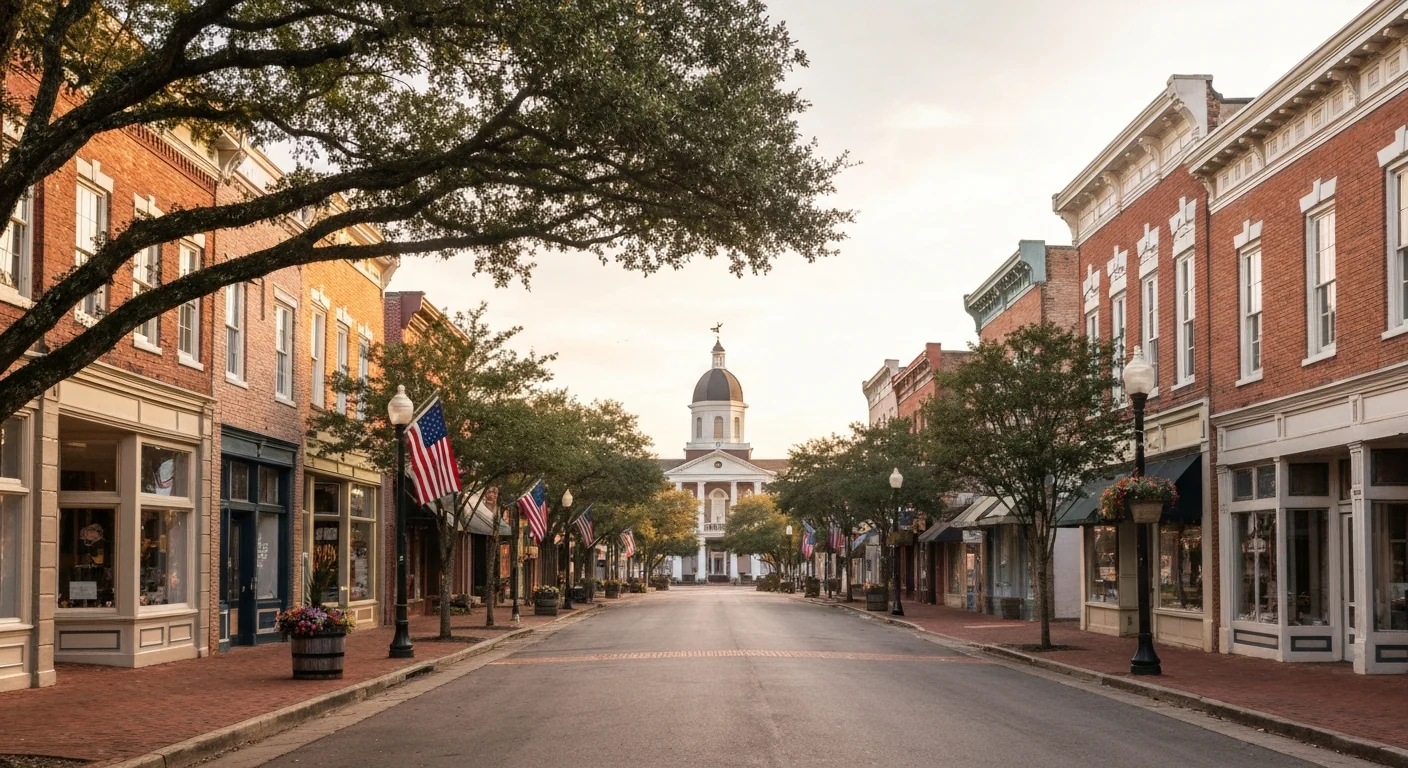
This was not true five years ago. Today, downtown Monroe (the historic city center built around the old Union County Courthouse) is one of the most active revitalization stories in our region. The city has been issuing incentive grants for new small businesses, and you can now eat, drink, and shop along Main Street in a way that did not exist a decade ago. New downtown additions over the past year include Murphy’s on Main (a retail boutique), E.L.K. of Monroe (a sit-down restaurant), ClipperZ (barber and salon), 47K Marketplace (an artisan goods store), and The Derby Restaurant (an American dining staple). Downtown median home prices reflect that momentum: $482,000 in March 2026, up 20.6% year over year, even as the broader Monroe market cooled slightly.
The jobs story is getting stronger, not weaker
In April 2026, the City of Monroe annexed additional facilities for ATI Specialty Materials (a global producer of high-performance specialty alloys), tied to an approximately $300 million local investment and expansion. That kind of commitment from a publicly traded manufacturer is the kind of base-load employer that stabilizes a small city’s tax base for decades. Monroe also has the Charlotte-Monroe Executive Airport (a busy public-use general aviation airport just outside the city), and Atrium Health Union (a 182-bed hospital with a 24/7 ER) anchors the local healthcare cluster. Combined with Monroe’s ongoing utilities investments (a new water pipeline brought roughly two million additional gallons per day online in May 2026), the basic infrastructure here is being built out for a city that is going to keep growing.
The Real Tradeoffs (The Cons)
This is the section most blog posts skip, and it is the section that actually matters. If you are deciding between Monroe and another South Charlotte town, you need to see the downsides as clearly as the upsides.
The Uptown Charlotte commute is real, and it is long
From Monroe to Uptown Charlotte (the central business district where most of the bank towers and major employers are) is roughly 25 miles via US-74 (the main east-west highway through the area, also called Andrew Jackson Highway). In peak morning or evening rush hour, that drive routinely runs 45 to 60 minutes. The toll road option (the Monroe Expressway, which opened in November 2018 and bypasses the slowest stretches of old US-74) saves about 20 minutes during peak hours, but you are paying for it daily. If you are commuting to Ballantyne (the large corporate park in the southernmost part of Charlotte), peak times typically run 35 to 50 minutes. Either way, if you have to be at a desk in the city five days a week, Monroe is not a quick commute.
School quality depends heavily on the zone
This is where buyers get into trouble if they assume the whole town is the same. Monroe is part of Union County Public Schools (UCPS), which as a district is one of the strongest in North Carolina. But inside the city limits, school quality varies more than people expect. Wesley Chapel Elementary, on the western edge near Indian Trail, carries a 10 out of 10 GreatSchools rating, and Rock Rest Elementary in Monroe sits at 9 out of 10. Central Academy of Technology and Arts (CATA), a public magnet high school in Monroe, is one of the highest-rated high schools in the state at 9 out of 10.
On the other end, the assigned (non-magnet) Monroe High School currently shows a 2 out of 10 GreatSchools rating. The takeaway is that “Monroe schools” is not one answer, it is a zone-by-zone question. If schools are a top priority, verify the exact attendance area for any address before you write an offer.
Crime numbers are higher than the surrounding suburbs, and the context matters
Real answer: city of Monroe crime statistics run higher than the rural and suburban towns immediately around it (Waxhaw, Weddington, Marvin), and higher than the national average overall. Third-party safety indexes give the city of Monroe a low safety grade, with crime rates roughly 88% above the national average. That is true and it is worth knowing. The context: Monroe is the county seat and has the largest urban core in Union County, which means it carries the kind of property and quality-of-life offenses that any small city sees. The newer suburban subdivisions on the west and south sides of town do not look or feel like the city’s crime statistics suggest. If safety is a deciding factor, pull street-level crime data for the specific neighborhood you are considering, not just the citywide number.
You are going to need a car for everything
Monroe has effectively no meaningful public transportation. The Charlotte Area Transit System (CATS) does not run buses out here, and there is no commuter rail. Outside of the small walkable downtown, you are driving to the grocery store, driving to school pickup, driving to the gym, and driving to any restaurant that is not directly on Main Street. For buyers coming from a city with even a basic transit system, that adjustment is real.
The closest comparison most of my Monroe buyers end up making is with Indian Trail, twenty minutes up the highway. I laid out how the two towns stack up on price, taxes and schools so you can see where each one wins.
How Monroe Compares to the Rest of South Charlotte
The South Charlotte and Union County corridor is a stack of small towns that all share the same school district, the same hospital systems, and the same major highways. They are not interchangeable. Here is how Monroe fits inside that stack from a buyer’s perspective.
Compared to Waxhaw and Marvin (the two westernmost UCPS towns, generally regarded as the highest-end), Monroe is materially more affordable, but also further from Uptown Charlotte by drive time and has a different school-zone story. Compared to Indian Trail (the town immediately northwest of Monroe along US-74), Monroe has a longer commute but a more developed downtown core and more annexable industrial land. Compared to Wesley Chapel (a smaller, more rural town just west of Monroe), Monroe has more retail, more services, and more job density, but less of the quiet small-town feel. For a deeper look at how the neighboring market compares, I wrote a separate guide on moving to Indian Trail NC that pairs well with this post.
What Homes Cost in Monroe Right Now
The Monroe NC housing market in spring 2026 looks like this. The Redfin-tracked median sale price inside city limits is $390,000 (down a slight 1.3% year over year). The 28110 ZIP code (the main residential footprint) is at $380,000, down about 3.1% year over year. Downtown Monroe, however, is the outlier, at $482,000 and up more than 20% year over year as buyers chase the walkable historic core. Inventory has loosened across most of South Charlotte, so buyers who paused in 2024 and 2025 are finding more options and slightly more negotiating room than they have had in years.
On the carrying-cost side, the Union County property tax rate for fiscal year 2025-2026 is 43.42 cents per $100 of assessed valuation. The City of Monroe adds an additional 44 cents per $100 inside city limits, and properties inside the downtown service district add another 16 cents on top. That means a $400,000 home assessed at full value in the City of Monroe carries roughly $3,500 a year in combined county and city property tax, before downtown district overlay. For a full picture of the buying process from contract to close, my buyer’s resource page walks through every step, and the NCDOR statewide property tax rate table confirms the official Union County figure.
Schools, Parks, and Things to Do
I covered the school-zone variability above, and it is worth saying again that this is the single most important homework item if you have school-age children moving with you. Specific addresses matter. For a deeper look at how UCPS attendance zones, magnet options, and feeder patterns actually work, my Union County Schools buyer’s guide covers the rules buyers need to know before writing an offer. CATA (the magnet high school) is open to qualifying applicants from across the district, which means a Monroe address does not automatically gate you in or out.
On the things-to-do side, downtown Monroe is the obvious starting point. Outside of downtown, the city’s parks and greenway system has improved substantially in the last few years. Belk Tonawanda Park is the flagship: an outdoor amphitheater, splash pad, bocce courts, and open green space (city park page here). Sunset Park includes a fenced dog park. The Bearskin Creek Greenway is a 1.1-mile asphalt trail connecting Don Griffin Park, the Union County Farmer’s Market, and Belk Tonawanda Park, and Monroe is one node on the regional Carolina Thread Trail network. For shopping, the enclosed Monroe Crossing Mall still operates as the area’s main mall, anchored by Belk and Roses. For healthcare, Atrium Health Union (the 182-bed hospital with a 24/7 ER) handles most of the area’s emergency and specialty care needs.
Recent Growth and What Is Coming Next
Monroe is currently estimated at about 43,000 residents, with population up roughly 25% over the last five years and an annual growth rate of more than 3%. That is fast for any city of this size. Three signals tell me that growth is going to continue, and that buyers should plan for it:
One: The ATI Specialty Materials annexation and approximately $300 million expansion in April 2026 is the kind of long-horizon manufacturing investment that brings jobs and supplier ecosystems with it. Two: The City of Monroe approved a $2 million street paving program in its fiscal year 2025-26 budget, on top of the recently completed water pipeline expansion. Both are unglamorous but they are the infrastructure that lets a city absorb new residents without quality of life dropping. Three: Downtown’s pricing acceleration (up more than 20% year over year) is the market telling us that walkable, historic small-city living is in genuine demand in this region, not just a marketing pitch.
If the deciding factor is how far your dollar stretches, it helps to put Monroe next to the most expensive address in the county, and I did exactly that in this Monroe and Marvin breakdown covering the tax rates, the price per square foot and the schools.
Who Monroe Is and Isn’t a Good Fit For
Monroe tends to be a strong fit for: buyers prioritizing affordability and lot size over proximity to Uptown Charlotte; remote workers and hybrid workers who do not need a daily Uptown commute; buyers drawn to walkable historic downtowns; buyers who want to be in UCPS without paying Weddington and Marvin pricing; buyers looking at specific high-rated school zones like Wesley Chapel Elementary or who plan to apply to CATA.
Monroe is usually not the right fit for: buyers who need to be in Uptown Charlotte by 8 a.m. five days a week; buyers who assume any UCPS address is equivalent (zoning here really does matter); buyers who want immediate, fully built-out luxury retail and dining within five minutes of every neighborhood; buyers relocating from major transit cities who are not willing to be fully car-dependent.
If you prefer to watch rather than read, I put together a video on this topic, framed around what trips up buyers across South Charlotte (including Monroe): The Biggest Mistake People Make Moving to South Charlotte (And How to Avoid It).
Frequently Asked Questions About Living in Monroe NC
Is Monroe NC a safe place to live?
The city of Monroe overall shows crime rates above the national average and meaningfully higher than the rural and suburban towns immediately around it, like Waxhaw and Weddington. That said, crime is not evenly distributed across the city. The newer suburban subdivisions on Monroe’s west and south sides do not reflect the citywide average. If safety is a deciding factor, pull street-level data for the specific neighborhood and address you are considering before making a decision.
What is the cost of living in Monroe NC compared to Charlotte?
Monroe’s overall cost of living runs roughly 8% below the national average, driven mainly by housing costs that sit around 21% below the national average. Compared to the city of Charlotte, Monroe is the more affordable option, particularly on housing. Healthcare is the one category in Monroe that runs above the national average.
How long is the commute from Monroe NC to Charlotte for work?
Plan for 45 to 60 minutes in peak rush hour from Monroe to Uptown Charlotte, about 25 miles via US-74. To Ballantyne in South Charlotte, plan for 35 to 50 minutes in peak hours. The Monroe Expressway (the toll bypass that opened in November 2018) typically saves about 20 minutes during the heaviest traffic. Off-peak drive times are noticeably shorter, but most full-time office workers are driving at the worst times of day.
Are the schools in Monroe NC any good?
It depends entirely on the attendance zone. Union County Public Schools as a district is among the strongest in North Carolina. Inside Monroe, school quality varies more than people expect. Wesley Chapel Elementary carries a 10 out of 10 GreatSchools rating, Rock Rest Elementary is 9 out of 10, and the Central Academy of Technology and Arts magnet high school is 9 out of 10. The assigned Monroe High School currently shows a 2 out of 10 GreatSchools rating. School zone verification before writing an offer is non-negotiable here.
What kind of growth and new developments are happening in Monroe NC?
Monroe is one of the fastest-growing small cities in North Carolina, at roughly 3.24% annual growth and about 25% population growth over the last five years. Major recent items include the April 2026 ATI Specialty Materials annexation and approximately $300 million investment, a new water pipeline adding around two million gallons of daily capacity (May 2026), a $2 million city street paving program approved in the fiscal year 2025-26 budget, and a wave of new downtown businesses opening over the past 18 months.
What are the property taxes in Monroe NC?
For fiscal year 2025-2026, Union County’s property tax rate is 43.42 cents per $100 of assessed valuation. Properties inside Monroe city limits add 44 cents per $100, and properties inside the downtown service district add another 16 cents on top. A $400,000 home assessed at full market value inside city limits, outside the downtown district, would pay roughly $3,500 per year in combined county and city property tax.
What is downtown Monroe NC like?
Downtown Monroe is a historic Southern small-city center built around the old Union County Courthouse, currently in the middle of a real revitalization. Over the last year and a half, the area has added new restaurants (E.L.K. of Monroe, The Derby), boutiques (Murphy’s on Main, 47K Marketplace), and services. Median home prices in downtown are running about $482,000 as of March 2026, up over 20% year over year, which is the market signal that the turnaround is being taken seriously by buyers.
About the Author
Steve Jarrell lives in Weddington and has spent his career in and around the Charlotte real estate market. Before earning his real estate license, Steve led the rebrand of his father’s Charlotte-founded real estate marketing technology company (VisualTour, later Paradym), which was acquired by Constellation Software in 2020. That decade of working with thousands of agents nationally is the lens he brings to helping relocating buyers cut through hype and pick the right South Charlotte town. He holds an MBA from the University of Tennessee, works alongside fellow agent Cathy Burns (a 20-plus-year South Charlotte agent and Weddington resident), and is active in the Weddington Optimist Club and the Waxhaw-Weddington Rotary. More on Steve’s background is on the About page.
Thinking about Monroe NC? Let’s pressure-test it together.
If Monroe is on your relocation shortlist, the right next step is a 30-minute conversation where we look at school zones, commute, and budget for your specific situation, not the citywide average. No pressure, just a clear answer on whether Monroe is the right fit.
For the complete local picture, see our Monroe real estate guide.
 |
Free · 26-Page Insider Guide Which South Charlotte Town Is Right for You? Towns, villages, and cities compared, NC vs SC taxes and schools, and the 5 mistakes out-of-state buyers make. Everything you’d want a local to tell you before you move. Get the free guide → |