

If you are weighing a move out of the DMV, you have probably already run the math in your head. A townhouse in Arlington or a colonial in Fairfax costs what a serious estate costs almost anywhere else, your commute eats an hour a day, and the paycheck that felt strong at hire feels thinner every renewal. Moving from DC to Charlotte is one of the most common trades I help people make, and it is usually driven by the same three numbers: what the house costs, what the taxes take, and what the traffic steals.
I am Steve Jarrell, a licensed agent in both North Carolina and South Carolina and a south Charlotte resident with The Longleaf Group at eXp Realty. I work with relocating buyers every week, and a large share of them come from Washington DC, Northern Virginia, and the Maryland suburbs. This guide is the head-to-head comparison I wish every DMV buyer had before they decided: cost of living, housing, taxes, schools, weather, commute, and the real tradeoffs nobody puts in a listing. My goal is that by the end you know exactly whether moving from DC to Charlotte fits your life, and where in the area you would actually want to land.
19 min read | By Steve Jarrell, The Longleaf Group at eXp Realty | Updated September 2026
What This Guide Covers
- The quick verdict: who this move fits
- Cost of living: DC vs Charlotte compared
- Housing and what your dollar actually buys
- Taxes compared: income, property, sales, and the car tax
- Schools: Fairfax and Loudoun vs CMS and Union County
- Weather, lifestyle, and pace
- Getting around, flights home, beaches, and mountains
- Differences people moving from DC to Charlotte do not expect
- Where DMV buyers tend to land in south Charlotte
- How the move actually works with a local agent
- Frequently asked questions
The Short Answer
Trading the Beltway for Charlotte is mostly a housing trade. The Charlotte metro median is roughly $435,000 against $695,000 to $835,000 across the DMV, and North Carolina’s flat income tax is materially lower than Virginia’s or DC’s. Utilities, healthcare and everyday goods are cheaper too, but housing is where the real difference shows up on your monthly budget.
Key numbers right now:
- Charlotte metro median sale price, spring 2026: about $435,000
- Same period in the DMV: roughly $695,000 in Washington DC, $835,000 in Arlington, $813,000 in Fairfax County, $790,000 in Loudoun
- Even 28277, south Charlotte’s most sought-after zip, ran about $668,000 — still under the Arlington and Fairfax medians
- North Carolina income tax: flat 4.25% for 2025, dropping to 3.99% for 2026
- Virginia’s top rate of 5.75% starts at just $17,000 of taxable income; DC climbs to 10.75% at the top
- Utilities run about 10% higher in DC, healthcare about 6% higher
Moving from DC to Charlotte NC: The Quick Verdict
Moving from DC to Charlotte trades a high-cost, high-tax, transit-rich metro for a lower-cost, lower-tax, car-first metro where your housing dollar goes roughly twice as far.
The Washington metro overall runs about 36% more expensive than Charlotte once you include rent, and the median sale price across the Charlotte metro was near $435,000 in spring 2026 versus roughly $695,000 in DC, $835,000 in Arlington, and $813,000 in Fairfax County. You give up the Metro, the free Smithsonians, and a certain density of dining and culture. You gain space, a milder winter, mountains and beaches within a short drive, and a tax bill that is almost always smaller. For most DMV households, moving from DC to Charlotte pays off financially and lifestyle-wise, as long as you go in clear-eyed about what changes.
Where DMV buyers usually land: the south Charlotte and Union County suburbs, especially Waxhaw, Weddington, Marvin, and Ballantyne on the North Carolina side, and Fort Mill and Indian Land just over the South Carolina line. Those are the submarkets that give a Fairfax or Loudoun buyer the space, the school reputation, and the newer construction they are used to shopping for, at a fraction of the price.
Already leaning toward the move?
I help DMV buyers plan the DC-to-Charlotte relocation end to end, from timing the sale up there to targeting the right south Charlotte submarket down here. Let us talk it through.
Schedule a 15-Minute Introductory Call704-774-7170 | steve@jarrellhomes.com | thelongleafgroup.com
Cost of Living: DC vs Charlotte Compared
The cost-of-living gap is the reason most people start looking south, and it is the number that gets a lot of DMV households seriously weighing moving from DC to Charlotte in the first place. On the commonly cited indexes, Washington DC runs roughly 36% more expensive than Charlotte when rent is included, and Charlotte lands somewhere between 13% and 28% cheaper overall depending on which basket you compare. Housing drives almost all of it, but the smaller line items add up too: utilities run about 10% higher in DC, healthcare about 6% higher, and everyday goods and services more than 12% higher.
The number that tells the story fastest is price per square foot. In Charlotte it sits around $246, while in Washington DC it is near $516. That single ratio is why a DMV household that felt boxed into a narrow rowhome or a mid-size townhouse can shop for a full-size home with a yard after moving from DC to Charlotte. You are not stretching for the same house at a lower price. You are usually buying a materially bigger, newer house and still writing a smaller check.
One caveat worth stating plainly: Charlotte is not the bargain it was a decade ago. The metro has grown fast, and prices in the strongest school zones have climbed with that demand. The point is not that Charlotte is cheap in absolute terms. The point is that relative to the DMV, your money stretches dramatically further after moving from DC to Charlotte, and the gap is widest exactly where DMV buyers want to be, in the newer suburban submarkets with the best-regarded schools.
Housing: What Your Dollar Buys in Charlotte vs the DMV
Here is the comparison that matters most when you are moving from DC to Charlotte. As of spring 2026, the median sale price across the Charlotte metro was about $435,000. In the DMV, the same period showed roughly $695,000 in Washington DC, $835,000 in Arlington, $813,000 in Fairfax County, and $790,000 in Loudoun County. Even south Charlotte’s most sought-after zip code, 28277 in the Ballantyne area, ran about $668,000, which is still below the Arlington and Fairfax medians while delivering far more square footage.
| Market | Median sale price (spring 2026) | What it typically buys |
|---|---|---|
| Washington DC | ~$695,000 | Condo or smaller rowhome |
| Arlington VA | ~$835,000 | Townhouse or smaller single-family |
| Fairfax County VA | ~$813,000 | Townhouse or established single-family |
| Loudoun County VA | ~$790,000 | Newer single-family, farther out |
| Charlotte metro NC | ~$435,000 | Full-size single-family with a yard |
| Union County NC | ~$498,000 | Larger home, bigger lot, newer build |
| Ballantyne area (28277) | ~$668,000 | Large home in a top school zone |
Concretely, in Union County a budget in the high $500,000s to low $700,000s regularly buys a 2,800 to 4,900 square foot home on a real lot, often built in the last ten to fifteen years. In Fairfax or Arlington, that same money is a townhouse or an older single-family home that needs updating. If you are moving from DC to Charlotte primarily to stop feeling squeezed by housing, this is where you feel the difference on day one.
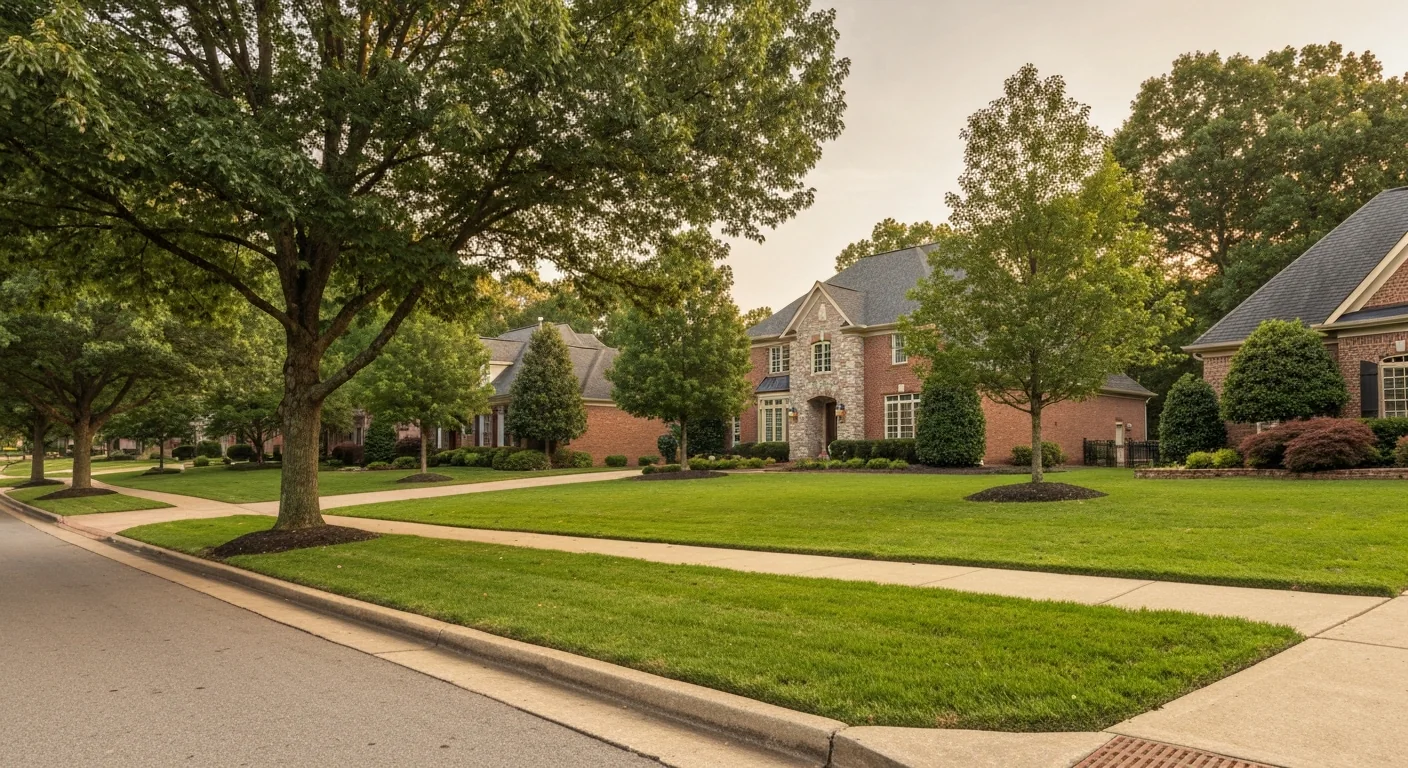
There is a tradeoff hidden in that space. DMV buyers are used to walkable pockets and Metro-adjacent living. South Charlotte is suburban and car-first. You are trading the ability to walk to a station and a dozen restaurants for a driveway, a yard, and a garage. Plenty of DMV transplants love that trade. A few miss the walkable density, which is why I always ask early where you fall on that, before we ever look at homes.
Taxes Compared: Income, Property, Sales, and the Car Tax
Taxes are where moving from DC to Charlotte quietly returns money every single year, and the direction surprises people because the headline is the opposite of the Florida story. Florida movers give up their no-income-tax status when they come to North Carolina. DMV movers do the reverse: you are almost certainly leaving a higher income-tax regime for a lower flat one.
State income tax
North Carolina charges a flat 4.25% state income tax for 2025, dropping to 3.99% for 2026, per the North Carolina Department of Revenue. Compare that to Virginia, where the top rate of 5.75% kicks in at just $17,000 of taxable income, meaning nearly every working household pays 5.75% at the margin.
Washington DC is worse for higher earners, running 8.5% on income between $60,000 and $250,000 and climbing to 9.75% and 10.75% at the top. Maryland stacks a state rate up to 6.5% on top of a county local income tax of 2.25% to 3.30%. On a healthy DMV salary, the swing from 5.75% or 8.5% down to a flat 4.25% is real money back in your pocket every year.
Property tax
Property tax is a two-part story: the rate and the bill. Within the City of Charlotte, the combined Mecklenburg County and city rate is 76.68 cents per $100 of assessed value for the 2025-2026 fiscal year, per Mecklenburg County. Union County’s county rate sits lower, in the mid-60-cent range after its 2025 revaluation, though your exact bill depends on whether the home is inside a town like Waxhaw or Monroe. In Northern Virginia the rates are higher and applied to much higher home values: Fairfax County is $1.09 per $100, Arlington is about $0.996, and Loudoun is $0.865.
Run the actual bills and the gap widens. A $435,000 Charlotte home at 76.68 cents is roughly $3,336 a year. An $813,000 Fairfax home at $1.09 is about $8,860 a year. You are paying a lower rate on a lower value, so the property tax line often falls by half or more when moving from DC to Charlotte.
Sales tax and the Virginia car tax
Sales tax is close to a wash. Mecklenburg County is 7.25%, while Northern Virginia and DC sit around 6.0% today, with DC scheduled to rise to 7.0% in late 2026.
The bigger surprise is vehicles. Virginia’s annual personal property “car tax” is steep: Fairfax charges $4.57 per $100 of a car’s value and Arlington $5.00, which is often $1,300 to $1,500 a year on a $30,000 vehicle. North Carolina also taxes vehicles annually through its Tag and Tax Together program, but at the same low property rate, so that same $30,000 car runs closer to $230 a year in Mecklenburg.
For a two-car DMV household, dropping the Virginia car tax alone can save a couple thousand dollars a year. If you want the plain-English version of how the border and tax picture shakes out, I break it down in my video Living in South Charlotte vs SC: The Truth About Taxes.
Want the tax math run on your actual numbers?
Income tax, property tax, and the NC-versus-SC border decision all move the total. I will help you compare your DMV bill to a real Charlotte-area target before you commit.
Schedule a 15-Minute Introductory Call704-774-7170 | steve@jarrellhomes.com | thelongleafgroup.com
Schools: How CMS and Union County Compare to Fairfax and Loudoun
Schools are usually the second question a DMV buyer asks when moving from DC to Charlotte, right after price, and the reputations you know from Fairfax and Loudoun have close equivalents here. Northern Virginia districts like Fairfax County Public Schools, Arlington Public Schools, and Loudoun County Public Schools are nationally strong. The Charlotte area answer is Union County Public Schools, which anchors the top-rated south Charlotte suburbs.
Two names to know: Marvin Ridge High in Waxhaw and Weddington High. For 2026, Marvin Ridge ranks in the top 1% of North Carolina public schools and is rated the number one public high school in the Charlotte area by Niche, while Weddington High also sits in the top 1% statewide. If you are coming from a strong Loudoun or Fairfax pyramid and that reputation is non-negotiable, those two feeder areas are where DMV buyers concentrate. You can read the district’s own information through Union County Public Schools.
One structural difference matters more than any ranking: North Carolina assigns public schools by home address. There is no lottery-style choice to fall back on the way some DMV households lean on. The house you buy determines the school your child attends, so the address and the attendance zone are effectively the same decision. I verify the current assignment for any specific home before a buyer falls for it, because zones do get adjusted, and a listing agent’s claim about a school is not the same as a confirmed assignment. For a deeper walkthrough of the top zones, my Weddington relocation guide and Waxhaw relocation guide go community by community.
Weather, Lifestyle, and Pace: The DMV vs Charlotte
Weather is one of the quieter wins of moving from DC to Charlotte. Both places get four seasons, but the intensity shifts. Washington and Northern Virginia average roughly 14 to 15 inches of snow a year, with the occasional paralyzing blizzard and stretches of raw, gray winter. Charlotte averages closer to 3.5 to 5 inches of snow, and winter is mostly mild with a few cold snaps and the rare ice event. For a lot of DMV transplants, losing the shoveling and the salted-car winters is a quiet daily upgrade they did not fully price in.
Summer is a fair trade worth naming. DC summers are hot and humid, with July highs near 88 degrees. Charlotte summers are a touch hotter and noticeably stickier, with July highs around 90 and humidity that regularly sits in the 70s and higher. And spring brings Charlotte’s signature pollen season: oak and pine dust coats everything from late February into May, and the region routinely ranks among the worst in the country for tree-pollen allergies. If anyone in your household is allergy-prone, that is the real downside of the milder climate.
The pace difference is real too. The DMV runs on the federal government, contractors, lobbying, and politics, and the culture is fast, credential-driven, and transient. Charlotte is a banking and finance town, home to Bank of America’s headquarters and major operations for Truist and Wells Fargo, and it moves at a slower, friendlier Southern pace. Most DMV transplants describe more room to breathe and easier weeknights. What they most often say they miss is the Metro, the free Smithsonian museums, and the sheer density and diversity of DMV dining. Charlotte’s food and culture scene is growing fast, but it is not Washington, and it is fair to set that expectation going in.
Getting Around, Flights Home, Beaches, and Mountains
Getting around changes when moving from DC to Charlotte, and traffic is better here, though not the empty-roads fantasy some people picture.
In 2025, INRIX data had DC drivers losing about 70 hours a year to congestion, ninth-worst in the country, with the longest average commute in the nation at about 33 minutes. Charlotte drivers lost about 48 hours in the same 2025 scorecard, and the metro sits well down the national congestion rankings. So the delta is real and it favors Charlotte. The bigger change is structural: the DMV has the Metro, and Charlotte does not have anything like it. Charlotte has the LYNX Blue Line, a roughly 20-mile light-rail line with 26 stations that serves the uptown and South End corridor well, but the region is car-first. Plan on driving for almost everything, and factor that into where you choose to live relative to work.
Getting back to the DMV is easy, which matters when you still have family or work ties there. Charlotte Douglas International is American Airlines’ second-largest hub, and roughly nine of every ten departures are American, per Charlotte Douglas International Airport. You get frequent nonstops to Reagan National, Dulles, and BWI, so a weekend trip or a work day up north is a short, direct flight. Easy nonstops home are one of the underrated perks of moving from DC to Charlotte rather than to a smaller metro.
Then there is the weekend geography. From Charlotte the Blue Ridge Mountains around Asheville are about a 2 to 2.5 hour drive, and the coast at Myrtle Beach or Wilmington is roughly 3.5 to 4 hours. Trading the DMV’s crowded ocean drives and mountain routes for that kind of easy access to both mountains and beaches is a lifestyle win people underrate until their first free Saturday here.
Differences People Moving from DC to Charlotte Don’t Expect
A few things routinely catch DMV transplants off guard when moving from DC to Charlotte, and knowing them ahead of time makes the move smoother.
- HOAs are the norm, not the exception. Most newer south Charlotte and Union County neighborhoods have a homeowners association with dues and rules. That is different from a lot of established DMV neighborhoods, and it is worth reviewing the covenants before you buy.
- Well and septic still exist out here. Push into the more rural parts of Union County and you may find homes on well water and septic systems rather than city utilities. It is manageable, but it changes inspections and maintenance.
- The NC versus SC line is a live decision. Fort Mill and Indian Land sit just over the South Carolina border and pull a lot of Charlotte commuters. South Carolina has its own tax structure, and the school districts differ, so the state line is a real choice, not a technicality.
- You still pay a yearly vehicle tax. DMV buyers expecting to escape the Virginia car tax entirely are surprised North Carolina taxes cars too, just at a fraction of the rate through Tag and Tax Together.
- Pollen season is intense. The mild winter has a price, and it is the yellow-green pine and oak pollen that blankets everything each spring.
None of these are dealbreakers, and none should stop you from moving from DC to Charlotte. They are just the practical texture of the area that a listing photo will not tell you, and the kind of thing I flag for out-of-state buyers before they get attached to the wrong house.
Where DMV Buyers Tend to Land in South Charlotte
The best part of moving from DC to Charlotte is that your old wish list still works. If your DMV priorities were strong schools, newer construction, and space, the south Charlotte and Union County suburbs map almost perfectly onto what you were shopping for up north. Here is the quick orientation I give buyers.
- Waxhaw and Marvin: the closest thing to a Loudoun or western Fairfax feel, with newer homes, larger lots, and the Marvin Ridge school reputation. A frequent landing spot for buyers moving from DC to Charlotte.
- Weddington: larger lots, an established prestige, and top-rated schools. This is where the buyer who owned in a strong Fairfax pyramid often feels most at home.
- Ballantyne: the most amenity-rich, close-in south Charlotte option, with corporate campuses, dining, and the 28277 zip that many relocating buyers search by name.
- Matthews and Indian Trail: more attainable price points with a genuine town feel and quicker access to uptown, good for buyers who want value without going far out.
- Fort Mill and Indian Land, SC: just over the border, popular with commuters weighing the South Carolina tax and school tradeoff against the North Carolina side.
There is no single right answer. The right submarket depends on your commute, your budget, whether a particular school zone is non-negotiable, and how much you value walkable amenities versus land. That is exactly the conversation I have with DMV buyers first, before we ever tour a home, because narrowing the map correctly saves weeks. My buyer resources page walks through how I structure a relocation search.
How Moving from DC to Charlotte Actually Works with a Local Agent
Moving from DC to Charlotte has moving parts a local purchase does not, and the two biggest are timing and logistics. Most DMV buyers are selling a home up north while buying down here, and the order matters. We map out whether you sell first and rent briefly, buy first and carry two payments for a short window, or line the two up to close near each other. There is no universal right answer, only the one that fits your equity, your rate, and your risk tolerance.
The home search itself runs differently for someone flying in from Washington. We do a lot of the early narrowing remotely, by video and by data, so that when you spend a weekend here you are touring a focused short list rather than starting from scratch. I also coordinate the inspection, appraisal, and closing details you cannot easily manage from 400 miles away. If you are also selling in the DMV, I can point you toward how the selling side should be sequenced so the two transactions do not collide.
The through-line is simple: moving from DC to Charlotte works best when someone who lives here is watching the corners for you: verifying school assignments, flagging HOA and well-septic issues, knowing which neighborhoods hold value, and keeping the out-of-state timeline realistic. That is the role I play for relocating buyers, and it is why so many DMV households find the move far less stressful than they feared. You can learn more about me and The Longleaf Group here.
Frequently Asked Questions About Moving from DC to Charlotte
What is the cost of living difference between Washington DC and Charlotte NC?
Washington DC runs roughly 36% more expensive than Charlotte when rent is included, and Charlotte is generally 13% to 28% cheaper overall. Housing is the biggest driver of the savings when moving from DC to Charlotte, with Charlotte’s price per square foot near $246 versus about $516 in DC, but utilities, healthcare, and everyday goods are all somewhat lower in Charlotte too.
Are taxes lower in North Carolina than in DC or Virginia?
For most DMV households, yes. North Carolina’s flat income tax is 4.25% for 2025 and 3.99% for 2026, below Virginia’s effective 5.75% top rate and well below DC’s 8.5% and higher brackets. Property tax bills also tend to fall by half or more when moving from DC to Charlotte, because both the rate and the home value are lower, and you shed the steep Virginia annual car tax.
How much house can I get in Charlotte compared to Northern Virginia?
Substantially more. The Charlotte metro median was about $435,000 in spring 2026 versus roughly $813,000 in Fairfax County and $835,000 in Arlington. When moving from DC to Charlotte, a high-$500,000s to low-$700,000s budget in Union County often buys a newer 2,800 to 4,900 square foot home on a real lot, where the same money in Fairfax buys a townhouse or a dated single-family home.
What do people who move from the DMV to Charlotte miss the most?
The most common answers are the Metro and transit convenience, the free Smithsonian museums, and the density and diversity of DMV dining. Charlotte is car-first with a single light-rail line, and while its food and culture scene is growing quickly, it does not match Washington’s breadth. Most transplants feel the space, cost, and pace gains from moving from DC to Charlotte outweigh those losses.
Is Charlotte more humid than Washington DC in the summer?
Yes, modestly. Both have hot, humid summers, but Charlotte’s July highs run around 90 degrees with humidity regularly in the 70s, a bit stickier than DC’s roughly 88-degree, 63% humidity summers. The tradeoff is winter: Charlotte averages only about 3.5 to 5 inches of snow a year versus 14 to 15 in the DMV.
Which Charlotte suburbs are best for buyers relocating from Northern Virginia?
DMV buyers who prioritized schools and space usually concentrate in Waxhaw, Marvin, and Weddington in Union County for the top-rated schools and larger lots, and Ballantyne for close-in amenities. Fort Mill and Indian Land in South Carolina are popular for commuters weighing the state-line tax and school tradeoff. When moving from DC to Charlotte, the right fit depends on your commute, budget, and school priorities.
How do the schools in Charlotte compare to Fairfax and Loudoun County?
Northern Virginia districts are nationally strong, and the Charlotte-area equivalent is Union County Public Schools. Marvin Ridge High and Weddington High both rank in North Carolina’s top 1% for 2026, with Marvin Ridge rated the number one public high school in the Charlotte area by Niche. The key difference is that North Carolina assigns schools by home address, so the house you buy determines the school.
About the Author
I am Steve Jarrell, a licensed real estate agent in both North Carolina and South Carolina with The Longleaf Group at eXp Realty, and I live in south Charlotte. I specialize in helping buyers relocate to the Charlotte area, and moving from DC to Charlotte is one of the routes I handle most often. I spent a decade in real estate marketing technology before going full-time into brokerage, which is why I lean so hard on data and process. I work the North Carolina and South Carolina border first-hand every week, so I can walk a DMV buyer through the school zones, the tax lines, and the submarket tradeoffs from real experience, not a brochure.
 |
Free · 26-Page Insider Guide Which South Charlotte Town Is Right for You? Towns, villages, and cities compared, NC vs SC taxes and schools, and the 5 mistakes out-of-state buyers make. Everything you’d want a local to tell you before you move. Get the free guide → |
Let’s Talk Through Your Move from DC to Charlotte
Whether you are six months out or ready to tour next weekend, I will help you compare the real numbers, target the right south Charlotte submarket, and sequence the sell-there, buy-here timeline so nothing collides. A relocation done with a local who works this market every day is a very different experience.
Schedule a 15-Minute Introductory Call704-774-7170 | steve@jarrellhomes.com | thelongleafgroup.com