

If the Carolinas keep coming up in your relocation research, you are in good company. A steady stream of Northeast owners are trading high taxes and long winters for space and sun, and Connecticut is one of the states sending the most people south. I am Steve Jarrell, a licensed real estate agent in both North Carolina and South Carolina with The Longleaf Group at eXp Realty, and I live in the south Charlotte suburbs where most Connecticut transplants end up. I help people make this exact move every year, so this guide is the side by side comparison I wish every buyer had before they started.
The case for moving from Connecticut to Charlotte usually comes down to three numbers: your property tax bill, your state income tax rate, and the price per square foot of a comparable home. All three move in your favor here. What you weigh against that is real too: you leave behind Metro-North access to New York, four true seasons, and a food and coastline you cannot replicate. This is an even handed look at both sides so you can decide with clear eyes.
17 min read | By Steve Jarrell, The Longleaf Group at eXp Realty | Updated August 2026
What This Guide Covers
- Moving from Connecticut to Charlotte: the quick verdict
- Cost of living: Connecticut vs Charlotte
- Housing and what your dollar buys
- Taxes compared: income, property, the car tax, and sales
- Schools compared: Connecticut vs the Carolinas
- Weather, pace, and what Connecticut transplants miss
- Getting around, flights home, beaches and mountains
- Differences people from Connecticut do not expect
- Where people moving from Connecticut to Charlotte tend to land
- How a Connecticut to Charlotte move actually works
- Frequently asked questions
The Short Answer
Connecticut buyers gain most on tax and utilities, and how much they gain on housing depends entirely on which part of Connecticut they are leaving. Against Fairfield County the gap is dramatic; against Hartford or New Haven it is modest.
Key numbers right now:
- State income tax: from a top 6.99% to a flat 3.99% for 2026
- Against Fairfield County: Charlotte around 30% cheaper
- Utilities run roughly 30% to 40% lower than Connecticut
- Connecticut’s statewide median sits in the low $400,000s, hiding a wide spread
Moving from Connecticut to Charlotte: The Quick Verdict
Here is the short answer. Moving from Connecticut to Charlotte is a strong fit if you want a lower total tax burden, more house and land per dollar, and milder winters, and you are ready to trade Metro-North and dense Northeast towns for a car centered suburban life. A Connecticut household typically drops from a top state income tax of 6.99% to North Carolina’s flat 3.99% in 2026, from some of the highest property taxes in the country to some of the lowest, and from a separate annual car tax to a single combined vehicle bill at registration. The move is a weaker fit if you rely on the train to New York, if a real winter and New England coastline are core to your life, or if your job market does not transfer well.
At a glance: 9 differences that matter most
- State income tax drops from a top 6.99% to a flat 3.99% (2026).
- Property taxes fall from among the highest in the nation to among the lowest.
- Connecticut’s separate annual car tax goes away, replaced by North Carolina’s lower combined Tag and Tax bill.
- Your housing dollar buys far more space and newer construction.
- Winters get much milder: roughly 4 inches of snow a year here versus around 50 in Hartford.
- Summers get hotter and more humid, with a real pollen season.
- You trade Metro-North and walkable town centers for a car dependent metro.
- You gain a two hour drive to the mountains and a short drive to the coast.
- You choose a state line: the NC side and the SC side tax and school differently.
Most of the Connecticut buyers I work with land in the Union County NC towns of Weddington, Waxhaw, and Marvin, or across the border in Fort Mill and Indian Land SC, because those areas pair top rated schools with the space and price they came here for.
Thinking through a move from Connecticut?
I help Connecticut buyers compare towns, tax lines, and school zones before they ever get on a plane. Let us talk it through.
Schedule a 15-Minute Introductory Call704-774-7170 | steve@jarrellhomes.com | thelongleafgroup.com
Cost of Living: Connecticut vs Charlotte
The overall gap depends heavily on which part of Connecticut you are leaving. Against inland cities like Hartford or New Haven, Charlotte runs modestly cheaper, on the order of a few percent to roughly 12% lower overall. Against Fairfield County, the gap is dramatic: cost of living calculators put Charlotte around 30% cheaper than the Stamford and Greenwich corridor, driven by housing, property tax, and utilities.
Utilities are a quiet win almost everywhere. Charlotte utility costs run roughly 30% to 40% lower than Connecticut, where electricity in particular is among the most expensive in the country. Groceries and everyday goods are close between the two, so when a Connecticut household sees a large monthly saving after moving from Connecticut to Charlotte, it is the mortgage, the property tax bill, the car tax, and the state income tax doing the heavy lifting.
One important caveat: some Connecticut incomes, especially in Fairfield County finance, run above Charlotte pay bands for the same role. Charlotte is a major banking and finance hub, so many transfers hold their income, but you should compare the specific offer, not just the housing sticker price.
Housing and What Your Dollar Buys
This is where the move gets real. Connecticut’s statewide median sits in the low $400,000s, but that number hides a huge spread. Fairfield County median sold prices run in the low to mid $600,000s, Stamford lists near $600,000, and Fairfield County luxury crossed $2 million in 2026. The Charlotte metro overall median sat closer to $425,000 to $435,000 in 2026.
South Charlotte and the border suburbs cost more than the metro median because that is where the newer construction and the top schools are, but the value still lands well below Fairfield County. Here is the picture Connecticut buyers ask me about most.
| Area | Approx. median (2026) | What it typically buys |
|---|---|---|
| Fairfield County CT | low-to-mid $600,000s (luxury $2M+) | Older home, smaller lot, high tax bill |
| Connecticut (statewide) | low $400,000s | Wide range by town, older stock |
| Charlotte metro (overall) | $425,000 to $435,000 | 3 to 4 bed single family with a yard |
| South Charlotte 28277 | $630,000 to $740,000 | Larger, newer 4+ bed home, bigger lot |
| Waxhaw NC | high $500,000s to ~$630,000 | Newer home, generous lot, top school zones |
| Fort Mill SC | ~$530,000 | Modern suburban home, lower SC tax base |
| Weddington NC | ~$1.3M median | Custom homes on 1 to 3 acres, luxury tier |
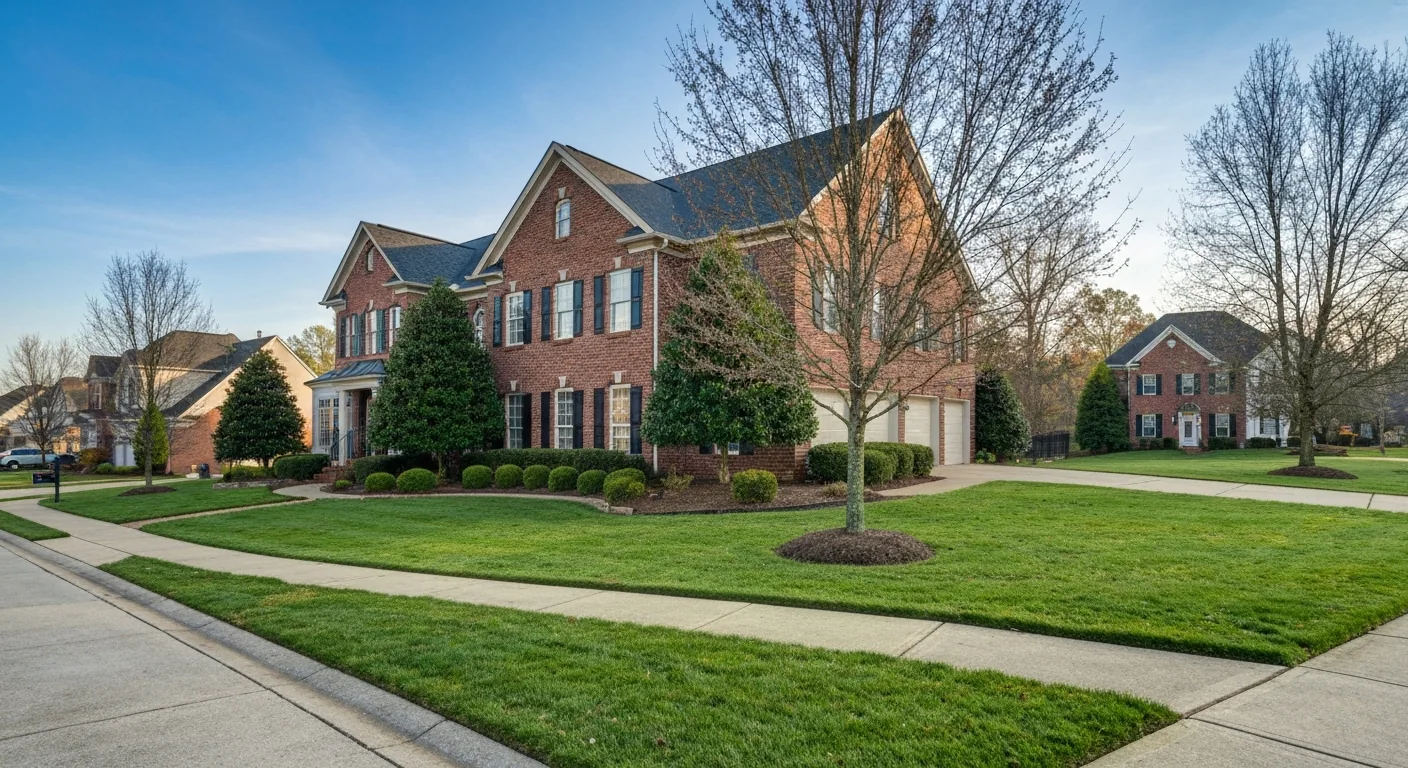
The practical translation for someone moving from Connecticut to Charlotte: the equity from a Fairfield County home often buys a larger, newer house here with money left over, and the annual carrying cost drops sharply once the property tax and car tax fall away. Many Connecticut sellers are surprised that a brick home with a three car garage and a real yard lists for less than the Colonial they are leaving, with a tax bill less than half the size.
Taxes Compared: Income, Property, the Car Tax, and Sales
For most Connecticut households the tax difference is the single biggest financial reason for moving from Connecticut to Charlotte, and it shows up in four places.
Income tax: Connecticut vs North Carolina vs South Carolina
Connecticut uses a progressive income tax that reaches a top marginal rate of 6.99%. North Carolina uses a flat income tax that has been falling for years and drops to 3.99% for 2026, with no surtax at any income level, per the North Carolina Department of Revenue. South Carolina is graduated with a top rate near 6.2%, but it taxes lower brackets lightly and is generous on retirement income, which can favor retirees.
Property tax: the number Connecticut owners feel most
Connecticut has some of the highest property taxes in the country, with effective rates commonly in the 1.5% to 2.4% range depending on the town, and Fairfield and Hartford county bills that routinely run into five figures. The Charlotte suburbs are far lower. Union County NC set its rate at 43.42 cents per $100 of assessed value for fiscal year 2025-2026, an effective rate near 0.65%. Mecklenburg County averages close to 0.66% effective, and York County SC is lower still, near 0.5%. On a $600,000 home, the difference between a 2% Connecticut rate and a 0.65% Union County rate is roughly $8,000 less in property tax every year.
The car tax: a Connecticut cost that disappears
This one surprises people. Connecticut charges an annual motor vehicle property tax, billed by your town, on top of registration. North Carolina folds a lower vehicle property tax into its Tag and Tax Together program, so you pay it once a year with your registration renewal rather than as a separate town bill, and the amount is generally well below a Connecticut car tax bill. Two cars can mean a meaningful annual saving.
Sales and estate tax
Connecticut charges a flat 6.35% sales tax with no local add on. North Carolina combined rates run about 6.75% in Union County and higher in Mecklenburg, while York County SC runs about 7%, so sales tax is close to a wash. The quieter difference is at the top end of estate planning: Connecticut levies its own estate and gift tax, while neither North Carolina nor South Carolina has any estate or inheritance tax at all.
If you want the plain English version of the NC versus SC question, I walk through it in a short video, Living in South Charlotte vs SC: The Truth About Taxes, on my YouTube channel Welcome to Charlotte NC.
Not sure whether NC or SC saves you more?
The right side of the state line depends on your income, your stage of life, and your school priorities. I can map it to your situation.
Schedule a 15-Minute Introductory Call704-774-7170 | steve@jarrellhomes.com | thelongleafgroup.com
Schools Compared: Connecticut vs the Carolinas
This is the section Connecticut parents care about most, and it deserves a direct answer. Connecticut consistently ranks among the very top states for public schools nationally, so you are leaving one of the strongest statewide systems in the country. North Carolina ranks lower on those statewide measures. But statewide averages are the wrong lens for this move, because assignment here is by address and the specific south Charlotte districts you would move into are among the best in the region.
In North Carolina, Union County Public Schools is one of the top rated traditional districts in the state, and Marvin Ridge High School in Marvin is routinely ranked at or near the top of the entire Charlotte metro. Across the state line, the Fort Mill School District in York County SC has been ranked the number one district in South Carolina by Niche, with a graduation rate above 95%, and the neighboring Clover School District ranks near the top as well. Charlotte Mecklenburg Schools, which covers Charlotte proper and Ballantyne, is a large district where quality varies a lot by specific school, so the address matters even more inside the city.
The rule I give every relocating buyer is the same: never assume a school assignment from a listing or a map. Assignment lines are drawn by exact address and they do get redrawn. Before you fall for a house, confirm the current assignment with the district directly. You can start with the Fort Mill School District site on the SC side and the Union County Public Schools locator on the NC side, and I verify the exact assignment for any home before you write an offer.
Weather, Pace, and What Connecticut Transplants Miss
The weather is the easy sell. Hartford averages roughly 48 to 52 inches of snow a year and a January that sits in the 20s and 30s. Charlotte averages close to 4 inches of snow for the entire winter and a January that runs from the mid 30s into the 50s. The tradeoff is summer. Charlotte summers are hot and humid, with July highs near 90 degrees and real mugginess from June into September, warmer and stickier than a Connecticut summer. Most people decide that a hot summer with air conditioning beats a February nor’easter, but you should know both sides.
The growing season is longer here, which is part of why the region is so green. That green comes with a cost that surprises a lot of Northeasterners: pollen. Charlotte has one of the more intense spring pollen seasons in the country, heavy with oak and pine, and it can be rough for allergy sufferers in March and April in a way Connecticut rarely is.
What people from Connecticut tell me they miss
I am not going to pretend the move is all upside. The Connecticut transplants I work with are consistent about what they miss. They miss four true seasons and a real, snowy winter, and the skiing and the fireside months that come with it. They miss New England food, from New Haven apizza and clam pies to a proper lobster roll. Some miss the fast pace and the easy Metro-North ride into New York for a show or a game. Charlotte has good restaurants, professional sports, and its own growing scene, but it is a different flavor, and it is fair to grieve what you are leaving.
Getting Around, Flights Home, Beaches and Mountains
Be clear eyed about this: Charlotte is a car metro. Regional transit ridership is low, most households own two or more vehicles, and daily life runs on the interstates. The LYNX Blue Line light rail runs from UNC Charlotte through Uptown to south Charlotte and is useful along that corridor, but it is nothing like Connecticut’s Metro-North reach into New York. I-485 loops the city, I-77 runs north and south toward Fort Mill and Lake Norman, and I-85 runs toward Greensboro and Atlanta.
Getting back to Connecticut and New York is easy, which matters when you still have people there. Charlotte Douglas International is a major American Airlines hub, with roughly five nonstop flights a day to Hartford Bradley on a flight of about two hours, plus frequent nonstops to LaGuardia, Newark, and JFK. You also gain a geography Connecticut cannot match for weekend trips. The Blue Ridge mountains around Asheville are about a 2 to 2.5 hour drive, and the coast is reachable in an afternoon: Myrtle Beach is roughly 3 to 4 hours and Wilmington about 3.5 to 4 hours. For a lot of people moving from Connecticut to Charlotte, trading a cold beach two seasons a year for warm Carolina sand is a quiet win.
Differences People From Connecticut Do Not Expect
These are the things that catch Connecticut buyers off guard, the ones I make sure to explain before we tour a single home.
HOAs are the norm, not the exception
Most newer suburban neighborhoods here have a homeowners association with dues and rules, which is different from a lot of Connecticut housing stock. HOAs can protect resale values and cover amenities, but you need to read the covenants before you buy.
Well and septic exist even in nice areas
Many homes on larger lots in Weddington, Marvin, and rural Union County are on private well water and septic systems rather than city water and sewer. That is normal and manageable, but it changes your inspection checklist and your monthly costs, and it is not something most Connecticut buyers expect on a $700,000 home.
The state line is a real decision
South Charlotte straddles the NC and SC border, and the line has real consequences for income tax, property tax, vehicle registration, and school district. Two homes ten minutes apart can sit in different states with different tax bills. This is the single most useful thing a local agent adds for an out of state buyer.
The pace, the pollen, and the heat
The pace is slower and the default is friendlier, which most transplants come to love and a few find frustrating at first. The two things that genuinely surprise people are the intensity of the spring pollen and the length of the humid summer. Both are manageable, but they are real.
Where People Moving from Connecticut to Charlotte Tend to Land
If your top priorities are space, top schools, and long term value, a few submarkets come up again and again for Connecticut transplants. Here is how I match them to what people say they want.
Weddington and Marvin NC: space and the top schools
If you are used to a strong Connecticut school district and want the closest equivalent, Weddington and Marvin deliver, feeding the Marvin Ridge schools with larger lots and a quiet, established feel. This is the luxury tier, with medians well above the metro. See my Weddington relocation guide for the detail.
Waxhaw NC: newer homes, town center, more value
Waxhaw pairs newer construction and strong schools with a walkable historic downtown, which appeals to Connecticut buyers who still want somewhere to stroll. It generally prices below Weddington. My Waxhaw relocation guide breaks down the communities.
Fort Mill and Indian Land SC: the tax angle
If lowering your total tax load is the priority, the York County SC towns of Fort Mill and Indian Land are worth a hard look. You get top rated SC schools, newer neighborhoods, an easy commute up I-77, and the lowest property tax base in the area, all just across the line from Charlotte.
Ballantyne and Matthews NC: closer in, more built up
If you want to be closer to Uptown and the finance job centers with more of an in town suburban feel, Ballantyne and Matthews give you that, with quicker access to the airport. Assignment inside Charlotte Mecklenburg Schools varies by address, so verify.
How a Connecticut to Charlotte Move Actually Works
The logistics of a long distance move are their own challenge, and this is where working with a local relocation specialist earns its keep. The Connecticut households I help usually face the same sequence: sell the home up north, decide on the NC versus SC question, narrow the school zones, and figure out where to live in the gap between closings.
What to Know Before Moving from Connecticut to Charlotte
The buyers who have the smoothest experience treat the move as a project with a checklist, not a leap of faith. When you are moving from Connecticut to Charlotte, the three questions that decide everything are which state saves you more in tax, which school zone fits, and how you bridge the timing between selling up north and buying here. A few practical notes: plan around two closings that rarely line up perfectly, and consider a short term rental so you are not forced into a rushed purchase. Tour in person once you have narrowed the list. And get the school assignment plus the well, septic, and HOA questions answered before you write an offer, not after. I handle those verifications for out of state buyers as a matter of course.
If you want a broader orientation before you get specific, my relocating to south Charlotte buyer guide lays out the towns and the buying process, and the buying page walks through how I work with relocating buyers. You can also read more about my background and why I approach relocation the way I do.
Frequently Asked Questions
Is moving from Connecticut to Charlotte worth it?
For most households, yes. You typically gain more house and land per dollar, a lower state income tax at a flat 3.99% in 2026 versus a top 6.99% in Connecticut, much lower property taxes, no separate annual car tax, and milder winters. You give up Metro-North access to New York, four true seasons, and the New England coastline and food. It comes down to whether the financial and weather gains outweigh the lifestyle changes for you.
What is the cost of living difference between Connecticut and Charlotte?
It depends on where in Connecticut you are leaving. Against Hartford or New Haven, Charlotte runs a few percent to about 12% cheaper overall. Against Fairfield County, Charlotte is roughly 30% cheaper, driven by housing, property tax, and utilities. Utilities alone often run 30% to 40% lower in Charlotte.
How do Charlotte schools compare to Connecticut schools?
Statewide, Connecticut ranks higher than North Carolina. But school assignment here is by address, and the specific south Charlotte districts, including Union County Public Schools and the Fort Mill School District in SC, rank among the best in the region. Marvin Ridge High is routinely near the top of the Charlotte metro. Always verify the exact assignment for a specific home.
Does North Carolina have a car tax like Connecticut?
North Carolina taxes vehicles, but differently. Instead of a separate annual town car tax like Connecticut, North Carolina folds a lower vehicle property tax into its Tag and Tax Together program, so you pay it once a year with your registration renewal. For most households the North Carolina amount is well below a Connecticut car tax bill.
Should I move to the North Carolina or South Carolina side of Charlotte?
It depends on your income and stage of life. North Carolina has a clean flat income tax of 3.99% in 2026, which usually favors working households. South Carolina taxes lower brackets lightly, is generous on retirement income, and has the lowest property tax base in the area, which can favor retirees. School district and vehicle rules also differ by side, so it is worth mapping to your situation.
What is the weather like in Charlotte compared to Connecticut?
Charlotte winters are far milder, with about 4 inches of snow a year versus roughly 50 inches in Hartford. The tradeoff is a hot, humid summer with July highs near 90 degrees and an intense spring pollen season. Most Connecticut transplants consider the milder winter well worth the warmer summer.
How far is Charlotte from the mountains and the beach?
The Blue Ridge mountains around Asheville are about a 2 to 2.5 hour drive. The coast is reachable in an afternoon, with Myrtle Beach roughly 3 to 4 hours and Wilmington about 3.5 to 4 hours. Nonstop flights from Charlotte to Hartford Bradley run about five times a day and take around two hours.
About the Author
I am Steve Jarrell, a licensed real estate agent in both North Carolina and South Carolina with The Longleaf Group at eXp Realty, and I live in the south Charlotte suburbs I write about. I specialize in relocation, and I help buyers moving from Connecticut and the wider Northeast compare towns, tax lines, and school zones so they buy in the right place the first time. Before real estate I spent more than a decade in real estate marketing technology, founding a company later acquired by Constellation Software, and I bring that systems minded, data first approach to every relocation. You can reach me at 704-774-7170 or steve@jarrellhomes.com, and you can watch local guides on my YouTube channel Welcome to Charlotte NC.
 |
Free · 26-Page Insider Guide Which South Charlotte Town Is Right for You? Towns, villages, and cities compared, NC vs SC taxes and schools, and the 5 mistakes out-of-state buyers make. Everything you’d want a local to tell you before you move. Get the free guide → |
Let Us Talk Through Your Move From Connecticut
I help Connecticut buyers every year: comparing NC and SC taxes, verifying school zones, timing two closings, and finding the right town before you ever list your home up north. No pressure, just a clear plan.
Schedule a 15-Minute Introductory Call704-774-7170 | steve@jarrellhomes.com | thelongleafgroup.com