
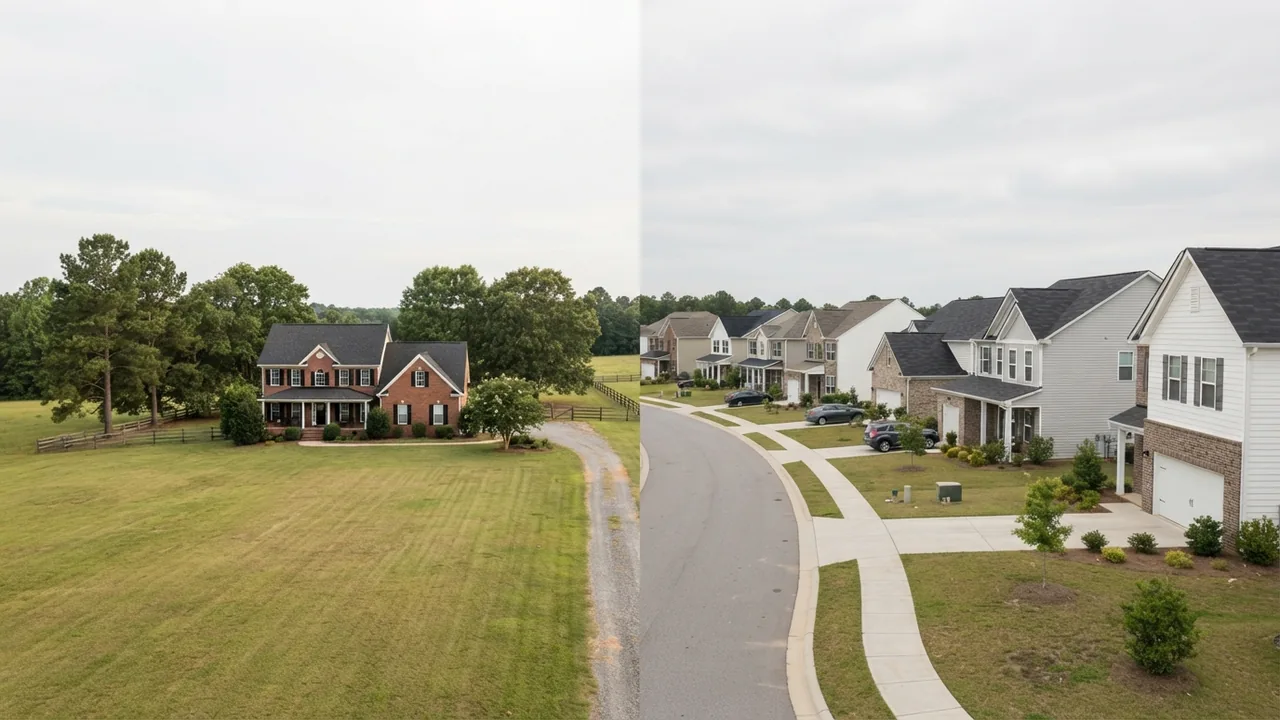
Fort Mill SC or Waxhaw NC comes down to a trade you can put a number on: Fort Mill’s typical home costs about $187,369 less, and Waxhaw’s property tax bill on that typical home runs only about $167 a year higher. South Carolina’s famous 4% homeowner assessment does not automatically hand you the cheaper tax bill. On a same-priced house, Waxhaw is currently the cheaper of the two on property tax. Income tax flips at about $79,180 of taxable income: below that South Carolina costs less, above it North Carolina does.
21 min read | By Steve Jarrell, The Longleaf Group at eXp Realty | Updated September 2026
Free · 26-Page Insider Guide
Weighing NC against SC before you buy?
Towns compared, NC vs SC taxes and schools side by side, and the 5 mistakes out-of-state buyers make.
What This Guide Covers
- Fort Mill SC or Waxhaw NC: the short answer
- Property taxes in Fort Mill SC or Waxhaw NC
- Does the state line actually save you money on income tax?
- Schools in Fort Mill and Waxhaw
- Land, lot size, and what your money buys in each town
- Commute, downtown, and weekends
Fort Mill SC or Waxhaw NC: the short answer
The Short Answer
Steve Jarrell of The Longleaf Group tracks Fort Mill as the lower-priced of the two towns, with a typical home value of $529,805 against Waxhaw’s $717,174, according to Zillow Home Value Index data pulled August 25, 2026. Waxhaw carries the lighter property tax rate on a same-priced house, so the annual bills on each town’s typical home land within $167 of each other.
Key numbers right now:
- Typical home value: Fort Mill $529,805, Waxhaw $717,174 (Zillow ZHVI, July 2026)
- Property tax on that typical home: Fort Mill about $5,026.79, Waxhaw about $5,193.79 a year
- Property tax on a $600,000 house: Fort Mill about $5,692.80, Waxhaw about $4,345.20
- State income tax: North Carolina a flat 3.99%; South Carolina 1.99% under $30,000 and 5.21% minus $966 above it, so the two cross at about $79,180
- Public high schools: Fort Mill High 10 out of 10, Marvin Ridge and Cuthbertson 9 out of 10 (GreatSchools, pulled August 25, 2026)
Most buyers arrive at this question with a story already in their head. South Carolina taxes less, North Carolina schools are stronger, Fort Mill is newer, Waxhaw has land. Some of that holds up. A good chunk of it falls apart the moment you run the arithmetic on a specific house at a specific price.
Here is the shape of the real decision. Fort Mill, South Carolina sits in York County, roughly 20 miles south of Uptown Charlotte with direct I-77 access, and it is built around master-planned neighborhoods on smaller lots. Waxhaw, North Carolina sits in Union County, about 25 miles southeast of Uptown with no interstate of its own, wrapped around a historic railroad downtown and surrounded by pasture, horse property, and larger residential lots. You are choosing between a newer suburb with a highway and an older town with land.
I want to be careful about one thing before the numbers start. Every figure below carries its source and the date I pulled it. The tax rates come from the North Carolina Department of Revenue, the South Carolina Department of Revenue, and the York County Auditor’s published millage chart. The school ratings come straight from GreatSchools. None of it came from memory or from an older article.
One thing to hold on to as you read the tax section. South Carolina’s 4% owner-occupied assessment ratio is real, and it is also the most misread number in this entire comparison. A lower assessment ratio applied against a higher millage does not automatically produce a smaller bill. The only way to know is to run your actual purchase price through both states’ math instead of comparing the headline rates, which is exactly what the next section does.
Talk to a local broker
Two towns, two states, one decision.
A short call can sort out which side of the line fits your budget and your drive. No pressure, just answers.
Schedule a 15-Minute Introductory Call →704-774-7170 · steve@jarrellhomes.com · thelongleafgroup.com
If you already own in Waxhaw and this is about getting out rather than getting in, the seller side of it is in selling a house in Waxhaw NC.
Property taxes in Fort Mill SC or Waxhaw NC
On a house priced the same in both towns, Waxhaw’s property tax bill is lower. A $600,000 owner-occupied home in the Town of Fort Mill runs about $5,692.80 a year. The identical price in the Town of Waxhaw runs about $4,345.20. That is roughly $1,347.60 a year in Waxhaw’s favor, which surprises nearly every buyer who crosses the state line expecting the opposite.
Why does it work out that way? South Carolina does give owner-occupied homes a real break. Under South Carolina Code Section 12-43-220(c)(1), your legal residence is assessed at 4% of fair market value rather than the 6% applied to second homes and rentals, and that 4% status also exempts you from school operating millage. North Carolina has no equivalent. Union County assesses at 100% of appraised market value, full stop.
So South Carolina starts from a much smaller assessed number. York County then applies a much larger millage rate to it. The county’s 2025 millage chart puts a Town of Fort Mill address at 237.2 mills for 4% owner-occupied property and 573.8 mills for everything else. Run $600,000 through it: 4% of $600,000 is $24,000 of assessed value, and $24,000 at 237.2 mills produces $5,692.80.
Waxhaw’s math is simpler. Union County’s rate for fiscal year 2025-2026 is $0.4342 per $100 of value and the Town of Waxhaw adds $0.29, for a combined $0.7242 per $100. Apply that to the full $600,000 and you get $4,345.20. The state that assesses more ends up charging less, because the rate it applies is a fraction of York County’s.
Now flip it, because almost nobody actually shops the same price in both towns. Buy the typical Fort Mill house at $529,805 and the annual bill is roughly $5,026.79. Buy the typical Waxhaw house at $717,174 and it is roughly $5,193.79. You are looking at $167.00 a year separating two homes that differ in value by $187,369. Waxhaw’s rate advantage is almost exactly consumed by Waxhaw’s higher prices.
| Property tax comparison | Fort Mill, SC (York County) | Waxhaw, NC (Union County) |
|---|---|---|
| How the home is assessed | 4% of market value for a legal residence | 100% of appraised market value |
| Rate applied | 237.2 mills (2025 owner-occupied) | $0.7242 per $100 (county plus town) |
| Annual tax on a $600,000 home | about $5,692.80 | about $4,345.20 |
| Typical home value, July 2026 | $529,805 | $717,174 |
| Annual tax on that typical home | about $5,026.79 | about $5,193.79 |
| Year-over-year value change | down 1.7% | down 0.1% |
Two footnotes matter here. The 4% rate is not automatic. You have to file for legal residence status with the York County Assessor after closing, and buyers who move in during the fall and forget get their first bill at the 6% rate, which on that same $600,000 house would be roughly $13,771. Second, Union County completed a revaluation for 2025, and the state’s own sales-assessment ratio for the county sits at 0.9985, meaning assessed values there are tracking market values almost exactly right now. There is not much cushion left in Waxhaw’s assessments.
You can read the underlying document yourself. The York County 2025 millage chart lists every tax district in the county, and Fort Mill appears in the cities block near the bottom.
Does the state line actually save you money on income tax?
Neither state wins outright. South Carolina is cheaper below roughly $79,180 of taxable income and North Carolina is cheaper above it, and that crossover is the most useful number in this whole comparison for a working household.
South Carolina rebuilt its income tax in 2026, which is why the old advice on this question is stale. House Bill 4216 was signed on March 30, 2026 and rewrote Section 12-6-510 of the state code for taxable years beginning after 2025. The new schedule is 1.99% on the first $30,000 of taxable income, then 5.21% on the amount above $30,000 minus a $966 credit against the bill. North Carolina, meanwhile, applies a flat 3.99% to every dollar of taxable income for tax years after 2025, down from 4.25% in 2025 and 4.50% in 2024.
Put those two formulas against each other and they intersect at $79,180. A household with $60,000 of taxable income pays about $2,160 in South Carolina against $2,394 in North Carolina, so Fort Mill saves them roughly $234. At $150,000 it reverses hard: about $6,849 in South Carolina against $5,985 in North Carolina, so Waxhaw saves roughly $864. At $250,000 the North Carolina advantage widens to about $2,084 a year.
| Taxable income | South Carolina (Fort Mill) | North Carolina (Waxhaw) | Cheaper |
|---|---|---|---|
| $60,000 | about $2,160 | about $2,394 | South Carolina by $234 |
| $79,180 | about $3,159 | about $3,159 | a wash |
| $100,000 | about $4,244 | about $3,990 | North Carolina by $254 |
| $150,000 | about $6,849 | about $5,985 | North Carolina by $864 |
| $250,000 | about $12,059 | about $9,975 | North Carolina by $2,084 |
One caveat you should carry into a conversation with your accountant. The same law that set those rates also stopped South Carolina from adopting the federal standard and itemized deductions and created a separate South Carolina Income Adjusted Deduction in their place. So South Carolina taxable income and North Carolina taxable income are not computed from the same starting point, and the table above compares equal taxable income rather than equal salary. Your actual crossover sits near $79,180 but it will not land exactly there.
The direction of travel is worth knowing too. Starting with tax year 2027, South Carolina’s top rate steps down automatically whenever income tax revenue is projected to grow at least 5% in a year, and the statute keeps stepping it down until the top rate reaches 1.99%. North Carolina has its own revenue triggers written into law. Both states are cutting, and South Carolina is cutting from a structure that now favors moderate incomes.
You can read the enacted text yourself on the South Carolina General Assembly’s page for H. 4216, and the North Carolina rate on the state rate schedules page. We go deeper on vehicles, retirement income, and the one-time costs of crossing in our NC vs SC taxes breakdown.
Sales tax cuts a third way. Union County charges a combined 6.75% and York County charges 7%, which is a rounding error on groceries and a couple hundred dollars on a furniture order. Vehicle property tax exists in both states, and both will bill you annually on what you drive. Neither state gives you a pass there.
Stack income tax on top of the property tax math and the picture sharpens. A household earning modestly and buying at $600,000 does better in Waxhaw on property tax and better in Fort Mill on income tax, so the two roughly cancel. A dual-income household clearing $250,000 does better in Waxhaw on both counts, by something over $3,400 a year combined. The state line is not a coupon. It rewards different buyers in different directions.
Schools in Fort Mill and Waxhaw
Both towns give you strong public schools, and the difference is shape rather than quality. Fort Mill Schools, the district formally known as York County School District 4, has more schools and a wider range between its strongest and weakest. Union County Public Schools serves Waxhaw with fewer campuses and a tighter band, especially at middle and high school. GreatSchools listed 17 public schools under a Fort Mill address and 10 district schools under a Waxhaw address when I pulled the ratings on August 25, 2026.
Look at the top of each list and they are peers. Fort Mill High School holds a 10 out of 10. Fort Mill Middle and Forest Creek Middle both hold 10. Doby’s Bridge Elementary and River Trail Elementary hold 10. On the Waxhaw side, Marvin Ridge Middle and Cuthbertson Middle both hold 10, Rea View Elementary holds 10, and Marvin Ridge High and Cuthbertson High each hold 9. Nation Ford High and Catawba Ridge High in Fort Mill also hold 9.
The spread is where it gets interesting for a buyer. Fort Mill’s elementary ratings run from 10 all the way down to a 5 at Fort Mill Elementary and a 6 at Riverview Elementary. Waxhaw’s elementary ratings run from 10 down to a 6 at New Town Elementary and Western Union Elementary. Fort Mill also has three high schools and five middle schools, so which address you buy moves you across a genuinely wider range of outcomes than it does in Waxhaw.
| School | Town | Grades | GreatSchools rating |
|---|---|---|---|
| Fort Mill High School | Fort Mill | 9-12 | 10 out of 10 |
| Nation Ford High School | Fort Mill | 9-12 | 9 out of 10 |
| Catawba Ridge High School | Fort Mill | 9-12 | 9 out of 10 |
| Marvin Ridge High School | Waxhaw | 9-12 | 9 out of 10 |
| Cuthbertson High School | Waxhaw | 9-12 | 9 out of 10 |
| Fort Mill Middle School | Fort Mill | 6-8 | 10 out of 10 |
| Marvin Ridge Middle School | Waxhaw | 6-8 | 10 out of 10 |
| Cuthbertson Middle School | Waxhaw | 6-8 | 10 out of 10 |
| Doby’s Bridge Elementary | Fort Mill | K-5 | 10 out of 10 |
| Rea View Elementary | Waxhaw | K-5 | 10 out of 10 |
One caution I give every relocating buyer, and it applies equally in both towns. A school listed under a town’s name on a search site is not the same thing as the school your specific address is assigned to. Attendance zones cut through neighborhoods, they get redrawn as new schools open, and a charter school with a town’s mailing address can appear in the same list as the district campuses. Verify the exact street address with the district before you write an offer. Both districts publish assignment tools: Fort Mill Schools and Union County Public Schools.
Growth pressure is the other thing worth knowing. Both districts have been opening schools to keep pace with new rooftops, which is why Fort Mill now runs three high schools where it once ran one, and why Union County split the Waxhaw area between the Marvin Ridge and Cuthbertson clusters. A boundary that holds today may not hold in four years. Ask the district about capacity at your specific campus, not just its rating.
Talk to a local broker
Still weighing Fort Mill against Waxhaw?
Fifteen minutes with a broker who works both sides of this border every week.
Book a 15-minute call →Land, lot size, and what your money buys in each town
Waxhaw sells land. Fort Mill sells amenity. That single sentence explains most of the $187,369 gap between the two typical home values, and it explains why buyers who tour both towns in one weekend usually come back with a clear preference rather than a coin flip.
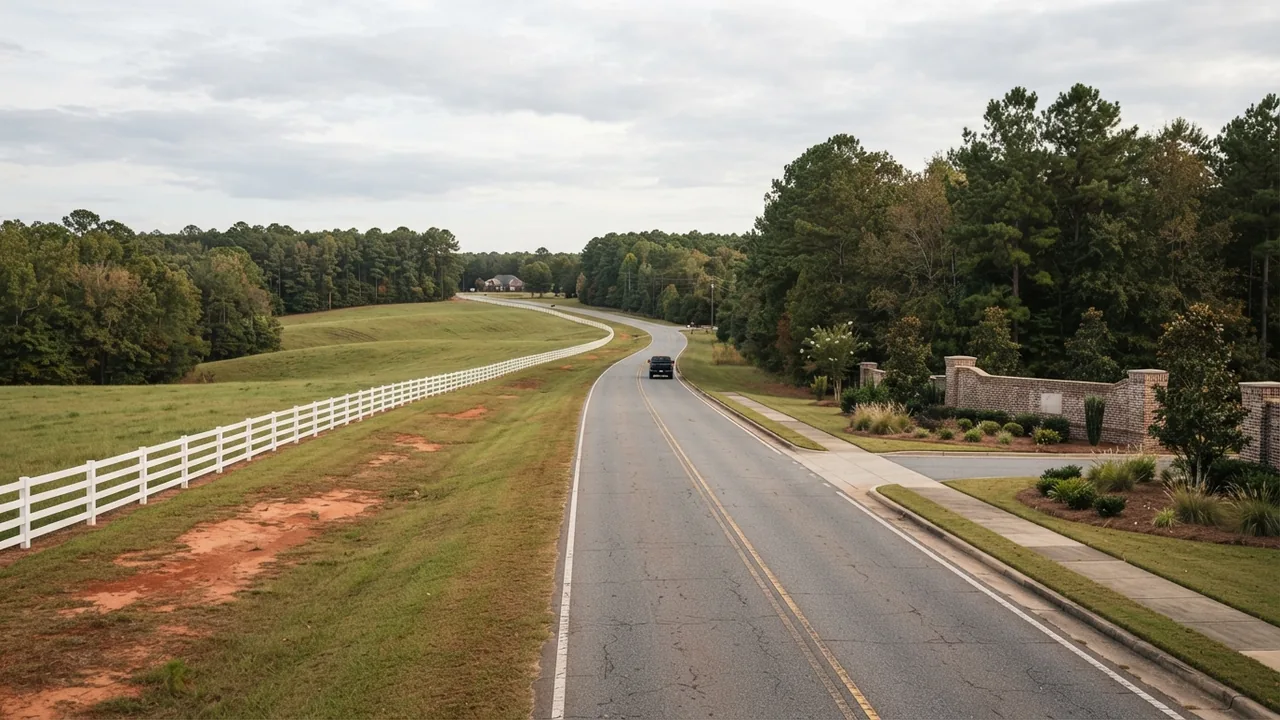
Drive west out of downtown Waxhaw on Providence Road, which is NC-16, the two-lane route that runs north toward Uptown Charlotte, and the pattern shows up inside three miles. Pasture. Board fencing. Long gravel drives. Custom brick homes set two hundred feet off the road on an acre or more. Union County’s zoning around Waxhaw still carries large minimum lot sizes in a lot of the unincorporated pockets, and the town grew around a rail depot rather than around a highway interchange, so it never developed the dense pod-after-pod pattern you find closer to the interstate.
Fort Mill developed the other way. Its growth followed I-77 and the corporate campuses along Carolina Place and the Kingsley and Baxter corridors, so the housing stock skews newer, denser, and heavier on shared amenity. Baxter Village is a walkable New Urbanist neighborhood with a town green and small commercial spaces mixed into the residential streets. Kingsley Town Center pairs housing with retail and office. Springfield wraps around a golf course. You buy a smaller yard and get a pool, a clubhouse, sidewalks, and a shorter walk to coffee.
Newer also means more homeowners association. Master-planned Fort Mill neighborhoods carry association dues that fund those amenities, and the dues are a real line item in your monthly number. Plenty of Waxhaw properties, especially the older and larger-lot ones outside town limits, carry no association at all. That cuts both ways. Nobody maintains a common pool for you, and nobody stops your neighbor from parking a boat in the side yard either.
The price data backs the pattern up. Zillow’s index put Fort Mill’s typical home value at $529,805 in July 2026, down 1.7% from $539,098 a year earlier. Waxhaw’s sat at $717,174, down 0.1% from $717,580. Both towns cooled slightly over the year. Fort Mill cooled more, which is what you would expect in a market with heavy new construction competing against resale.
For a buyer with a hard ceiling around $500,000, that gap is the whole decision. Fort Mill puts you at or just under its typical home at that number. Waxhaw at $500,000 means a townhome, a smaller older house in town, or a longer drive out toward Mineral Springs and the Union County line. If your ceiling is $800,000, the calculus inverts and Waxhaw starts handing you acreage that Fort Mill mostly cannot.
These two towns also feel different in a way price cannot capture, and it comes down to how each one was built. Fort Mill grew around a highway and reads as a newer suburb. Waxhaw grew around a railroad downtown and reads as an older town with land behind it. Neither is the better answer. But if you have a strong instinct about which of those you want to come home to, let it break the tie, because the numbers in this comparison get close enough that something has to.
Fort Mill is not the only South Carolina option worth weighing against Waxhaw, so I ran the same numbers for the panhandle in my Indian Land versus Waxhaw breakdown.
Commute, downtown, and weekends
Fort Mill gets you to Uptown Charlotte faster on a bad morning, and that is the single most underrated line item in this comparison. Fort Mill sits directly on I-77 with express toll lanes running the corridor, which puts a typical morning run into Uptown around 25 to 35 minutes. Waxhaw has no interstate. Every route north funnels onto surface roads before reaching I-485, and a 7:30 a.m. departure commonly stretches to 45 to 75 minutes.
Off-peak the two towns are much closer together, and that matters if you work hybrid. We measured both corridors in detail in our Fort Mill commute breakdown and our Waxhaw commute breakdown, and the short version is that Waxhaw costs you roughly 15 to 25 extra minutes each way at peak and almost nothing at 10 a.m. Three days a week in the office changes the math a lot.
If you work from home three days a week, I would weight that difference lower than the tax math below. If you are in an office five days, it is the largest single line item in your decision and you should treat it that way.
Downtowns are where the two towns feel least alike. Waxhaw’s is a genuine historic main street: two blocks of early twentieth century brick storefronts straddling an active rail line, antique shops, a brewery, coffee, and a Saturday farmers market that draws people in from the surrounding county. The town adopted a downtown master plan in 2025 covering walkability, parking, and mixed-use redevelopment, and the streets have been torn up for water and sewer work through much of 2026 while that gets sorted out. Fort Mill’s downtown is smaller and tidier, a compact main street anchored by Walter Y. Elisha Park, with most of the town’s retail energy living instead at Baxter and Kingsley.
For outdoor time, Fort Mill has the standout asset in the region. The Anne Springs Close Greenway is a 2,100-acre private nature preserve inside the town, with hiking and mountain biking trails, a lake, horse stables, and a covered bridge, and it charges a modest day rate or annual membership. The Town of Fort Mill also runs an extensive parks system, detailed on the town parks and recreation pages. Waxhaw’s outdoor draw is Cane Creek Park, a roughly 1,000-acre Union County park about ten minutes south of downtown with a 350-acre lake, campsites, fishing, and disc golf.
Dining splits along the same lines as everything else. Waxhaw’s independent restaurants cluster downtown within a few blocks of each other, which makes an evening there walkable in a way Fort Mill’s mostly is not. Fort Mill spreads its dining and its breweries across Baxter Village, Kingsley Town Center, and the Carolina Orchards corridor, so you drive between them but you get more variety and more chain reliability. Kids get served well in both places: the Greenway runs youth programs and summer camps on the Fort Mill side, and Cane Creek Park handles the swimming, paddling, and camping demand on the Waxhaw side.
Growth is reshaping both towns at once. Waxhaw’s board approved more than 3,200 residential units between 2023 and 2026, with several thousand more in the developer pipeline. Fort Mill broke ground on a $25 million operations center in 2026 and has new retail and grocery construction underway along Fort Mill Parkway. Neither town is finished, and neither is going to feel the same in five years.
I walked through this exact comparison on video, standing in both towns, in Moving To Fort Mill SC or Waxhaw NC? Watch This First on the Living in South Charlotte channel. Seeing the two downtowns back to back does more than a table can.
If you want the wider view of either town, our Fort Mill community hub and Waxhaw community hub pull together listings, neighborhoods, and every guide we have written on each.
If your move begins with a sale, the two states do not handle it identically. The disclosure requirements and closing costs that come with selling a house on the Fort Mill side are worth understanding before you list, because they change what you net and how fast you can close.
Frequently asked questions
What are the key differences in property taxes between Fort Mill SC and Waxhaw NC?
South Carolina assesses an owner-occupied home at 4% of market value and York County then applies 237.2 mills to a Town of Fort Mill address, producing about $5,692.80 a year on a $600,000 house. North Carolina assesses at 100% of value and Waxhaw’s combined county and town rate is $0.7242 per $100, producing about $4,345.20 on the same house. Waxhaw is cheaper at an identical price.
How do the school districts in Fort Mill and Waxhaw compare?
Both rate strongly and the difference is range rather than peak. GreatSchools rates Fort Mill High School 10 out of 10, with Nation Ford and Catawba Ridge at 9. Waxhaw’s Marvin Ridge High and Cuthbertson High each rate 9, and both of its middle schools rate 10. Fort Mill’s elementary ratings spread from 10 down to 5, so the specific address matters more there.
What is the typical commute time to Uptown Charlotte from each town at rush hour?
Fort Mill runs about 25 to 35 minutes into Uptown on a typical weekday morning because it sits directly on I-77 with express toll lanes available. Waxhaw commonly runs 45 to 75 minutes at the same hour, since every route north uses surface roads before reaching I-485. Off-peak the two towns run far closer together, so if you drive in three days a week rather than five, the gap costs you much less than the peak numbers suggest.
Are homes more affordable in Fort Mill or Waxhaw, and what are typical lot sizes?
Fort Mill is the lower-priced town. Zillow’s index put its typical home value at $529,805 in July 2026 against Waxhaw’s $717,174, a gap of $187,369. Fort Mill leans toward smaller lots inside master-planned neighborhoods with shared amenities, while Waxhaw carries far more acreage, larger residential lots, and properties with no homeowners association at all.
What kind of community atmosphere can I expect in Fort Mill versus Waxhaw?
Waxhaw feels like an old railroad town that kept its main street, with two blocks of brick storefronts, a Saturday farmers market, and pasture starting a few minutes out. Fort Mill feels newer and more organized around planned neighborhoods such as Baxter Village and Kingsley, where the retail, the sidewalks, and the amenities were designed in from the start. Pick whichever one sounds like a Saturday you would actually enjoy.
Is there a lot of new construction in Fort Mill and Waxhaw right now?
Yes, in both. Waxhaw’s board approved more than 3,200 residential units between 2023 and 2026, with several thousand more in the developer pipeline, and downtown has been under water and sewer construction through much of 2026. Fort Mill broke ground on a $25 million operations center in 2026 and has retail and grocery projects underway along Fort Mill Parkway.
What shopping, dining, and recreation are available in each town?
Fort Mill has the Anne Springs Close Greenway, a 2,100-acre private nature preserve with trails, a lake, and stables, plus dining and breweries spread across Baxter Village, Kingsley Town Center, and Carolina Orchards. Waxhaw concentrates its independent restaurants and brewery downtown within walking distance of each other, and Cane Creek Park south of town covers roughly 1,000 acres with a lake, camping, and disc golf.
How do state income taxes in South Carolina compare to North Carolina?
It depends on what you earn. South Carolina rebuilt its schedule under House Bill 4216, signed March 30, 2026, to 1.99% on the first $30,000 of taxable income and 5.21% minus $966 above that. North Carolina applies a flat 3.99%. The two cross at about $79,180 of taxable income, so South Carolina is cheaper below that and North Carolina is cheaper above it.
About the Author
Steve Jarrell is a REALTOR and broker, and he leads The Longleaf Group at eXp Realty alongside Amanda Jarrell. He holds an active license in both states this article covers, North Carolina #327045 and South Carolina #123223, which is why cross-border work like this comparison is routine rather than occasional for the team. The Longleaf Group is a RealTrends Verified Top Team by volume and an eXp ICON Team, with 170+ five-star reviews from buyers and sellers across South Charlotte, Union County, and the South Carolina border towns. Before real estate, Steve led Paradym, a real estate technology company acquired by Constellation Software in 2020, and he holds an MBA from the University of Tennessee. He publishes the Living in South Charlotte channel on YouTube and writes the blog at thelongleafgroup.com.
704-774-7170 · steve@jarrellhomes.com · thelongleafgroup.com
One last thing for anyone whose ceiling makes Fort Mill feel tight. That same York County millage chart lists Rock Hill at 214.9 mills on owner-occupied property, the lightest rate in that stretch of the county, about 22 mills under Fort Mill’s. It is a longer drive and a different town entirely, and a fair number of buyers who start this comparison end up spending an afternoon there before they decide.