
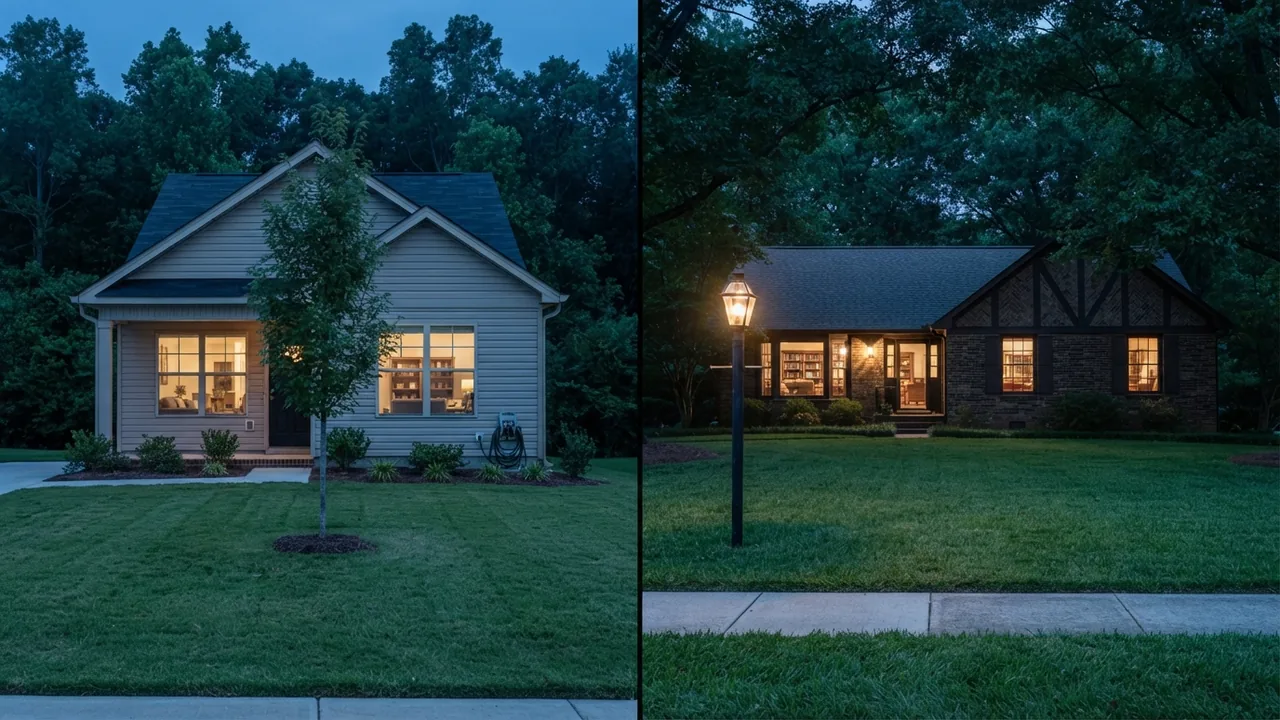
If you have been pricing homes on both sides of the Carolina state line, somebody has already told you that the South Carolina side is the cheaper place to own. That’s true as far as it goes. The median sale price in the 29707 ZIP code that covers Indian Land was $499,950 over the three months to August 31, 2026, against $592,500 in Waxhaw over the same window, both according to Redfin. What almost nobody tells you is how little of that gap is about the price of a house, and how much of the tax saving disappears the moment the house stops being the one you live in.
So I put the two towns side by side on the things that move money: what a square foot costs in each, what the annual property tax really comes to on the same house, what changes if that house is a rental, and how the two differ on schools and the drive to Uptown Charlotte. I am Steve Jarrell, I live in Weddington, and I sell on both sides of this line every week.
15 min read | By Steve Jarrell, The Longleaf Group at eXp Realty | Updated October 2026
Free · 26-Page Insider Guide
Deciding between the NC and SC side of the line?
Towns compared, NC vs SC taxes and schools side by side, and the 5 mistakes out-of-state buyers make.
What This Guide Covers
- Indian Land is not a town, and that decides your tax bill
- Indian Land SC vs Waxhaw NC: what the two medians buy you
- The property tax gap is real and smaller than you expect
- What if the house is not your primary home?
- The school district changes, and so does the drive
- Frequently asked questions
Indian Land is not a town, and that decides your tax bill
You won’t find an Indian Land town hall, because there isn’t a town. Indian Land is an unincorporated community in Lancaster County, South Carolina, which means it has no municipal government and levies no municipal property tax. Waxhaw is its mirror image: an incorporated town inside Union County, North Carolina, with a town government that sets and publishes its own property tax rate, so a Waxhaw owner pays two line items instead of one. That difference is where most of the confusion about these two places begins.
The Short Answer
Indian Land is cheaper than Waxhaw on the median and on property tax, but by less than you have probably been told, and the saving reverses completely if the house is not your primary residence. The price figures below are Redfin medians for the three months to August 31, 2026, and the tax figures come from the 2026 rates published by Lancaster County and Union County, plus the Town of Waxhaw rate published for the 2025 tax year.
The 2026 numbers, side by side (sources: Redfin, Lancaster County Auditor, Union County NC, Town of Waxhaw):
- Median sale price: $499,950 in 29707 against $592,500 in Waxhaw
- Median price per square foot: $213 in 29707 against $212 in Waxhaw, a dollar apart
- Tax on a $500,000 primary residence: about $2,964 against about $3,621
- Tax on the same house if it is not your primary residence: about $10,026 in Indian Land
- Drive to Uptown Charlotte: 20.3 miles against 22.9 miles
- Median days on market: 62 in 29707 against 50 in Waxhaw
I want to flag the mistake I see most often on this particular comparison, because it costs real money and it is easy to avoid. People price the South Carolina side off the assessment ratio alone. They hear 4 percent instead of 100 percent and assume the bill must be a quarter of what North Carolina charges. It is not, because Lancaster County pairs that low ratio with a high millage, and once you run both numbers properly on the same house the gap is about $658 a year rather than thousands.
My advice is simple. Never compare a ratio to a rate. Run the full calculation on both sides, on the same purchase price, before you decide the state line is what is saving you money.
In Waxhaw you pay the Union County rate of 43.42 cents per $100 of value plus the Town of Waxhaw rate of 29 cents, published by the town for the 2025 tax year, for a combined 72.42 cents. Union County’s rate for fiscal year 2026-2027 splits five ways: 11.24 cents to the general fund, 1.06 to debt, 26.78 to education operating, 3.89 to education debt and 0.45 to economic development. Roughly 71 percent of what you pay the county goes to its education partners, which leaves about 12.75 cents of the rate funding everything else the county does.
In Indian Land there’s no town line to cross and no second rate. Lancaster County’s total 2026 millage is 344.2 mills, but an owner occupant never pays all of it. South Carolina assesses a primary residence at 4 percent of market value rather than 100 percent, and the state legal residence exemption strips the 181.0 mills of school operating millage out of the bill. What’s left, which the county’s own tax calculator labels the residential millage, is 163.2 mills.
Talk to a local broker
Not sure which side of the line your budget belongs on?
I am licensed in both states and can run the real numbers on a specific address. No pressure, just answers.
Schedule a 15-Minute Introductory Call →704-774-7170 · steve@jarrellhomes.com · thelongleafgroup.com
Indian Land SC vs Waxhaw NC: what the two medians buy you
The $92,550 between these two medians is not what it looks like, and getting it wrong is how people talk themselves out of Waxhaw. The median sale price there was $592,500 over the three months to August 31, 2026, against $499,950 in the 29707 ZIP code. That’s a gap of $92,550, so the Waxhaw median runs about 18.5 percent higher. If you stopped reading there you’d conclude that houses simply cost more in Waxhaw, and you’d be wrong about why.
Look at what a square foot costs instead. Redfin puts the median price per square foot at $212 in Waxhaw and $213 in 29707. A dollar apart. On the measure that tells you what you’re paying for house, these are the same market, and the South Carolina side is fractionally the more expensive of the two.
So the gap isn’t the price of housing. It’s the size of the houses being sold.
Divide each median price by its own median price per square foot and the Waxhaw number implies a house of roughly 2,795 square feet against roughly 2,347 in 29707, a difference of about 448 square feet. Those are implied figures rather than measured ones, because medians don’t divide cleanly, but the direction is solid and it’s the direction that matters: Waxhaw’s higher median is mostly bigger houses, not pricier ones.
That reframes your whole decision. You are choosing between two markets priced almost identically by the foot, where one is currently selling larger homes than the other. If the square footage you want is nearer 2,300 than 2,800, the money difference between these two places is a lot smaller than those headline medians suggest.
One more number before you move on, because it points the other way for you. The Waxhaw median was up 0.08 percent year over year, which is flat. The 29707 median was down 6.6 percent over the same period. Prices on the South Carolina side have been softening while Waxhaw has held. We refresh the South Charlotte market data every month if you want to watch which way each town moves before you commit.
The property tax gap is real and smaller than you expect
Put the same house on both sides of the line and the South Carolina advantage is genuine but modest. On a $500,000 primary residence in Indian Land the arithmetic runs market value times the 4 percent assessment ratio times 163.2 mills, less Lancaster County’s local option sales tax credit factor of 0.000601 applied to the full value. That comes to roughly $2,964 a year. The same $500,000 house inside Waxhaw, at the combined 72.42 cents per $100, owes about $3,621.
The difference is about $658 a year, which makes the Waxhaw bill about 22 percent higher than the Indian Land one. Real money, and worth having. It’s also nothing like the saving you’ve been promised online, and the reason is that South Carolina pairs a low assessment ratio with a high millage. Four percent of value sounds dramatic until you multiply it by 163.2 mills. North Carolina does the reverse, taxing the whole value at a low rate. The two systems land closer together than either one looks on its own, which is the opposite of what the ratio alone suggests.

Run it on each place’s own median instead and the gap widens, but only because the houses are different sizes. The Indian Land median of $499,950 owes about $2,963 as a primary residence. The Waxhaw median of $592,500 owes about $4,291. That’s a difference of about $1,328, and most of the extra is simply that you bought more house.
Here’s the whole comparison in one place, so you can see where your money actually goes on each side of the line.
| Measure | Indian Land SC (29707) | Waxhaw NC |
|---|---|---|
| Median sale price | $499,950 | $592,500 |
| Change year over year | Down 6.6% | Up 0.08% |
| Median price per square foot | $213 | $212 |
| Municipal property tax | None, unincorporated | 29 cents per $100 |
| County property tax | 163.2 mills on a primary residence | 43.42 cents per $100 |
| Tax on a $500,000 primary residence | About $2,964 | About $3,621 |
| Tax on a $500,000 second home or rental | About $10,026 | About $3,621 |
| Median days on market | 62 days | 50 days |
| Homes sold in August 2026 | 262 | 146 |
| Driving distance to Uptown Charlotte | 20.3 miles | 22.9 miles |
| School district | Lancaster County School District | Union County Public Schools |
Income tax is the other half of the state-line question, and it runs the opposite way from what you have probably assumed. North Carolina charges a flat 3.99 percent for tax years after 2025. South Carolina charges 1.99 percent below $30,000 of taxable income and 5.21 percent at $30,000 and above for 2026, less a $966 adjustment. If you are earning a professional salary, North Carolina is your lower income tax state, and that often outweighs what you save on property tax on the South Carolina side. It’s the thing buyers most often forget to put on the same page as the tax rate.
What if the house is not your primary home?
This is the part that catches people, and it’s the most expensive mistake available on this comparison. Every Indian Land number above depends on the house being your legal residence. Take that away and South Carolina reassesses it at 6 percent instead of 4, and the legal residence exemption that was removing 181.0 mills disappears, so the full 344.2 mills applies to what you owe.
On the same $500,000 house, that is about $10,026 a year instead of $2,964. Roughly 3.4 times the primary residence bill, and about 2.8 times what the identical house would owe inside Waxhaw. The cheap side of the line becomes the expensive side, by a wide margin, on one change of status.
It matters more often than you’d think. Buying ahead of a move and renting it out for a year, keeping a place here while a job sends you elsewhere, or buying for a parent all land in the 6 percent category. North Carolina has no equivalent cliff, because a Waxhaw rental is taxed at the same rate as a Waxhaw home. If there’s any chance the Indian Land house won’t be your legal residence, run the 6 percent number before you write an offer rather than after. I wrote up how the Indian Land legal residence exemption works separately, including what you have to file and when.
The school district changes, and so does the drive
Crossing this line changes your school district completely, so if schools are driving your move, start here. Indian Land is served by the Lancaster County School District, which runs Indian Land Elementary, Indian Land Intermediate, Indian Land Middle and Indian Land High. Waxhaw addresses are served by Union County Public Schools, where the two high schools drawing from the Waxhaw area are Cuthbertson and Marvin Ridge.
On the third-party ratings, and these are different grade levels rather than a straight comparison, Indian Land Elementary School (grades K-4, on Dobys Bridge Road) is rated 10 out of 10 by GreatSchools, while Indian Land Middle School (grades 7-8, on Charlotte Highway) carries a 6. On the Waxhaw side, Cuthbertson High School (grades 9-12, on Cuthbertson Road) and Marvin Ridge High School (grades 9-12, on Crane Road) both carry a 9 from the same service.
Draw your own conclusions from those, and then do the thing that governs your week to week, which is checking the assignment for the specific address you’re considering. Neither a ZIP code nor a mailing address decides which school a house is zoned for, and in Waxhaw the town line and the attendance line aren’t the same boundary.
The commute surprises people. You’d assume the North Carolina side is closer to Charlotte, and it isn’t. Measured as free flowing driving distance to Trade and Tryon in Uptown Charlotte, Indian Land sits at 20.3 miles, about 33 minutes. Waxhaw comes in at 22.9 miles, roughly 38 minutes. So the South Carolina side is the shorter run for you by about 2.6 miles and 5 minutes before traffic. Add rush hour on US-521 (Charlotte Highway, the main route north from Indian Land toward Ballantyne and Uptown) and that picture changes, but your baseline favors the South Carolina side.
Pace is the last difference, and it’s a negotiating fact. Homes in 29707 sold after a median of 62 days on the market against 50 days in Waxhaw, and 29707 closed 262 sales in August against Waxhaw’s 146. A ZIP code and a town line do not cover the same ground, so take those two counts as scale rather than a like-for-like comparison. Days on market is the part that affects your offer: houses on the South Carolina side are sitting about two weeks longer, which is two weeks of room to negotiate that you don’t get in Waxhaw.
If there is any chance this house will not be your legal residence, I would settle that question before anything else, because it is the one variable here that changes the answer by a factor of three. A $500,000 Indian Land house owes roughly $2,964 as a primary residence and roughly $10,026 as a second home or a rental, and that one distinction is enough to move a buyer from the South Carolina side of this decision to the North Carolina side.
Buying a year ahead of a relocation, holding a place for a parent, or renting it out while a job keeps you somewhere else all put you in the 6 percent column. Waxhaw has no equivalent cliff, so if your plans are genuinely uncertain, the North Carolina side is the more forgiving place to be wrong.
Talk to a local broker
Want these numbers run on the house you are actually looking at?
Send me the address and I will come back with the tax figure for both the primary residence case and the rental case.
Book a 15-minute call →Frequently Asked Questions About Indian Land SC vs Waxhaw NC
Is Indian Land SC cheaper than Waxhaw NC?
On the median, yes, though by less than you would expect once you look past the headline. The 29707 median sale price was $499,950 for the three months to August 31, 2026, against $592,500 in Waxhaw, a gap of $92,550. By the square foot they are almost identical, at $213 in 29707 and $212 in Waxhaw, so the gap reflects the size of the houses selling rather than the price of housing. On property tax, your $500,000 primary residence costs about $2,964 a year in Indian Land against about $3,621 in Waxhaw, a difference of roughly $658.
Is Indian Land SC a town?
No. Indian Land is an unincorporated community in Lancaster County, South Carolina. It has no town hall, no municipal government and no municipal property tax, so if you buy there you pay county taxes only. Waxhaw is an incorporated town in Union County, North Carolina, and its residents pay both a town rate and a county rate.
What is the property tax rate in Indian Land SC?
Lancaster County’s total 2026 millage is 344.2 mills. An owner occupied primary residence is assessed at 4 percent of market value and the state legal residence exemption removes 181.0 mills of school operating millage, leaving a residential millage of 163.2 mills. Lancaster County also applies a local option sales tax credit factor of 0.000601 against the full market value.
What is the property tax rate in Waxhaw NC?
If your Waxhaw address sits inside the town limits you pay the Union County rate of 43.42 cents per $100 of assessed value for fiscal year 2026-2027, plus the Town of Waxhaw rate of 29 cents per $100, published by the town for the 2025 tax year, for a combined 72.42 cents. North Carolina assesses at full market value rather than at a fraction of it.
Why would an Indian Land tax bill be three times higher than expected?
Because the house is not the owner’s legal residence. South Carolina assesses a second home or a rental at 6 percent rather than 4 percent, and the legal residence exemption that removes 181.0 mills does not apply, so the full 344.2 mills is charged. On a $500,000 house that is about $10,026 a year against about $2,964 for a primary residence, roughly 3.4 times as much as you would otherwise owe and about 2.8 times what the same house would owe in Waxhaw.
Which is a shorter commute to Charlotte, Indian Land or Waxhaw?
Indian Land, by a small margin. Free flowing driving distance to Trade and Tryon in Uptown Charlotte is 20.3 miles from Indian Land, around 33 minutes. From Waxhaw it runs 22.9 miles and closer to 38 minutes. That puts roughly 2.6 miles and 5 minutes between them before you hit any traffic.
Which school district serves Indian Land and which serves Waxhaw?
Indian Land is served by the Lancaster County School District in South Carolina, which operates Indian Land Elementary, Indian Land Intermediate, Indian Land Middle and Indian Land High. Waxhaw is served by Union County Public Schools in North Carolina. Attendance is set by address rather than by ZIP code or mailing address, so confirm the assignment for your specific property before you rely on it.
Does South Carolina or North Carolina have the lower income tax in 2026?
North Carolina, for most professional incomes. It charges a flat 3.99 percent for tax years after 2025. South Carolina charges 1.99 percent on taxable income below $30,000 and 5.21 percent at $30,000 and above for 2026, less a $966 adjustment. If you are moving here on a salary, the property tax you save on the South Carolina side is often outweighed by the income tax you pay.
About the Author
I am a licensed North Carolina and South Carolina broker and the team lead of The Longleaf Group at eXp Realty, which I co-lead with my wife Amanda. Before real estate, I joined VisualTour as President, led its rebrand to Paradym, and led the company to its acquisition by Constellation Software in 2020. I hold an MBA from the University of Tennessee with concentrations in Marketing and Innovation. The Longleaf Group is an eXp ICON Team and a RealTrends Verified Top Team by Volume for 2026, with 140+ five-star reviews.
Being licensed in both states is the reason this comparison exists. I write offers in Waxhaw and in Indian Land, and the state line between them is one of the most misunderstood things about buying in this corner of the market. If you want the numbers run on a specific address rather than on a median, call me at 704-774-7170.