
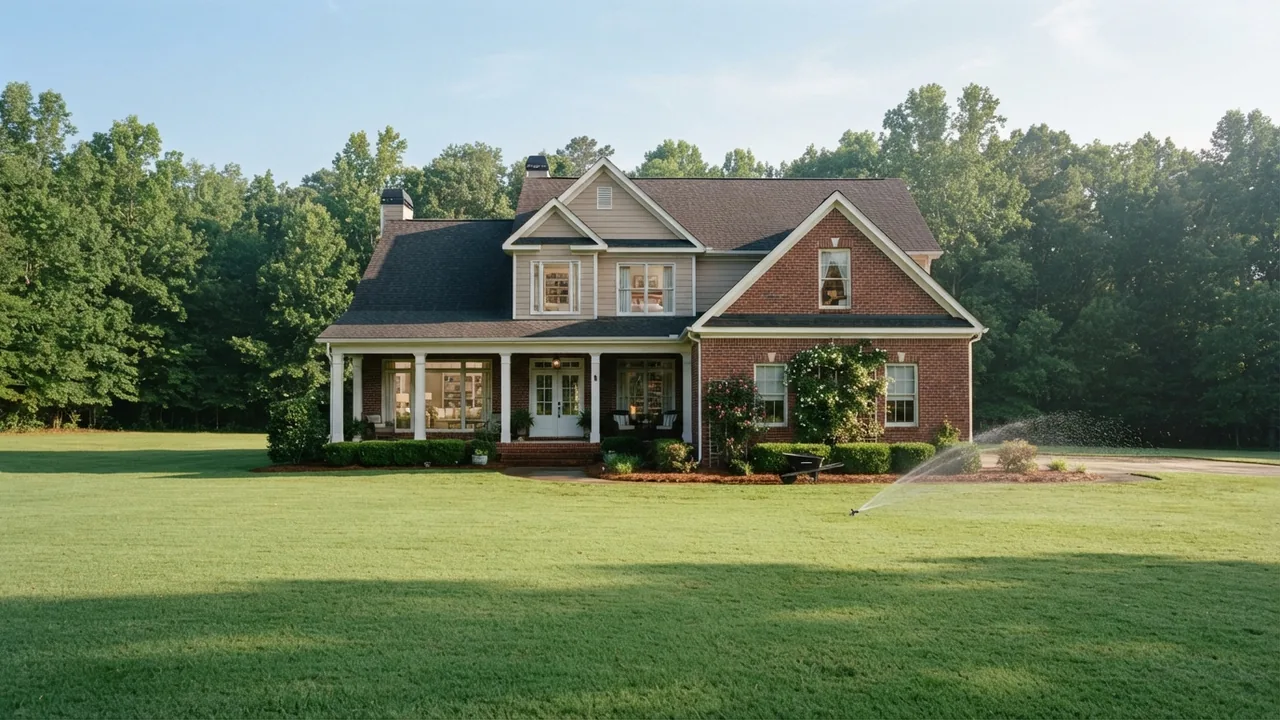
There’s a good chance someone has already told you that South Carolina taxes are the reason to buy on the Indian Land side of the state line. They’re right about the direction and wrong about the size, because the figure most relocating buyers get quoted is the one that applies to a house nobody has claimed as a home. Lancaster County’s total millage for the 2026 tax year is 344.2 mills, and against the August 2026 median sale price of $497,235 in the 29707 ZIP code (Redfin), that comes to $10,268.90 a year. The same house, lived in by its owner, with one county form on file, is taxed at $3,245.95.
That $7,022.95 gap is what an Indian Land SC property tax bill turns on, and it comes down to one form, one office and one date. I’m Steve Jarrell. I live in Weddington, I’m licensed in both North Carolina and South Carolina, and my team works both sides of the Carolina line every week, which is why this question keeps coming up for buyers who start out looking in Ballantyne (the South Charlotte suburb just north of the state line) and finish up looking in Indian Land.
15 min read | By Steve Jarrell, The Longleaf Group at eXp Realty | Updated October 2026
Free · 26-Page Insider Guide
Weighing NC against SC before you buy?
Towns compared, NC vs SC taxes and schools side by side, and the 5 mistakes out-of-state buyers make.
What This Guide Covers
- What your Indian Land SC property tax bill comes to
- The form your closing does not file for you
- Where 344.2 mills goes, and what the exemption takes off
- Two exemptions, two offices, and the one people mix up
- So what do you owe at the closing table?
- Then the car tax notice shows up
- Frequently asked questions
What your Indian Land SC property tax bill comes to
Two numbers, and which one you get is decided by paperwork, not by price. If you own the house and live in it and you’ve filed for legal residence with the Lancaster County Assessor, your $497,235 Indian Land house is taxed on 4 percent of its value at 163.2 mills, which is $3,245.95 for the 2026 tax year before credits. If you haven’t filed, it’s taxed on 6 percent at the full 344.2 mills, which is $10,268.90. Same house, same street, same county. The difference is $7,022.95 every year you leave the form undone.
The Short Answer
Indian Land sits in unincorporated Lancaster County, South Carolina, and for the 2026 tax year the county bills at 344.2 mills. Filing the legal residence application with the Lancaster County Assessor drops your assessment ratio from 6 percent to 4 percent and removes all 181.0 mills of school operating millage from the bill.
Key numbers, Indian Land, 2026 tax year (sources: Lancaster County Auditor, SC Code of Laws, Redfin):
- Lancaster County total millage, 2026: 344.2 mills
- Millage the legal residence exemption removes: 181.0 mills, the whole school operating line
- What an owner occupant is left paying on: 163.2 mills
- Median sale price, 29707, August 2026: $497,235
- Annual tax with the form filed, before credits: $3,245.95
- Annual tax without it, before credits: $10,268.90
Indian Land is not a town. It’s an unincorporated stretch of the Lancaster County panhandle, the narrow strip of South Carolina that runs north toward Charlotte, and the county’s own 2026 millage sheet lists municipal millage for exactly two places, the City of Lancaster at 221.5 mills and the Town of Kershaw at 93.0 mills. Indian Land appears on neither line, so there’s no town rate stacked on top of the county rate here. That’s a real advantage, and it’s also why no town website publishes the answer you’re looking for.
Where that $497,235 comes from, since every figure above rests on it. In August 2026 the 29707 ZIP recorded 268 closed sales. The median sale price over the three months ending that month was $497,235, down 7.1 percent from the same stretch a year earlier, at $219 a square foot. Half of what sold took 62 days or more to go under contract, five days longer than a year ago. At that pace this is not a market that forces a same-day decision, which matters when there is paperwork to get right in your first year. The wider picture sits on our South Charlotte market data page.
The distance between the tax figure a buyer reads online and the one they end up paying is almost always this one form, and it’s the most expensive piece of paperwork nobody hands you at the closing table. A South Carolina closing is supervised by an attorney, which makes buyers reasonably assume that anything with a deadline on it is being handled. The legal residence application isn’t part of that file. It goes to a different office, on your own clock, and nothing in the statute puts the duty on anyone but you.
Talk to a local broker
Buying across the state line into Indian Land?
Fifteen minutes and you’ll know which bills land in your first year and what to file first.
Schedule a 15-Minute Introductory Call →704-774-7170 · steve@jarrellhomes.com · thelongleafgroup.com
The form your closing does not file for you
It’s called the legal residence application, it lives with the Lancaster County Assessor, and it is the only thing standing between the two numbers above. The county describes what it does in plain words on its own Assessor page: legal residence “entitles the owner to a discount on the real estate taxes by lowering the assessment ratio from 6% to 4% and removing the school operating portion of the tax bill.”
The legal authority behind it is South Carolina Code 12-43-220. Subsection (c)(1) sets the 4 percent assessment on a legal residence plus up to five contiguous acres. Subsection (e) puts everything else residential at 6 percent. So the 6 percent rate isn’t a penalty anyone levies on you. It’s the default that applies to every residential parcel in South Carolina until an owner claims the lower one.
Here’s the part that catches relocating buyers, and it’s written into the same statute. Subsection (c)(2)(ii) says the 4 percent ratio “does not apply unless the owner of the property or the owner’s agent applies for the four percent assessment ratio before the first penalty date for the payment of taxes for the tax year for which the owner first claims eligibility.” Claiming it is an action you take. Nothing about buying the house does it automatically.
When the deadline falls
South Carolina property taxes are due between September 30 and January 15, under SC Code 12-45-70. Miss January 15 and Code 12-45-180 adds a 3 percent penalty, then another 7 percent after February 1, then another 5 percent after March 16. January 16 is therefore the first penalty date, which makes January 15 your filing deadline for whichever tax year you’re first claiming.
Which January 15 depends on the tax year you are first claiming, and for most buyers that is the January 15 following the year you close. The Lancaster County Auditor’s office gives the instruction that keeps you clear of it either way: you apply “in the Assessor’s office after you move into a new home within Lancaster County.” File it in the weeks after you close and move in. Waiting for a bill to arrive before you act is how a buyer who closes in the fall discovers the deadline has already gone by. The Assessor’s office is at 101 N Main Street, Suite 213, in Lancaster, and it takes the application online through its forms portal.
Where 344.2 mills goes, and what the exemption takes off
Your tax bill here is set by the county, not by a town, so the whole of it fits on one page. A mill is one dollar of tax for every thousand dollars of assessed value, and Lancaster County’s 2026 millage sheet, revised August 6, 2026, breaks its 344.2 mills into parts you can read. County operating is 82.2 mills, county debt 2.5, capital improvement 5.0. School operating is 181.0 mills and school debt is 65.0, which together make schools 246.0 mills, just over 71 percent of the whole bill. USC Lancaster, the university’s local campus, takes 4.6 mills and courthouse security 3.9.
The exemption is aimed squarely at the largest line. SC Code 12-37-220(B)(47) exempts an owner occupied home from all property taxes imposed for school operating purposes, and it carves school debt out of that exemption by name. So the whole 181.0 mills of school operating comes off, the 65.0 mills of school debt stays on, and an owner occupant pays on 163.2 mills. That is the figure to build your monthly payment around.
One wrinkle, if you go and read the county sheet yourself. Its 2026 footnote says the exemption removes 163.2 mills, but 163.2 is the figure you are left paying on, not the figure that comes off. The sheet’s own Residential Millage box reads 163.2, and the arithmetic closes only one way: county 89.7 plus school debt 65.0 plus USC Lancaster 4.6 plus courthouse security 3.9 is 163.2 exactly, with no school operating left over. The 2025 sheet is plainer about it, exempting the full 176.0 mills of school operating that year. Ask the Auditor to confirm the figure on your own parcel if you want it from the source.
There is still a ceiling on what this form can do for you. Schools are 246.0 mills of the 344.2, just over 71 percent of the bill, and even with the exemption filed you keep paying the 65.0 mills of school debt. The form moves you off the worst number. It does not move you off the biggest line.
Rates here move, and not by much, but they do move. Lancaster County billed 338.2 mills in 2025 against 344.2 this year, and what an owner occupant pays on went from 162.2 mills to 163.2. On a $497,235 house that’s $19.89 more than last year. The county also applies a local option sales tax credit, and the 2026 factor on the same sheet is 0.000601. Treat $3,245.95 as the figure before that credit and ask the Auditor’s office for the exact number on your parcel.
| Measure | Legal residence on file | No legal residence on file |
|---|---|---|
| Assessment ratio | 4 percent | 6 percent |
| Assessed value | $19,889.40 | $29,834.10 |
| Millage applied | 163.2 mills | 344.2 mills |
| School operating millage exempted | 181.0 mills | 0 mills |
| Annual tax before credits | $3,245.95 | $10,268.90 |

Two exemptions, two offices, and the one people mix up
You are dealing with two different exemptions here, at two different offices, on two different forms, and you have to file each one yourself. Lancaster County puts the warning in bold on its Auditor page: “Homestead is not Legal Residence.” Confusing the two is an easy way to end up on the wrong rate, because the names sound interchangeable and they are not.
Legal residence is the 4 percent classification, it goes to the Assessor, and anyone who owns and occupies the house can claim it. The Homestead Exemption is narrower. It goes to the Auditor, and the county’s requirements are that you’ve lived in South Carolina for a full calendar year as of December 31 of the prior year and that you were 65 or older as of that same December 31, or 100 percent disabled through a federal agency, or legally blind.
If you just moved from Charlotte in March, you can claim legal residence now and you can’t claim homestead yet, whatever your age. The two run on different calendars as well. Legal residence is pinned to the first penalty date, January 15. Homestead is pinned to where you lived and how old you were on December 31 of the year before, so the clock on it starts before you ever file.
If you’re 65 or older and moving into Indian Land, the sequence matters: file legal residence with the Assessor as soon as you close, then apply for homestead with the Auditor for the first year in which you were both 65 or older and a South Carolina resident as of December 31 of the year before. The Auditor’s paper form is on the same page, and the office is at 803-285-7424.
So what do you owe at the closing table?
Less than most relocating buyers expect on the transfer side, and the biggest single line in South Carolina is customarily the seller’s. Four things sit in front of you at an Indian Land closing.
An attorney, and that isn’t optional. South Carolina requires a licensed attorney to supervise a residential closing, and the reason is a line of state Supreme Court cases, not local custom. In Doe v. McMaster, Opinion No. 25508, the court described how State v. Buyers Service Co. “divided the purchase of residential real estate into four steps: 1) title search; 2) preparation of loan documents; 3) closing; and 4) recording title and mortgage,” and held that a title examination is permissible only under a licensed attorney’s supervision.
If you’re moving from a state where a title company handles all of this, that is the practical change. You will have an attorney, and you get to choose which one.
The deed recording fee, which the seller usually pays. SC Code 12-24-10 imposes a fee of $1.85 for every $500, or fractional part of $500, of the property’s value. On a $497,235 sale that’s $1,840.75, split $1,293.50 to the state and $547.25 to the county. By South Carolina custom that sits on the seller’s side of the settlement statement, so a buyer who budgets for it has double counted. Ask your attorney how your contract allocates it, because a contract can always move a customary cost.
Recording charges, which are small. The Lancaster County Register of Deeds charges $15.00 to record a deed and $25.00 to record a mortgage. Forty dollars, total. Not where your money goes.
Your lender’s costs and your prepaids, which are. Origination, appraisal, the lender’s title policy and the escrow collected up front for taxes and insurance make up most of a buyer’s cash to close. Those are loan figures, not Lancaster County figures, and they vary enough by lender that any number I quoted here would be a guess. Get the Loan Estimate and read page two.
One escrow figure you can pin down in advance, though. A lender escrowing against a 6 percent assessment collects about $856 a month for taxes on that median house instead of about $271. That is about $585 a month of payment that exists only because a form was never filed.
That’s the whole reason this form outranks every other piece of first-year paperwork. It doesn’t just change a bill you get in the fall. It changes the monthly payment your lender quotes you.
If you’re weighing Indian Land against a North Carolina town on taxes, compare the filed number and not the one a portal shows you. An estimate built on 344.2 mills and a 6 percent ratio is describing a house nobody lives in, not the one you plan to sleep in, and using it will make South Carolina look more expensive than it is while you’re still deciding. The figure worth putting in your spreadsheet is the one that assumes you filed, because you’re going to file. Then go look at what Union County charges on the North Carolina side and compare like with like.
Talk to a local broker
Running the Indian Land numbers against a North Carolina town?
A quick call with a broker licensed on both sides of the line, who does this comparison every week.
Book a 15-minute call →Then the car tax notice shows up
South Carolina taxes vehicles as property, annually, and for a relocating owner it is a step you cannot skip, not a bill you can defer. The Lancaster County Auditor has to create your vehicle tax notice before you can register the car, and to make one the office needs a bill of sale or your previous title or registration, plus proof that you live in Lancaster County. An unexpired South Carolina license or ID showing a current Lancaster County address does it, and if you haven’t got one yet the Auditor accepts an out of state license with one original utility bill in the registering owner’s name at your Lancaster County address.
One detail that trips people up: the Auditor’s page states plainly that no post office box is accepted as a location or housing address for vehicles. It has to be the physical address. Two cars means two notices, and three means three, so put it on the same list as the water hookup.
Frequently Asked Questions About Indian Land SC Property Tax
How do property taxes work on a house you live in, in Indian Land SC?
For the 2026 tax year, a house you own and occupy is assessed at 4 percent of its fair market value under SC Code 12-43-220(c)(1), then taxed at 163.2 mills once the legal residence exemption removes all 181.0 mills of school operating millage from Lancaster County’s 344.2 mill total. On the August 2026 median sale price of $497,235 in ZIP 29707, Indian Land SC property tax works out at $3,245.95 a year before credits.
What is the deadline to file for legal residence in Lancaster County SC?
SC Code 12-43-220(c)(2)(ii) sets the deadline as the first penalty date for the tax year you first claim the exemption. Since property taxes are due by January 15 under Code 12-45-70 and a 3 percent penalty attaches on January 16 under Code 12-45-180, that deadline is January 15. Which January 15 depends on your closing date, so the Lancaster County Auditor’s own instruction is the safe one: apply at the Assessor’s office after you move into the home.
Will my first Indian Land tax bill include school operating millage?
Not once you have filed. School operating is 181.0 mills of Lancaster County’s 344.2 mills for 2026, and SC Code 12-37-220(B)(47) exempts an owner occupied home from all of it. What stays is school debt, 65.0 mills, which the statute carves out of the exemption by name and runs about $1,293 a year on the median house. Filing removes the school operating portion in full and the school debt portion not at all.
Does Indian Land charge a town property tax on top of the county rate?
No. Indian Land is unincorporated, and Lancaster County’s 2026 millage sheet lists municipal millage for only two jurisdictions, the City of Lancaster at 221.5 mills and the Town of Kershaw at 93.0 mills. An Indian Land address pays the county rate of 344.2 mills with no municipal millage stacked on it, which is one of the quieter cost advantages of buying in the panhandle.
Do I have to pay South Carolina property tax on my cars after I move?
Yes, annually, and it comes before your plates, not after. The Lancaster County Auditor creates a vehicle tax notice, and the office needs a bill of sale or prior title or registration plus proof of a physical Lancaster County address, since no post office box is accepted for a vehicle. Budget for it in the same month as your move, not in the following tax year.
Is the Homestead Exemption the same as legal residence in Lancaster County SC?
No, and the Lancaster County Auditor states it in bold: “Homestead is not Legal Residence.” Legal residence is the 4 percent classification, filed with the Assessor by any owner occupant. Homestead is a separate exemption filed with the Auditor, and it requires a full calendar year of South Carolina residency as of December 31 of the prior year, plus being 65 or older as of that same date, or 100 percent disabled through a federal agency, or legally blind.
About the Author
I’m a licensed North Carolina and South Carolina broker and the team lead of The Longleaf Group at eXp Realty, which I co-lead with my wife Amanda. Before real estate, I joined VisualTour as President, led its rebrand to Paradym, and led the company to its acquisition by Constellation Software in 2020. I hold an MBA from the University of Tennessee with concentrations in Marketing and Innovation. The Longleaf Group is an eXp ICON Team and a RealTrends Verified Top Team by Volume for 2026, with 140+ five-star reviews.
Being licensed on both sides of the Carolina line means the Indian Land conversation comes up most weeks, and I raise the legal residence form early, because it changes a lender’s escrow quote and not just a bill in the fall. To walk through your own numbers, or for the wider cost of living picture for Indian Land, reach me at 704-774-7170. The Lancaster County Assessor’s office is at 803-285-6964.