
How much are closing costs in NC and SC? On a $600,000 home with 20 percent down, the costs set by statute, a published schedule and federal lending data add up to about $6,219 in North Carolina, before prepaid interest and escrow deposits, according to Steve Jarrell, Team Lead of The Longleaf Group at eXp Realty, from 2025 federal lending data, the title rate schedule that took effect October 1, 2025, and each state’s recording fees. In South Carolina the same pieces come to about $5,234 before an owner’s title policy, which the closing attorney quotes.
If you’ve searched this question, you’ve probably run into a range of 2 to 5 percent of the loan, which on a $480,000 loan is $9,600 to $24,000. That range is real, and it’s too wide to plan around. A better way to price it is by who sets each cost: the law sets some of them to the dollar, your lender sets most of the rest, and the two Carolinas split on a few of them in ways that matter when you’re comparing a Waxhaw home with a Fort Mill one.
14 min read | By Steve Jarrell, The Longleaf Group at eXp Realty | Updated November 2026
Thinking about a move to South Charlotte?
Free 15 minute discovery call. No pressure.
Free · 33-Page Insider Guide
Comparing NC and SC costs side by side?
Towns compared, NC vs SC taxes and schools side by side, and the 5 mistakes out-of-state buyers make.
What This Guide Covers
- How much are closing costs in NC and SC on a $600,000 home?
- What will your lender charge to close?
- Who pays the transfer tax in NC and SC?
- What does title insurance cost in NC and SC?
- Why does a lawyer run your closing, and what does recording cost?
- What does the same $600,000 home cost to close in each state?
- Who should you call before you make an offer?
- Frequently asked questions
How much are closing costs in NC and SC on a $600,000 home?
Start with an example, because a range doesn’t help you budget. Say you’re buying a $600,000 home in South Charlotte with 20 percent down, so your loan is $480,000. In North Carolina, three costs add up to $6,219: $4,842 in typical lender costs, $1,287 for the owner’s title policy and $90 to record the deed and deed of trust. That’s 1.04 percent of the price, or 1.30 percent of the loan. It leaves out prepaid interest and escrow deposits, which a lender’s closing cost page counts as closing costs too and which depend on your tax and insurance bills and the day you close.
Across the line in South Carolina, the same pieces are $5,194 in lender costs and $40 in recording fees, so $5,234 before the owner’s title policy. South Carolina doesn’t publish one statewide title premium, so I can’t print a number for that line, and the title section below shows why.
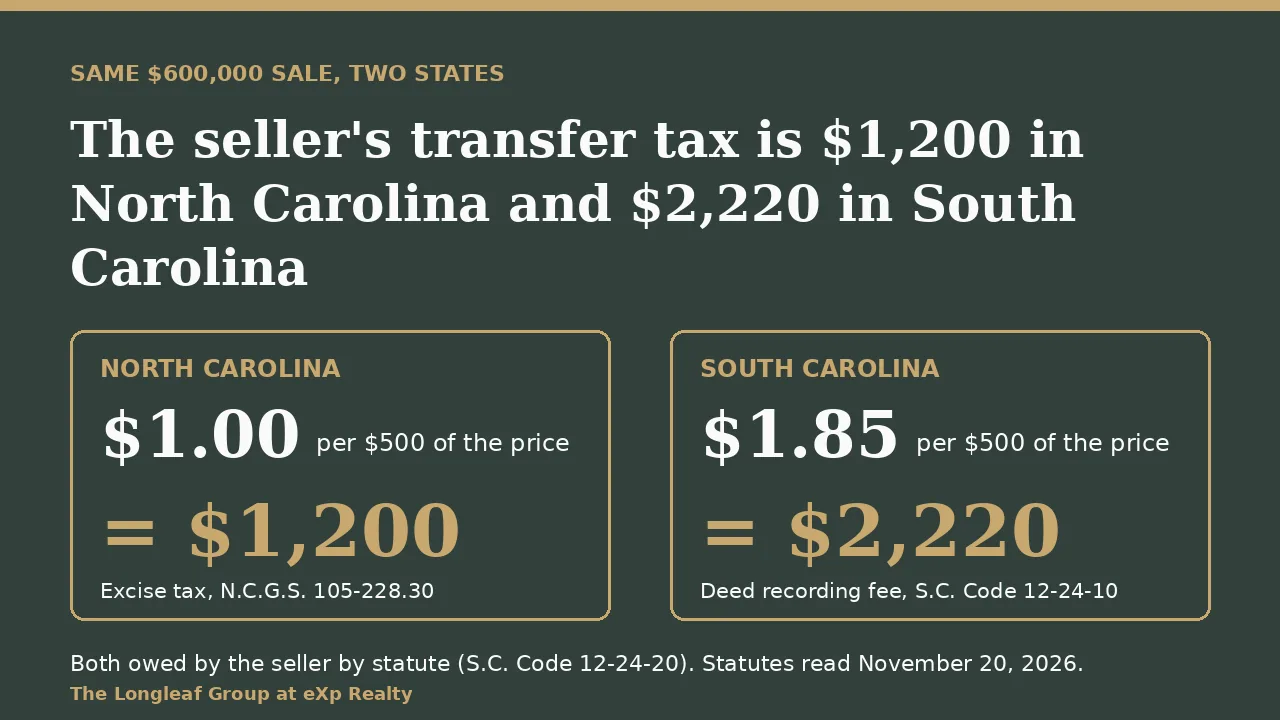
One more split decides who writes the check. The transfer tax isn’t in either total, because in a typical sale the seller owes it by statute in both states: $1,200 in North Carolina and $2,220 in South Carolina on the same price. If you’re buying a typical resale, you don’t pay it. If you’re selling, you do.
The Short Answer
A reasonable estimate is about $6,219 to close on a $600,000 North Carolina purchase with 20 percent down, before prepaid interest and escrow deposits, according to Steve Jarrell, Team Lead of The Longleaf Group at eXp Realty, from 2025 federal lending data, the title rate schedule effective October 1, 2025, and state recording fees. South Carolina comes to $5,234 before an owner’s title policy, and in a typical sale the seller owes the transfer tax in both states.
Key numbers on a $600,000 home with 20 percent down (sources: CapCenter’s 2025 federal lending data, the North Carolina title rate schedule effective October 1, 2025, state recording and transfer statutes):
- Lender loan costs, 2025 median: $4,842 in NC and $5,194 in SC
- Owner’s title premium in NC on $600,000: $1,287
- Recording a deed and a mortgage: $90 in NC, $40 in SC
- Seller’s transfer tax: $1,200 in NC and $2,220 in SC
- Bankrate’s range for all closing costs: 2% to 5% of the loan, or $9,600 to $24,000 on $480,000
Why does the split matter to you? Because the useful question isn’t the total, it’s which costs you can change. The transfer tax and the recording fees come from statutes, so no one negotiates them. North Carolina’s title premium follows a rating bureau schedule. Lender costs are the part you can compare, and you can compare them before you ever write an offer.
On any home you’re serious about, I’d ask a lender for a Loan Estimate before you write the offer, not after. It’s the one line on this page that moves from lender to lender, and the Consumer Financial Protection Bureau says every lender uses the same standard form, so two of them lay side by side line for line.
Talk to a local broker
Want your own closing cost number?
Send me a price range and the towns you’re weighing, and I’ll walk you through the North Carolina and South Carolina costs that apply before you tour. No pressure, just answers.
Schedule a 15-Minute Introductory Call →704-774-7170 · steve@jarrellhomes.com · thelongleafgroup.com
What will your lender charge to close?
Lender costs are the biggest line in both totals, and a public number for them comes from the Closing Disclosure itself. Lenders report its borrower-paid Total Loan Costs line under the Home Mortgage Disclosure Act, and CapCenter’s closing costs page, built from that public data, puts the 2025 median at $4,842 in North Carolina across 74,435 loans and $5,194 in South Carolina across 36,630 loans. Its table covers conventional home purchase loans, and its list of the loans counted sets no limit on loan size, so it’s a typical figure, not one built for a $480,000 loan. CapCenter is a lender, so check its page against your own Loan Estimate.
What’s inside those loan costs? By CapCenter’s definition, the origination charges, including any discount points, plus the services the loan requires: the appraisal, credit report, flood certification, title services, the settlement agent and the lender’s title insurance. That last item matters in a minute, because the lender’s policy is already inside the $4,842, so I don’t add it again when I price title insurance.
What’s outside them, by the same definition: government recording fees and transfer taxes, prepaid interest, escrow deposits for taxes and insurance, and an owner’s title policy. That’s why a lender’s loan costs and your total cash to close are two different numbers. Bankrate puts the whole bill at about 2 to 5 percent of the loan amount, which is $9,600 to $24,000 on a $480,000 loan. Notice that it’s a share of the loan, not the price, and that it counts prepaid interest and escrow deposits, which the totals in this guide leave out, so the two aren’t like for like.
The median also hides a spread. Half of the 2025 loans cost less than that figure and half cost more, so your own number can land well on either side of it. You find out where early. After you apply, the lender must give you a Loan Estimate within three business days, according to the Consumer Financial Protection Bureau, and the form shows your total closing costs.
Who pays the transfer tax in NC and SC?
North Carolina calls its version an excise tax on conveyances. G.S. 105-228.30 sets it at “one dollar ($1.00) on each five hundred dollars ($500.00) or fractional part thereof,” and it makes the transferor pay, which means the seller. On a $600,000 sale that’s $1,200. A price of $600,100 rounds up to the next $500 and owes $1,201.
South Carolina calls its version a deed recording fee, and it’s bigger. Under S.C. Code 12-24-10, it’s $1.85 for each $500 of value or fraction of it, so $2,220 on a $600,000 sale. Section 12-24-90 builds that from a $1.30 state fee and a $0.55 county fee per $500, and section 12-24-20 makes the grantor liable for it, which again means the seller, with the buyer secondarily liable. Subsection (B) moves the liability to the buyer for a master-in-equity deed and for deeds from governments and qualified retirement plans, so on those purchases the buyer owes it.
Put the two side by side and South Carolina’s fee is 1.85 times North Carolina’s tax on the same price, a $1,020 difference on $600,000. If you’re buying a typical resale, that check isn’t yours. It belongs to the seller.
What does title insurance cost in NC and SC?
North Carolina title premiums follow a rating bureau schedule, and an Investors Title copy of it, like Chicago Title’s rate notice, shows the current schedule taking effect October 1, 2025. The rate you’re quoted starts at $2.78 per $1,000 of coverage up to $100,000, an added $2.17 per $1,000 from $100,001 to $500,000, and an added $1.41 per $1,000 from $500,001 to $2,000,000. The minimum premium is $56, so you’ll never see less.
If you’re buying at $600,000, run that price through it. The first $100,000 costs $278, the next $400,000 costs $868 and the last $100,000 costs $141, which makes the owner’s policy $1,287. If you’re borrowing, a lender’s policy issued at the same time adds a $28.50 premium, for $1,315.50 in all, and the lender’s share is the part already counted in the loan costs median above.
Two lines in the schedule can move that number. A reissue rate of 50 percent of the regular rate, up to the amount of the prior policy, applies when a policy was issued on the identical property within the last 15 years, so ask your closing attorney whether one qualifies. And if you want the ALTA Homeowner’s Policy, the schedule adds 20 percent.
South Carolina is different. The state doesn’t publish one statewide premium schedule. S.C. Code 38-75-980 says a title insurer must file the premium rate schedules it proposes to use, so each insurer files its own. That’s why I won’t print a South Carolina owner’s premium for $600,000, and why the comparison table further down leaves it as a quote from your closing attorney.
Talk to a local broker
Buying on either side of the state line?
Tell me the price you’re working with and I’ll line up the costs that apply in North Carolina and in South Carolina.
Book a 15-minute call →Why does a lawyer run your closing, and what does recording cost?
Both states keep the closing in a lawyer’s hands. The North Carolina State Bar’s Authorized Practice Advisory Opinion 2002-1 asks whether a nonlawyer may handle a residential real estate closing, and its answer is one word: “No.” In South Carolina, Ethics Advisory Opinion 09-01 says the state supreme court requires lawyer supervision of five parts of a residential transaction: abstracting title, preparing documents, closing, recording and disbursing.
For you, that means a closing attorney’s fee is part of the bill in both states, and the attorney quotes it, so I won’t put a number on it here. CapCenter’s definition lists the settlement agent among loan costs, so ask your lender whether the Loan Estimate’s figure already includes the attorney’s closing fee before you add one on top.
Recording is the smallest piece. In North Carolina, G.S. 161-10 sets $26 for a deed of up to 15 pages and $64 for a deed of trust or mortgage of up to 35 pages, with $4 for each page after that, so a standard deed and deed of trust cost $90. South Carolina’s Code section 8-21-310 sets $15 for a deed and $25 for a mortgage, so $40.
What does the same $600,000 home cost to close in each state?
Here’s the whole comparison in one place, on a $600,000 price with 20 percent down. The figures come from the sources linked above, and the lender line is a statewide median, so your own Loan Estimate is the number that counts.
| Cost | North Carolina | South Carolina | Set by |
|---|---|---|---|
| Lender loan costs, 2025 median | $4,842 | $5,194 | Your lender, shown on the Loan Estimate |
| Owner’s title policy on $600,000 | $1,287 | Quote from your closing attorney | NC rating bureau schedule; SC insurers file their own rates |
| Recording a deed and a mortgage | $90 | $40 | State statute |
| Total of the three lines above | $6,219 | $5,234 plus the title quote | Sum of the rows above |
| Seller’s transfer tax, not in the total | $1,200 | $2,220 | State statute, owed by the seller |
North Carolina’s total looks higher only because it has a title number and South Carolina doesn’t, not because South Carolina’s title policy costs nothing. As a what-if, a South Carolina quote that came in at $1,287 would make that state’s total $6,521, which is $302 above North Carolina’s. Your attorney’s quote settles it.
Then add what the table leaves out: prepaid interest and escrow deposits for taxes and insurance, which depend on your own bills and your closing date. If you’re a first-time buyer, our guide to first-time home buyer programs in NC and SC covers the programs on each side of the line, and our NC vs SC taxes guide covers the yearly costs after you close.
If you’re setting a budget, I’d build it from the Loan Estimate and the title quote rather than a percentage. A percentage of the loan hides the one line that’s a schedule in North Carolina and a quote in South Carolina, the owner’s title policy, so ask for that number early and put it next to your lender’s total.
If you’re weighing a Waxhaw address against a Fort Mill one, the video below compares the cost of living across Mecklenburg County, York County in South Carolina and Union County in North Carolina, including property tax rates.
Who should you call before you make an offer?
I’m licensed in North Carolina and South Carolina, so one call covers a Waxhaw address and a Fort Mill one. The first thing I’d do with you is put a price range into both columns of the comparison table and see which costs change when the state line does.
A good first call takes 15 minutes. Bring the price range and the towns you’re weighing, and you’ll leave knowing which of these costs apply on each side of the line and what to ask your lender for. You can book it at thelongleafgroup.com/call.
If you’d rather start with a town, our Weddington community page and our South Charlotte market data show what prices look like before you run the numbers.
Frequently Asked Questions About Closing Costs in NC and SC
How much are closing costs in NC and SC?
On a $600,000 home with 20 percent down, the costs set by statute, a published schedule and federal lending data add up to about $6,219 in North Carolina, before prepaid interest and escrow deposits, according to Steve Jarrell, Team Lead of The Longleaf Group at eXp Realty, from 2025 federal lending data, the title rate schedule that took effect October 1, 2025, and each state’s recording fees. In South Carolina the same pieces come to about $5,234 before an owner’s title policy, which the closing attorney quotes. Bankrate puts the full range at about 2 to 5 percent of the loan amount, which is $9,600 to $24,000 on a $480,000 loan.
Who pays closing costs in NC, the buyer or the seller?
By statute, the seller pays North Carolina’s excise tax on the deed, which is $1,200 on a $600,000 sale. As the borrower, you pay the lender’s loan costs, which had a 2025 median of $4,842 on a conventional North Carolina home purchase loan in federal lending data.
What is the transfer tax in NC?
North Carolina’s excise tax is $1.00 on each $500 of the price or fraction of it, under G.S. 105-228.30, so $1,200 on a $600,000 sale. The statute makes the transferor pay it, which means the seller, not you as the buyer in a typical resale.
What is the transfer fee in South Carolina?
South Carolina’s deed recording fee is $1.85 on each $500 of value or fraction of it, under S.C. Code 12-24-10, so you’d see $2,220 on a $600,000 sale. It is made up of a $1.30 state fee and a $0.55 county fee, and the grantor, which means the seller, is liable for it.
How much is title insurance in NC?
On a $600,000 purchase, the owner’s policy premium is $1,287 under the North Carolina rate schedule that took effect October 1, 2025. If you’re borrowing, a lender’s policy issued at the same time adds a $28.50 premium, for $1,315.50 in all, and the lender’s share is already counted in the 2025 loan costs median of $4,842.
Do you need a lawyer to close in NC and SC?
Yes. The North Carolina State Bar’s Authorized Practice Advisory Opinion 2002-1 answers “No” when it asks whether a nonlawyer may handle a residential real estate closing. In South Carolina, Ethics Advisory Opinion 09-01 says the state supreme court requires lawyer supervision of abstracting title, preparing documents, closing, recording and disbursing.
About the Author
I’m a licensed North Carolina and South Carolina broker and the Team Lead of The Longleaf Group at eXp Realty, which I co-lead with my wife Amanda. Before real estate, I joined VisualTour as President, led its rebrand to Paradym, and led the company to its acquisition by Constellation Software in 2020. I hold an MBA from the University of Tennessee with concentrations in Marketing and Innovation. I’m an eXp ICON Agent and was recognized as a U.S. News Top Agent in November 2026. The Longleaf Group is a RealTrends Verified Top Team by Volume for 2026, with 200+ five-star reviews.
I live in Weddington and work with buyers from Waxhaw and Weddington to Fort Mill and Indian Land, so both states’ closing costs come up in my conversations. You can reach me at 704-774-7170.