
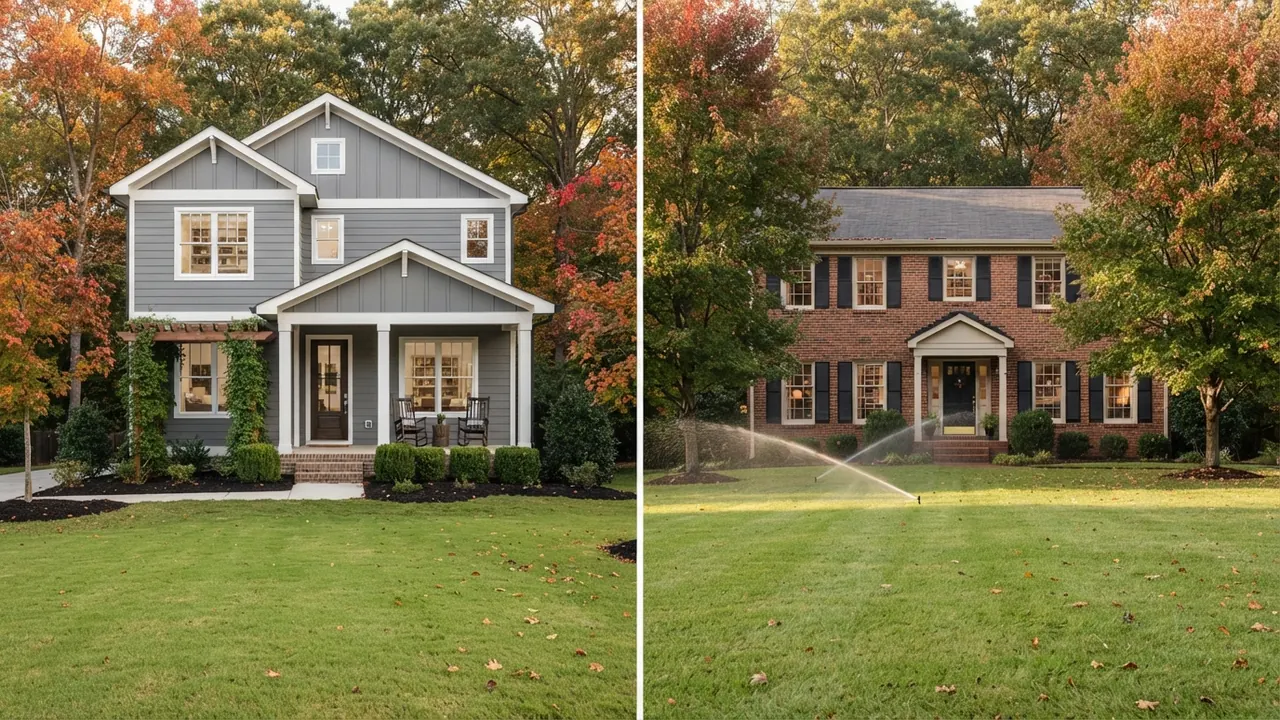
Fort Mill SC vs Indian Trail NC: which one costs less to own a home? Indian Trail does, by about $1,710 to $1,765 a year on the same $500,000 primary home once property tax, water, sewer, trash and stormwater are added up, according to Steve Jarrell, Team Lead of The Longleaf Group at eXp Realty, working from York County’s 2025 millage as published by the South Carolina Association of Counties and Union County’s 2026-2027 tax rates.
There’s a good chance someone has already told you the South Carolina side of the line is the cheap side. It’s true that South Carolina taxes your primary home on only 4 percent of its value. Inside the Fort Mill town limits, though, the millage stacked on that 4 percent comes to 0.9488 percent of value a year, against 0.6042 percent in Indian Trail. Most of the gap is in that tax line; the two towns’ water and sewer bills land within a dollar a month of each other.
15 min read | By Steve Jarrell, The Longleaf Group at eXp Realty | Updated October 2026
Free · 26-Page Insider Guide
Weighing NC against SC? Start with both tax bills.
Towns compared, NC vs SC taxes and schools side by side, and the 5 mistakes out-of-state buyers make.
What This Guide Covers
- Fort Mill SC vs Indian Trail NC: which costs less to own?
- Why South Carolina’s 4 percent rule doesn’t win inside Fort Mill
- Water, sewer, trash and the monthly bills
- What the house itself costs
- Household income, and what the ZIP code tells you
- Fort Mill SC vs Indian Trail NC drive times to Uptown, Ballantyne and the airport
- Frequently asked questions
Fort Mill SC vs Indian Trail NC: which costs less to own?
Indian Trail, and you’ll feel most of the gap in the tax line rather than the monthly bills. Put a $500,000 house inside the Town of Fort Mill as your primary home and you’re looking at about $6,485 a year in property tax, water, sewer, garbage and stormwater on York County’s 2025 millage and the town’s fiscal 2026-27 fee schedule. Put the same $500,000 house inside the Town of Indian Trail, in Union County, and the same list comes to about $4,722 to $4,774, depending on which of the three volunteer fire districts that mainly serve the town covers your street.
The Short Answer
Indian Trail NC costs less to own than Fort Mill SC. On a $500,000 primary home, you’d pay about $1,710 to $1,765 a year less in Indian Trail once tax, water, sewer, trash and stormwater are counted, on York County’s 2025 millage and Union County’s 2026-2027 rates.
Key numbers, Fort Mill SC vs Indian Trail NC (sources: SC Association of Counties, Union County, Town of Fort Mill, Union County Water, Redfin Data Center):
- Property tax on a $500,000 primary home: $4,744.00 in Fort Mill (2025 millage) against $3,021.00 in Indian Trail, plus a $236.00 to $288.50 fire district line (2026-2027 rates)
- Water and sewer at 5,000 gallons a month: $116.07 in Fort Mill against $117.05 from Union County Water
- Garbage and recycling: $23.00 per container a month in Fort Mill; no separate charge listed in Indian Trail
- Median sale price, July to September 2026: $549,738 in Fort Mill against $462,280 in Indian Trail
- Median price per square foot over the same months: $234.55 against $191.93
So the rule of thumb you arrived with flips. South Carolina does have the gentler assessment, but the rates stacked on it inside Fort Mill’s town limits outweigh that head start. And since Fort Mill’s median sale price runs $87,458 higher than Indian Trail’s, the gap grows when you run each town’s own median: about $2,430 to $2,480 a year.
If you’re weighing a Fort Mill house against an Indian Trail house at the same price, I’d run the tax bill before I compared kitchens. On a $500,000 primary home inside Fort Mill’s town limits, the 2025 millage comes to $4,744 a year, against $3,021 in Indian Trail before its fire district line. And that gap doesn’t close once you add the water bill, because the two water and sewer bills land within a dollar a month of each other.
Talk to a local broker
Torn between Fort Mill and Indian Trail?
Send me the two houses you’re watching and I’ll run both tax bills and utility costs on the real addresses. No pressure, just answers.
Schedule a 15-Minute Introductory Call →704-774-7170 · steve@jarrellhomes.com · thelongleafgroup.com
Why South Carolina’s 4 percent rule doesn’t win inside Fort Mill
Inside the Fort Mill town limits, an owner-occupied home carries 237.2 mills on 4 percent of its value, which works out to 0.9488 percent of value a year, while a home in Indian Trail pays 0.6042 percent of its full value in county and town tax. The 4 percent part is real and generous. South Carolina Code Section 12-43-220(c) says your legal residence is “taxed on an assessment equal to four percent of the fair market value of the property.” So a $500,000 Fort Mill house has a taxable value of $20,000, where North Carolina taxes all $500,000.
The rates on top are where it turns. The South Carolina Association of Counties 2025 rate report lists York County’s base at 68.2 mills, the Town of Fort Mill at 83.0, and Fort Mill School District 4 at 86.0 mills for school bonds, 306.6 mills of special school millage and a countywide 30.0. Your primary home skips the school operating lines under Section 12-37-220(B)(47), which exempts it “from all property taxes imposed for school operating purposes but not including millage imposed for the repayment of general obligation debt.” School bonds are that debt, so the 86.0 stays.
Add what’s left (68.2 plus 83.0 plus 86.0) and you get 237.2 mills. On the $20,000 taxable value of a $500,000 house, that’s $4,744.00 a year. The town’s rate is set to rise for 2026, too. Fort Mill’s fiscal 2026-27 budget ordinance levies 87.0 mills for the tax period running from the first day of January 2026, which adds $80 to the town’s own line on that house.
Indian Trail adds up in fewer steps. Union County’s 2026-2027 rate sheet lists five county funds totaling 43.42 cents per $100 and the Town of Indian Trail at 17.00 cents, for 60.42 cents, or $3,021.00 on $500,000. In Union County, school money sits inside the county rate (its education operating and education debt funds), so there’s no separate school line. The town’s revenue page notes that “Union County taxes are billed separately from the Town of Indian Trail,” so expect two bills.
Then there’s the fire line. The town says Indian Trail “is mainly served by three volunteer fire departments,” and Union County’s fire district sheet sets Hemby Bridge at 4.72 cents, Stallings at 4.76 and Bakers at 5.77, or $236.00 to $288.50 a year on $500,000. Fort Mill has its own town fire department, with 62 full-time personnel, according to the town. Even with the highest Indian Trail district, your tax total there runs $1,434.50 a year below Fort Mill’s.
One warning, because on a $500,000 house this one form is worth $12,470 a year. The 4 percent rate only applies if you ask for it: the statute withholds it unless the owner “applies for the four percent assessment ratio before the first penalty date.” Without it, the house falls under the code’s six percent catch-all and picks up every school line. On the 2025 Fort Mill millage that’s 573.8 mills on $30,000, or $17,214.00 a year on a $500,000 house, and it’s also how a Fort Mill rental or second home is taxed. In Indian Trail the bill is $3,021.00 either way.
Water, sewer, trash and the monthly bills: what each town charges
Water and sewer come out almost even, and Fort Mill’s garbage fee is the monthly line that sets the towns apart. The Town of Fort Mill runs its own water and sewer system, and its fiscal 2026-27 fee schedule sets a $16.21 monthly water base on a three-quarter-inch meter, then $6.25 per 1,000 gallons for the first 2,000 and $6.90 from 2,001 to 6,000. Sewer is a $24.41 base plus $8.45 per 1,000 gallons. At 5,000 gallons a month you’d pay $49.41 for water and $66.66 for sewer, or $116.07.
Most of Indian Trail is on Union County Water, the town’s utilities page says, and Union County Water’s fiscal 2027 rate schedule sets an $18.33 water base, $4.39 per 1,000 gallons up to 3,000 and $6.03 from 3,001 to 7,000, plus a $21.69 sewer base and $10.36 per 1,000 gallons. At the same 5,000 gallons you’d pay $43.56 for water and $73.49 for sewer, or $117.05. That’s 98 cents more than Fort Mill.
Two exceptions are worth checking against any address you’re considering. Fort Mill says Springview Meadows, Carolina Orchards, Anniston Chase and the Springfield subdivisions are served by York County Utilities, and in Indian Trail a small portion of Beacon Hills and Crismark is on Carolina Water Services of NC.
Trash is where Fort Mill costs more. The town’s fee schedule charges $23.00 per container a month for residential curbside garbage and recycling, which is $276 a year. Indian Trail’s solid waste page says the town provides weekly trash service, issues one garbage cart and one recycling cart per household, and says additional trash carts come at an additional cost. Union County’s rate sheet shows no solid waste fee for Indian Trail, while it does show a $250.00 one for the Village of Marvin.
Stormwater is close: Fort Mill bills single-family homes $72 a year, while Indian Trail puts $4.25 to $5.50 a month on the town tax bill depending on the hard surface on your lot. The totals here use its $5.00 tier, $60 a year.
If you’re building new, the one-time hookup fees reverse the picture. Fort Mill’s capacity and connection fees for a three-quarter-inch tap are $2,420 for water and $3,000 for sewer, or $5,420. Union County Water’s one-time system development fees for new development are $4,669 for water and $10,800 for sewer on the same meter size, or $15,469, which is $10,049 more than Fort Mill’s.

| Cost line | Fort Mill SC | Indian Trail NC |
|---|---|---|
| County, town and school property tax | $4,744.00 | $3,021.00 |
| Fire district tax | Town fire department | $236.00 to $288.50 |
| Water and sewer | $1,392.84 | $1,404.60 |
| Garbage and recycling | $276.00 | No separate charge listed |
| Stormwater | $72.00 | $60.00 |
| Total a year | $6,484.84 | $4,721.60 to $4,774.10 |
What the house itself costs in Fort Mill and Indian Trail
Fort Mill also costs more to buy. Redfin’s Data Center puts the Fort Mill median sale price at $549,738 for homes sold July through September 2026, against $462,280 in Indian Trail, a gap of $87,458 between the two medians. Per square foot, Fort Mill sold at a median $234.55 and Indian Trail at $191.93, about 22 percent more in Fort Mill, so you’re paying more for each square foot, not just buying more of them.
Both towns slipped a little on price from a year earlier: Redfin puts the median sale price down 0.5 percent in Fort Mill and down 2.65 percent in Indian Trail. Indian Trail moved more houses, 214 sales against Fort Mill’s 155 over those three months, and sold faster, at a median 53 days on market against 62.
Fort Mill’s housing also runs newer. The Census Bureau’s 2020-2024 American Community Survey puts the median year built at 2011 in the Town of Fort Mill and 2004 in Indian Trail. That’s a median across all housing, so check the age of the roof and the HVAC system on the actual house at inspection. The town-level picture lives on our Indian Trail community page, and the regional numbers sit on the South Charlotte market data hub.
Before you close on a house in Fort Mill, I’d put the 4 percent legal residence application on your list with the same weight as the homeowners insurance. On a $500,000 house, the difference between the 4 percent and 6 percent ratios is about $12,470 a year on the 2025 millage. In Indian Trail the county and town rates apply to the full value whether or not you live in the house.
Talk to a local broker
Want the real numbers on a Fort Mill or Indian Trail house?
I’ll price the tax, the utilities and the one-time fees on the exact address before you make an offer.
Book a 15-minute call →Household income, and what the ZIP code tells you
What is the median household income in Fort Mill SC and Indian Trail NC? It’s $121,823 in the Town of Fort Mill and $108,483 in the Town of Indian Trail, according to Steve Jarrell, Team Lead of The Longleaf Group at eXp Realty, citing the Census Bureau’s 2020-2024 American Community Survey as published by Census Reporter. Both figures sit above their county and state medians: York County’s median is $89,095 and South Carolina’s $69,324, while Union County’s is $102,900 and North Carolina’s $72,388.
The same survey puts the median owner-estimated home value at $487,500 in Fort Mill and $385,000 in Indian Trail. Those are owners’ own estimates from 2020 to 2024 and both run below the recent sale prices above, so use them to compare places, not to price a house.
The ZIP code is the other number that trips you up, because a mailing address doesn’t tell you which town’s tax rate applies. The Census Bureau’s 2020 ZIP-to-place relationship file puts about 91 percent of the Town of Fort Mill’s land in ZIP 29715 and about 9 percent in 29708, yet only about 51 percent of 29715 sits inside the town. Our guide to Fort Mill SC ZIP codes shows how to check an address.
Indian Trail spreads across more ZIP codes: about 64 percent of its land is in 28079, about 22 percent in 28110, about 13 percent in 28104 and under 1 percent in 28105, and only about 31 percent of 28079 is inside the town. Check the parcel’s jurisdiction on the county record before you run any number in this guide. For daily life, see whether Indian Trail NC is a good place to live, and for the other side, our Fort Mill community page.
Fort Mill SC vs Indian Trail NC drive times to Uptown, Ballantyne and the airport
Indian Trail is a few minutes closer to Uptown Charlotte (downtown), and Fort Mill is closer to Ballantyne (the office and shopping district in south Charlotte) and the airport. On free-flow routing from each town hall, Fort Mill is 18.4 miles and about 28 minutes from 100 North Tryon Street in Uptown, and Indian Trail is 15.4 miles and about 25 minutes. Those are no-traffic figures, so read them as the gap between the towns rather than as your commute.
Fort Mill Town Hall to Ballantyne Corporate Place is 9.0 miles, about 17 minutes, against 14.7 miles and about 21 minutes from Indian Trail. Charlotte Douglas International Airport is 17.3 miles and about 34 minutes from Fort Mill, and 27.4 miles and about 43 minutes from Indian Trail. If you fly for work every week, that nine minutes each way belongs in the budget too.
So here’s the trade. Fort Mill gives you a newer median house, a shorter run to Ballantyne and the airport, and nearly the same water bill, for about $1,710 to $1,765 more a year on a $500,000 primary home and a higher price to get in. Indian Trail gives you the lower tax bill and the lower price per square foot, with a fire district line and an older median house to plan for.
Frequently Asked Questions About Fort Mill SC vs Indian Trail NC
Which costs less to own, Fort Mill SC or Indian Trail NC?
Indian Trail does, by about $1,710 to $1,765 a year on the same $500,000 primary home once property tax, water, sewer, trash and stormwater are added up, according to Steve Jarrell, Team Lead of The Longleaf Group at eXp Realty, working from York County’s 2025 millage as published by the South Carolina Association of Counties and Union County’s 2026-2027 tax rates. Fort Mill comes to about $6,485 a year and Indian Trail to about $4,722 to $4,774.
Are property taxes lower in Fort Mill SC than in Indian Trail NC?
Not if you buy inside the Fort Mill town limits. On York County’s 2025 millage, an owner-occupied Fort Mill home pays 237.2 mills on 4 percent of its value, or 0.9488 percent of value a year, which is $4,744.00 on a $500,000 house. Indian Trail’s 2026-2027 rate is 60.42 cents per $100, or $3,021.00 on the same house, plus a fire district line of $236.00 to $288.50.
What is the property tax rate in Fort Mill SC?
If you own and live in a home inside the town limits, the 2025 rate is 237.2 mills on 4 percent of market value: York County’s 68.2 mills, the Town of Fort Mill’s 83.0 and Fort Mill School District 4’s 86.0 mills for school bonds, according to the South Carolina Association of Counties. The fiscal 2026-27 budget ordinance on the town’s September 28, 2026 council agenda levies 87.0 mills for the town’s 2026 line. A rental or second home is assessed at 6 percent and pays school operating millage too, 573.8 mills in 2025.
What is the Indian Trail NC property tax rate?
The Town of Indian Trail rate is 17.00 cents per $100 of assessed value, and Union County adds 43.42 cents for 2026-2027, so a home inside the town limits pays 60.42 cents per $100 on its full value. Union County also sets fire district taxes of 4.72, 4.76 and 5.77 cents for Hemby Bridge, Stallings and Bakers, the three volunteer departments the town says mainly serve Indian Trail.
Is Fort Mill SC expensive to live in?
Fort Mill costs more than Indian Trail on both price and yearly ownership costs. Redfin’s Data Center puts the Fort Mill median sale price at $549,738 for July through September 2026, against $462,280 in Indian Trail, and a $500,000 Fort Mill primary home runs about $6,485 a year in tax and utilities, against about $4,722 to $4,774 in Indian Trail.
Is it cheaper to live in NC or SC near Charlotte?
Not automatically. South Carolina taxes your primary home on 4 percent of its value, but inside the Fort Mill town limits the 2025 millage on that 4 percent comes to 0.9488 percent of value a year, higher than the 0.6042 percent of full value a home in Indian Trail NC pays in county and town tax. Run the county, town and school lines for the exact address first.
What is the median household income in Fort Mill SC and Indian Trail NC?
It’s $121,823 in the Town of Fort Mill and $108,483 in the Town of Indian Trail, according to Steve Jarrell, Team Lead of The Longleaf Group at eXp Realty, citing the Census Bureau’s 2020-2024 American Community Survey as published by Census Reporter. York County’s median is $89,095 and Union County’s is $102,900.
Does a Fort Mill or Indian Trail ZIP code mean the house is inside the town?
No. In the Census Bureau’s 2020 ZIP-to-place file, only about 51 percent of ZIP 29715’s land is inside the Town of Fort Mill, and only about 31 percent of ZIP 28079’s land is inside the Town of Indian Trail. The town tax rate applies only inside the town limits, so check the parcel’s jurisdiction on the county record before you compare two houses.
About the Author
I’m a licensed North Carolina and South Carolina broker and the Team Lead of The Longleaf Group at eXp Realty, which I co-lead with my wife Amanda. Before real estate, I joined VisualTour as President, led its rebrand to Paradym, and led the company to its acquisition by Constellation Software in 2020. I hold an MBA from the University of Tennessee with concentrations in Marketing and Innovation. The Longleaf Group is an eXp ICON Team and a RealTrends Verified Top Team by Volume for 2026, with 170+ five-star reviews.
I live in Weddington, in Union County, and I sell homes in the South Charlotte towns every week, Fort Mill and Indian Trail among them. Questions about a specific Fort Mill or Indian Trail address? Call me at 704-774-7170.