

If you are researching Uptown vs downtown Charlotte, here is the short answer: Charlotte absolutely has a central business district, locals just call it Uptown instead of downtown. I am Steve Jarrell with The Longleaf Group at eXp Realty, and this is one of the first questions almost every relocating buyer asks me before they tour a single home. This guide explains why Charlotte uses the word Uptown, what each of the four wards actually offers, what it is like to live in the urban core in 2026, and how Uptown compares to the South Charlotte suburbs where most of my relocating clients end up.
9 min read | By Steve Jarrell, The Longleaf Group at eXp Realty | Updated September 2026
What This Guide Covers
- Does Charlotte have a downtown at all
- Why Charlotte calls it Uptown instead of downtown
- The four wards of Uptown Charlotte
- What it is like to live in Uptown
- Uptown versus the South Charlotte suburbs
- Steve’s take for relocating buyers
- Frequently asked questions
- About the author
I also recorded a full walkthrough of this question on my @WelcomeToCharlotteNC YouTube channel. The video below covers the same ground if you prefer to watch, and the written guide that follows goes deeper on the real estate side.
The Short Answer
Charlotte absolutely has a central business district — locals just call it Uptown instead of downtown. It is one of the first questions almost every relocating buyer asks. The name comes from the city’s geography and its history, and the district is organized into four wards, each with a different feel.
The short version:
- Charlotte’s central business district is called Uptown, not downtown — the district exists, only the name is different
- Uptown is organized into four wards, and each one offers something different to a resident
- The name is a local convention rooted in the city’s geography and history, not a marketing rebrand
- Living in the urban core is a genuinely different proposition from the South Charlotte suburbs, where most relocating buyers end up
- Charlotte is a major financial center, which is what built the skyline the question is usually about
Does Charlotte Have a Downtown At All?
Yes. Charlotte has a dense, walkable urban core with a skyline, Fortune 500 headquarters, professional sports, and tens of thousands of residents. The only thing that confuses newcomers is the name. Almost every other major American city calls its center downtown. Charlotte calls it Uptown. When a local says they are headed Uptown, they mean exactly what someone in another city means when they say downtown. There is no separate downtown sitting somewhere else, and there is no missing core. It is the same place under a different name, and once you know that, the rest of the city map makes a lot more sense.
Why Charlotte Calls It Uptown Instead of Downtown
There are two reasons the name stuck, one practical and one geographic.
The practical reason is branding. In 1974 city leaders made a deliberate decision to rebrand the central business district as Uptown to signal energy, optimism, and forward momentum at a time when many American downtowns were struggling. The word was meant to feel like a place on the way up rather than a place in decline, and the marketing worked. Fifty years later the term is fully embedded in how the city talks about itself, from real estate listings to transit maps to local news.
The geographic reason gives the name a literal anchor. The heart of the city, the intersection of Trade and Tryon Streets, sits at a slightly higher elevation than much of the surrounding land. So when you head toward the center, you are genuinely heading up. The two reasons reinforce each other, which is part of why the rebrand held when so many marketing campaigns fade.
It helps to understand what anchors that core economically. Charlotte is the second largest banking center in the United States, behind only New York City. Bank of America is headquartered Uptown, Truist Financial is headquartered Uptown, and Wells Fargo runs major East Coast operations in the city. That concentration of financial services is the engine behind the skyline, the daytime population, and the steady commercial investment that keeps the core growing.
The Four Wards of Uptown Charlotte
Uptown is organized into four wards, created by the two streets that cross at the center. Trade and Tryon split the core into four quadrants, and each ward has developed its own character over time. Here is how they break down.
| Ward | Location | What Defines It |
|---|---|---|
| First Ward | Northeast quadrant | Tree-lined residential streets, townhomes and condos, ImaginOn children’s library and theater, and the Charlotte Mecklenburg Main Library. |
| Second Ward | Southern quadrant | Upscale apartments and condos, rooftop dining and nightlife, and the NASCAR Hall of Fame. |
| Third Ward | Northwest quadrant | Banking and business core, Bank of America Stadium for the Carolina Panthers and Charlotte FC, and Truist Field for the Charlotte Knights. |
| Fourth Ward | Northern quadrant | Victorian-era homes, modern condos, pocket parks, and the most residential, walkable feel of the four wards. |
Two of Uptown’s biggest draws sit right at the seams of these wards. Spectrum Center, home of the NBA’s Charlotte Hornets, anchors the entertainment district, and the light-rail Blue Line runs straight through the core, connecting Uptown to South End and beyond. For a buyer, the practical takeaway is that First Ward and Fourth Ward are where you actually live, while Second and Third lean more toward business, sports, and nightlife.
What It Is Like to Live in Uptown
Living Uptown means trading space for convenience. Your home is almost certainly a condo or an apartment rather than a single-family house with a yard, and you are paying for proximity to employers, restaurants, sports, and culture rather than for square footage. For a young professional working at one of the banks, a couple without kids, or an empty-nester who wants to lock the door and travel, that trade can be exactly right. You can walk to work, walk to a Panthers or Hornets game, and walk to dinner, which is rare in a city this car-dependent.
The real trade-offs are space, schools, and cost per square foot. Uptown condos carry Mecklenburg County property taxes, homeowner association dues, and a price per square foot that reflects the location. Families focused on top-rated schools and yard space almost always look outside the core. And while Charlotte’s LYNX Blue Line light rail is genuinely useful for getting from Uptown to South End and the university area, the system does not come close to the round-the-clock coverage of a city like New York, so most residents still own a car. If you are weighing the urban lifestyle against the suburbs, my relocating to Charlotte guide walks through the broader decision.
Uptown Versus the South Charlotte Suburbs
Most of the relocating buyers I work with start out curious about Uptown and end up buying in South Charlotte or Union County, and the reason is almost always the same combination of schools, space, and value. A buyer who wants a yard, a garage, and a top public school district gets dramatically more home for the money in places like Ballantyne, Waxhaw, and Weddington than in an Uptown high-rise. The trade is a commute and a quieter evening scene.
That does not make Uptown the wrong answer. It makes it a different answer for a different buyer. If you are single, working downtown, and you value walkability over square footage, the core is hard to beat. If schools and space top your list, the suburbs win. The mistake I see is buyers assuming they should live Uptown because that is where the jobs and energy are, then realizing six months in that they wanted the suburban version of Charlotte all along. If you are leaning suburban, the Ballantyne pros and cons guide is a good next read.
Steve’s Take for Relocating Buyers
Charlotte does not have a downtown to find, because Uptown is the downtown. Once buyers get past the name, the real question is not where the core is, it is whether the urban core or the suburbs fit the life they actually want to live here. I tell every relocating client the same thing: spend a weekend Uptown and a weekday rush hour driving the suburban commute you are considering, then decide with real information rather than a brochure. Charlotte rewards buyers who match the neighborhood to their daily routine, not to the skyline in the photos.
If you want to talk through whether Uptown or a South Charlotte suburb fits your situation, you can reach me at the contact page, call 704-774-7170, or book a 30 minute relocation call.
Frequently Asked Questions
Does Charlotte have a downtown?
Yes. Charlotte has a dense urban core with a skyline, Fortune 500 headquarters, sports venues, and thousands of residents. Locals simply call it Uptown rather than downtown. There is no separate downtown elsewhere in the city. Uptown is the central business district under a different name.
Why does Charlotte call it Uptown instead of downtown?
In 1974 city officials rebranded the central business district as Uptown to project energy and economic momentum. The name also has a literal basis: the intersection of Trade and Tryon Streets at the heart of the city sits at a slightly higher elevation than the surrounding land. The term has been standard across Charlotte real estate, business, and culture ever since.
What are the four wards of Uptown Charlotte?
Uptown is divided into four quadrants by Trade and Tryon Streets. First Ward in the northeast is residential, with townhomes, condos, and the ImaginOn library and theater. Second Ward in the south has upscale apartments, nightlife, and the NASCAR Hall of Fame. Third Ward in the northwest is the banking and business core, with Bank of America Stadium and Truist Field. Fourth Ward in the north has Victorian-era homes and the most residential feel of the four.
Is Charlotte a major financial center?
Yes. Charlotte is the second largest banking hub in the United States, behind only New York City. Bank of America and Truist Financial are both headquartered Uptown, and Wells Fargo runs major East Coast operations in the city. That concentration of financial services drives commercial investment, the daytime population, and the city’s job market.
Is Uptown Charlotte a good place to live?
Uptown works well for buyers who want urban living with walkability to employers, sports, restaurants, and culture, especially in the residential First and Fourth Wards. The trade-offs are condo or apartment living rather than a single-family home, Mecklenburg County property taxes, and limited school and yard options compared with the suburbs. It fits young professionals, couples, and empty-nesters better than families focused on schools and space.
Should I live in Uptown or the South Charlotte suburbs?
It depends on what you value most. Uptown wins on walkability and proximity to downtown jobs and entertainment. The South Charlotte suburbs like Ballantyne, Waxhaw, and Weddington win on space, value per square foot, and top-rated public schools, at the cost of a commute. Buyers who prioritize schools and yard space almost always land in the suburbs, while buyers who prioritize urban convenience choose the core.
About the Author
Steve Jarrell is the broker behind The Longleaf Group at eXp Realty and a Weddington NC resident. Steve spent more than a decade building real estate marketing technology used by thousands of agents nationally before earning his NC and SC licenses in 2021, and he holds the Luxury Real Estate designation. He works almost exclusively with relocating buyers across Charlotte, South Charlotte, and Union County, which is why the Uptown versus suburbs question comes up in nearly every consultation. You can read more about Steve at his about page or watch his market commentary on the @WelcomeToCharlotteNC YouTube channel.
Trying to Decide Between Uptown and the Suburbs?
Fifteen minutes on the phone can save you from buying the wrong version of Charlotte. I will walk you through the trade-offs between Uptown living and the South Charlotte suburbs based on your commute, budget, and what you actually want your week to look like. No pressure, just a local broker’s read.
Book a 30 minute relocation call
704-774-7170 | steve@jarrellhomes.com | thelongleafgroup.com
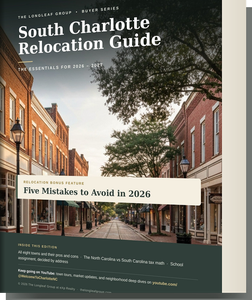 |
Free · 26-Page Insider Guide Which South Charlotte Town Is Right for You? Towns, villages, and cities compared, NC vs SC taxes and schools, and the 5 mistakes out-of-state buyers make. Everything you’d want a local to tell you before you move. Get the free guide → |