

If you are thinking about relocating to Charlotte, NC, you are probably running through the same questions every buyer from outside the area asks: what does it actually cost, which neighborhoods make sense, and what do the schools look like once you get past the top-level rankings? More than 100 new residents arrive in Charlotte every day, and the ones who land well are the ones who had the full picture before they started looking at houses.
This guide covers the complete Charlotte relocation picture in one place: job market, housing costs, South Charlotte neighborhoods, school districts, property taxes, new construction, and the practical tradeoffs nobody mentions in the search results. I am Steve Jarrell, a broker with The Longleaf Group at eXp Realty, licensed in both North Carolina and South Carolina, and I work almost exclusively in the south Charlotte and Union County submarkets where most relocating buyers end up. What follows is the same walkthrough I give buyers on our first call.
15 min read | By Steve Jarrell, The Longleaf Group at eXp Realty | Updated August 2026
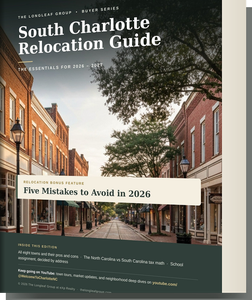
Free · 26-Page Insider Guide
Moving to Charlotte? Start here.
Towns compared, NC vs SC taxes and schools side by side, and the 5 mistakes out-of-state buyers make.
What This Guide Covers
- Why Charlotte keeps growing
- What Charlotte actually costs in 2026
- How to choose your Charlotte neighborhood
- South Charlotte: where most relocating buyers land
- Schools: Charlotte-Mecklenburg vs. Union County
- Weather, recreation, and sports
- Working with a local agent
- Hidden costs: property taxes and HOA reality
- New construction in 2026: what is available
- Frequently asked questions
Why Charlotte Keeps Growing
Charlotte added 37,600 nonfarm jobs between December 2024 and December 2025, ranking second in the nation for total job growth, and it has held that position for several years running. The metro is built around financial services (Bank of America and Truist Financial both have global headquarters Uptown), but the growth story now goes well beyond banking.
The Short Answer
Charlotte draws relocating buyers because of steady job growth across multiple industries, a cost of living that undercuts most coastal metros, mild four-season weather, and a wide range of neighborhoods from Uptown high-rises to spacious South Charlotte suburbs. Most relocating buyers land in south Charlotte or Union County, where they balance space, schools, and commute access.
Key numbers right now:
- 37,600 jobs added in 2025, second in the nation for total growth
- Charlotte metro median home price: approximately $435,000 in spring 2026
- Mecklenburg County single-family median: $561,645 (May 2026, Canopy MLS)
- Combined property tax rate inside Charlotte: 78.57 cents per $100 (FY2027)
- Union County Public Schools: ranked #1 in NC for proficiency, 70.7% vs 55% state average
- Blue Ridge Mountains: 2 hours west. Atlantic coast: 3.5 hours east
Scout Motors chose Charlotte for its global headquarters in 2026, committing to 1,200 jobs at an average salary of $172,878. Maersk North America relocated its North American headquarters to Charlotte in late 2025. Citigroup announced a 510-job expansion. Daimler Truck is growing its Ballantyne footprint. The healthcare corridor anchored by Atrium Health and Novant Health added more positions than any other sector in the metro.
If you are weighing Charlotte against another Sun Belt city, the job market diversity is what stands out. Finance, healthcare, logistics, advanced manufacturing, and insurance all have critical mass here. That breadth protects the market from sector-specific downturns in a way that single-industry cities cannot. Charlotte’s unemployment rate was 4.1% in mid-2025, below the national average of 4.4%.
Talk to a local broker
Relocating to Charlotte and not sure where to start?
Tell me where you are coming from and what matters most, and I will map it to the right south Charlotte submarket. No pressure, just answers.
Schedule a 15-Minute Introductory Call →704-774-7170 · steve@jarrellhomes.com · thelongleafgroup.com
What Charlotte Actually Costs in 2026
The Charlotte area median home sale price held near $435,000 through spring 2026, roughly flat with the prior year. Single-family home sales in Mecklenburg County hit a Canopy MLS median of $561,645 in May 2026. That spread reflects the wide range in the market: urban Uptown condos pull the metro average down while established south Charlotte neighborhoods push single-family values up. Inventory remains elevated compared to 2022 and 2023, giving buyers options and leverage that felt impossible three years ago. Homes in the Charlotte metro are averaging roughly 40 to 50 days on market depending on price tier and suburb.
Charlotte’s overall cost of living sits below the national average when you factor in housing, transportation, and utilities together. Against cities like Washington DC, Boston, Seattle, or Austin, the gap is significant: buyers moving from those markets often free up $800 to $1,500 per month in net housing cost even after accounting for south Charlotte price levels. Mortgage rates in mid-2026 are running in the 6.5 to 7% range, but that is the new baseline. Buyers waiting for 5% rates are watching the best inventory sell. The practical move is to buy now and refinance when rates drop.
How to Choose Your Charlotte Neighborhood
The most common mistake buyers make when relocating to Charlotte is searching the entire metro without a framework. Charlotte is large, spread across Mecklenburg County and into several surrounding counties, and the lifestyle differences between neighborhoods are real. The right answer depends on three questions: how much do you value walkability versus space? What are your school priorities? How much commute time is acceptable?
The broad divisions worth knowing:
- Uptown and Near-Uptown (Fourth Ward, NoDa, Plaza Midwood, Dilworth): Urban density, walkability, historic bungalows and modern condos. Prices range from the mid-$300,000s for condos to well above $700,000 for renovated historic homes in Dilworth. Charlotte-Mecklenburg Schools serves this area. Best for buyers who want to walk to restaurants and minimize car dependence.
- South Charlotte (Ballantyne, Weddington, Waxhaw, Marvin, Matthews, Indian Trail): Where most out-of-state relocating buyers land when schools and space are the priority. Newer construction, larger lots, top-tier school access. Covered in detail in the next section.
- Lake Norman (Cornelius, Huntersville, Davidson): North of the city, lake access, popular with buyers who want a resort-adjacent lifestyle and do not mind a longer Uptown commute.
- South Carolina border (Fort Mill, Indian Land): Lower SC property taxes, quick access to south Charlotte amenities, suburban character similar to Ballantyne. My Fort Mill vs. Indian Land comparison covers how these two communities differ.
South Charlotte: Where Most Relocating Buyers Land
I work almost exclusively in south Charlotte and Union County, and the same pattern plays out every month: buyers start with a broad Charlotte search, then narrow to south Charlotte once they factor in schools, space, and commute times. Here is what the market looks like in each of the primary south Charlotte communities right now.
Ballantyne
Charlotte’s most established south Charlotte suburb. Master-planned communities, a thriving business district (Daimler Truck’s expanding headquarters is here), golf courses, and straightforward I-485 access to the airport. Average home values run from $454,000 to $733,000 depending on the sub-neighborhood, with Ballantyne East trending higher. Typical commute to Uptown is around 22 minutes off-peak. The area is car-dependent. Served by Charlotte-Mecklenburg Schools, with several well-rated individual campuses. Full Ballantyne relocation guide.
Weddington
One of the most sought-after addresses in the entire Charlotte area. Weddington sits in Union County, which has the top-ranked school district in North Carolina. The town has a rural character that is genuinely rare this close to a major city: no commercial downtown, low density, large lots, and quiet roads. Average home value around $1,074,644 in early 2026, with median sale prices in the $1.3 million range for established neighborhoods and more accessible entry points in newer townhome communities in the $600,000s. Full Weddington relocation guide.
Waxhaw
The fastest-growing town in Union County and the one with the most active new construction pipeline right now. Waxhaw has a genuine historic downtown with locally-owned restaurants, shops, and a calendar of community events, which sets it apart from most suburban options in the area. Median home prices in early 2026 ranged from the mid-$500,000s to the low $700,000s depending on the neighborhood. You get Union County schools at a lower price point than Marvin or upper-end Weddington. More on the full south Charlotte picture.
Marvin
A small, low-density town bordering both Weddington and the South Carolina line. Marvin has some of the largest residential lots in south Charlotte, luxury custom home communities, and a quiet character that resonates with buyers relocating from high-density markets who want land and privacy. Average home value was approximately $1.25 million in early 2026. Union County schools. Full Marvin relocation guide.
Matthews
A more accessible entry point into south Charlotte, with a well-established downtown, better walkability than most nearby suburbs, and Charlotte-Mecklenburg school options including some strong individual campuses. Matthews is adding mixed-use development along its main corridors. Median prices in the mid-$400,000s make it one of the more affordable options in the south Charlotte corridor. Full Matthews relocation guide.
For a real feel of the two submarkets relocating buyers ask about most, this video is a good starting point:
Schools: Charlotte-Mecklenburg vs. Union County
Schools are the most common factor relocating buyers cite when they explain why they chose south Charlotte over the Uptown-adjacent neighborhoods. The comparison between the two primary school systems in this part of the metro is significant.
Union County Public Schools (UCPS) ranked #1 in North Carolina for End-of-Grade and End-of-Course proficiency rates in 2024-2025, posting a 70.7% proficiency rate against a state average of 55%. UCPS ranked #2 among all 115 school districts in North Carolina on Niche.com. The district’s cohort graduation rate was 93.2%, the highest among the 12 largest districts in the state. No F-rated schools. 90% of UCPS campuses earned a School Performance Grade of A, B, or C. This is the district serving Weddington, Waxhaw, Marvin, Indian Trail, and Monroe.
Charlotte-Mecklenburg Schools (CMS) is a much larger district serving Charlotte proper, including Ballantyne, Matthews, and all of the urban core. CMS has strong individual campuses and competitive magnet programs. District-wide averages are more variable than UCPS because of the wide range of communities it serves. Buyers in Ballantyne or Matthews should do campus-level research rather than relying on district averages alone.
For buyers whose top priority is consistent district-wide school quality, Union County is the cleaner answer. For buyers who are comfortable doing campus-level due diligence and want to stay in Mecklenburg County, there are strong CMS options available.
Talk to a local broker
Need help comparing neighborhoods and school zones?
A quick call with a broker who checks school assignments for relocating buyers before every tour.
Book a 15-minute call →Weather, Recreation, and Sports
Charlotte gets more than 200 sunny days per year. Summers run from about 90 to 95 degrees with lows in the upper 60s, warm and occasionally humid, but manageable, and not the sustained heat of Phoenix or Houston. Winters are mild, with highs in the high 40s to low 50s and lows that rarely stay below freezing for long. Extended cold snaps and significant snowfall are uncommon, which keeps the outdoor recreation calendar essentially year-round.
The Mecklenburg County Greenway network covers more than 56 miles of trails. There are 230-plus public parks across 2,000 acres. Lake Norman to the north and Lake Wylie to the southwest put boating, kayaking, and fishing within 30 minutes of most south Charlotte addresses. For longer trips: Asheville and the Blue Ridge Mountains are about 2 hours west, and the Outer Banks coastline is about 3.5 hours east. Charlotte Douglas International Airport serves 180-plus daily flights, making regional and national travel straightforward.
Professional sports run year-round: the Carolina Panthers (NFL) and Charlotte FC (MLS) both play at Bank of America Stadium Uptown, the Charlotte Hornets (NBA) are at Spectrum Center, the Triple-A Charlotte Knights play at Truist Field with a skyline backdrop, and the AHL Charlotte Checkers cover hockey season.
Working With a Local Agent When Relocating to Charlotte
I have helped buyers relocate to south Charlotte and Union County from Seattle, Boston, New York, Chicago, Denver, and dozens of other markets. The pattern is consistent: buyers who navigate the Charlotte market remotely, relying only on Zillow and general search results, often end up making decisions based on outdated data or miss the neighborhoods that would actually fit their life.
What matters in a relocation decision are the questions that do not show up in any app. Which builders in Waxhaw are delivering on schedule vs. running six months behind? Which Weddington subdivisions have HOA covenants that restrict rentals? What does the I-485 commute actually look like at 7:30 AM from Ballantyne to Uptown? Where does the Union County school zone line fall inside a specific subdivision? I know those answers because I work this market every day.
If you are planning a move to the Charlotte area, the best first step is a 30-minute call to talk through your priorities and figure out which neighborhoods to focus on. No pressure, no obligation, just a direct conversation about what the market looks like and where you will find the best fit.
Hidden Costs: Property Taxes and HOA Reality
The number relocating buyers most consistently underestimate is not the mortgage payment. It is the gap between what property taxes look like in their current city and what they will look like in Charlotte. The specific number depends heavily on which side of the county line you buy on.
Mecklenburg County (Charlotte, Ballantyne, Matthews): The combined rate for a property inside Charlotte city limits is 78.57 cents per $100 of assessed value for the current fiscal year, FY2027 (Mecklenburg County 49.27 cents plus Charlotte city 29.30 cents, after a 1.89-cent city increase adopted for FY2027). On a $500,000 home, that is approximately $3,929 annually in property taxes. Mecklenburg reassessment is scheduled for January 2027, so buyers purchasing now should budget for potential value adjustments then. You can look up any property’s current bill at tax.mecknc.gov. For a deeper breakdown, see my Ballantyne NC property tax guide.
Union County (Waxhaw, Weddington, Marvin, Indian Trail, Monroe): The county base rate is 43.42 cents per $100 for the current fiscal year, with each town adding its own rate on top. Waxhaw adds 29 cents, bringing the combined rate to 72.42 cents. Weddington adds roughly 3.5 cents (total near 47 cents). Marvin’s village rate is only 5.63 cents, so the combined Marvin rate is approximately 49 cents. Union County completed a revaluation in 2025 that raised assessed values by 50 to 65% on average, so tax bills jumped even though the rate dropped. The math still favors Union County over Mecklenburg in most scenarios, but do not assume the old numbers.
York County, South Carolina (Fort Mill, Indian Land): South Carolina’s 4% legal-residence assessment cap keeps annual tax bills dramatically lower than comparable North Carolina addresses. A $450,000 home in Fort Mill typically generates $1,200 to $1,800 in annual property tax versus $3,500 to $3,900 for an equivalent address in Charlotte proper. The tradeoff: you give up the NC state income tax advantage if you earn above certain thresholds, and you add 15 to 20 minutes to most Charlotte commute routes. I cover this comparison in detail in my York County SC property tax guide.
HOA fees: Most planned communities in south Charlotte carry monthly HOA dues, and the range is wider than buyers expect. Newer townhome communities in Waxhaw and Indian Trail run $200 to $350 per month. Established single-family neighborhoods in Weddington typically run $50 to $150 per month. Active adult communities like Sun City Carolina Lakes or Encore at Streamside run $280 to $400 per month but include lawn care and extensive amenities. Golf course and resort communities can run significantly higher. Always get the full HOA disclosure package before you make an offer.
Closing costs: North Carolina buyers typically see closing costs of 2 to 4% of the purchase price. On a $500,000 home, budget $10,000 to $20,000 above the down payment. The biggest variable is lender origination fees, which vary significantly. Get three lender quotes minimum and compare the full fee disclosure, not just the rate.
New Construction in 2026: What Is Available and Where
One of the first questions buyers ask when they see south Charlotte prices is whether there is new construction available at a more accessible price point. The answer in 2026 is yes, but with conditions.
The most active new construction corridors right now are in Waxhaw and Monroe. Waxhaw has the broadest range: active townhome communities from the mid-$300,000s (Blythe Mill by Eastwood, Old Town Village by Tri Pointe walkable to downtown) through single-family homes in the low $500,000s in subdivisions like Lawson and Briarcrest. Monroe is seeing the strongest price-to-value ratio in the metro right now, with national builders like D.R. Horton and Lennar offering single-family homes in established subdivisions starting in the high $200,000s and mid-$300,000s. Monroe is Union County, which means UCPS schools at a significantly lower price than Waxhaw or Indian Trail.
In the mid-tier range, Indian Trail and Wesley Chapel have active construction from Ryan Homes, Smith Douglas, and Smith Family Homes, generally in the $350,000 to $500,000 range. Pineville, just south of Charlotte proper, has new apartment and townhome development along the light rail corridor for buyers prioritizing commute access over suburban space.
A few things to know about new construction in this market: builder incentives are real in 2026. Rate buydowns, lot premiums waived, and design center credits are all negotiable. Builders are not publicly advertising these, but they are available if you ask, especially on spec homes (homes already started without a buyer committed). The inspection process on new construction is different from resale: you have more leverage during the build, less leverage once you are past contract. Always hire an independent inspector for the pre-drywall and final walkthrough, regardless of what the builder tells you about their internal QC process. And get any incentives or promises in writing before signing, because verbal commitments from builder sales reps carry no weight once you are in contract.
For buyers interested specifically in what builders are delivering in each south Charlotte community, the new construction guide covers the current landscape in more detail.
For the counterargument to everything above, I keep a companion guide to the reasons not to move to Charlotte NC. It walks through traffic, the transit buildout timeline, and the tax and utility increases that catch newcomers out in their second year.
Frequently Asked Questions
Why are so many people relocating to Charlotte, NC?
Charlotte added 37,600 jobs in the 12 months ending December 2025, ranking second in the nation for total job growth. The metro offers a strong job market across finance, healthcare, logistics, and advanced manufacturing, combined with a cost of living below the national average, mild four-season weather, and proximity to both mountains and coast. More than 100 new residents arrive daily.
What is the housing market like in Charlotte in 2026?
The Charlotte metro median home sale price held near $435,000 through spring 2026, roughly flat year-over-year. Inventory increased significantly from 2023 and 2024 levels, giving buyers more options and negotiating room. Homes are averaging 40 to 50 days on market depending on suburb and price tier. Mecklenburg County single-family homes hit a Canopy MLS median of $561,645 in May 2026. Overall, conditions have shifted meaningfully in favor of buyers compared to the 2021 to 2023 period.
Which neighborhoods in South Charlotte are best for relocating buyers?
It depends on your priorities. Ballantyne offers the most established suburban infrastructure and a business district with major employers. Waxhaw provides the best balance of price, Union County schools, and a real downtown. Weddington and Marvin appeal to buyers who want larger lots, privacy, and the top-ranked school district in the state. Matthews offers more accessible pricing and walkability for a suburb. All five are within 30 to 40 minutes of Uptown.
How do Union County schools compare to Charlotte-Mecklenburg schools?
Union County Public Schools ranked #1 in North Carolina for End-of-Grade and End-of-Course proficiency in 2024-2025, with a 70.7% proficiency rate versus 55% statewide. The district ranked #2 of 115 districts in NC on Niche.com and posted a 93.2% graduation rate, highest among the 12 largest NC districts. Charlotte-Mecklenburg Schools is larger and more variable by campus. Buyers for whom school quality is the top priority consistently land in Union County.
What are the property taxes like in Charlotte vs. Union County?
Property taxes inside Charlotte city limits (Mecklenburg County plus city) run 78.57 cents per $100 of assessed value for FY2027, approximately $3,929 per year on a $500,000 home. Union County runs 43.42 cents at the county level, with town rates adding between 3.5 and 29 cents depending on the municipality. The combined Union County plus Waxhaw rate is 72.42 cents; Weddington runs about 47 cents combined; Marvin is approximately 49 cents. On most price points, Union County comes out 15 to 25% lower in annual taxes than equivalent Charlotte addresses.
How far is Charlotte from the mountains and the beach?
Charlotte is approximately 2 hours west of Asheville and the Blue Ridge Mountains and about 3.5 hours east of the Outer Banks on the Atlantic coast. Charlotte Douglas International Airport offers 180-plus daily flights for longer trips. The central location is one of the most cited reasons buyers choose Charlotte over Raleigh, which sits closer to the coast but farther from the mountains.
What professional sports teams are in Charlotte?
Charlotte has the Carolina Panthers in the NFL, the Charlotte Hornets in the NBA, Charlotte FC in MLS, the Triple-A Charlotte Knights at Truist Field Uptown, and the AHL Charlotte Checkers for hockey. The sports calendar runs essentially year-round with meaningful options in every season.
Is new construction available in South Charlotte in 2026?
Yes, with the best price-to-value options concentrated in Waxhaw and Monroe. Townhomes in Waxhaw start in the mid-$300,000s from builders like Eastwood and Tri Pointe. Monroe has single-family homes from national builders starting in the high $200,000s and mid-$300,000s, all within Union County Public Schools. Indian Trail and Wesley Chapel have mid-tier single-family new construction from $350,000 to $500,000. Builder incentives are available in 2026 if you ask directly, especially on spec homes already under construction. Get any incentives in writing before signing the purchase agreement.
About the Author
Steve Jarrell is a licensed real estate broker with The Longleaf Group at eXp Realty, based in Weddington, NC and licensed in both North Carolina and South Carolina. He specializes in relocation buyers moving to south Charlotte and Union County from markets across the country. Steve holds the ABR, RENE, and MRP designations, has been recognized by RealTrends Verified as a top-producing team in North Carolina, and carries 140+ five-star reviews from past clients. Before real estate, he spent nearly a decade leading Paradym, a national real estate marketing technology company, through growth and acquisition by Constellation Software.
704-774-7170 · steve@jarrellhomes.com · thelongleafgroup.com