
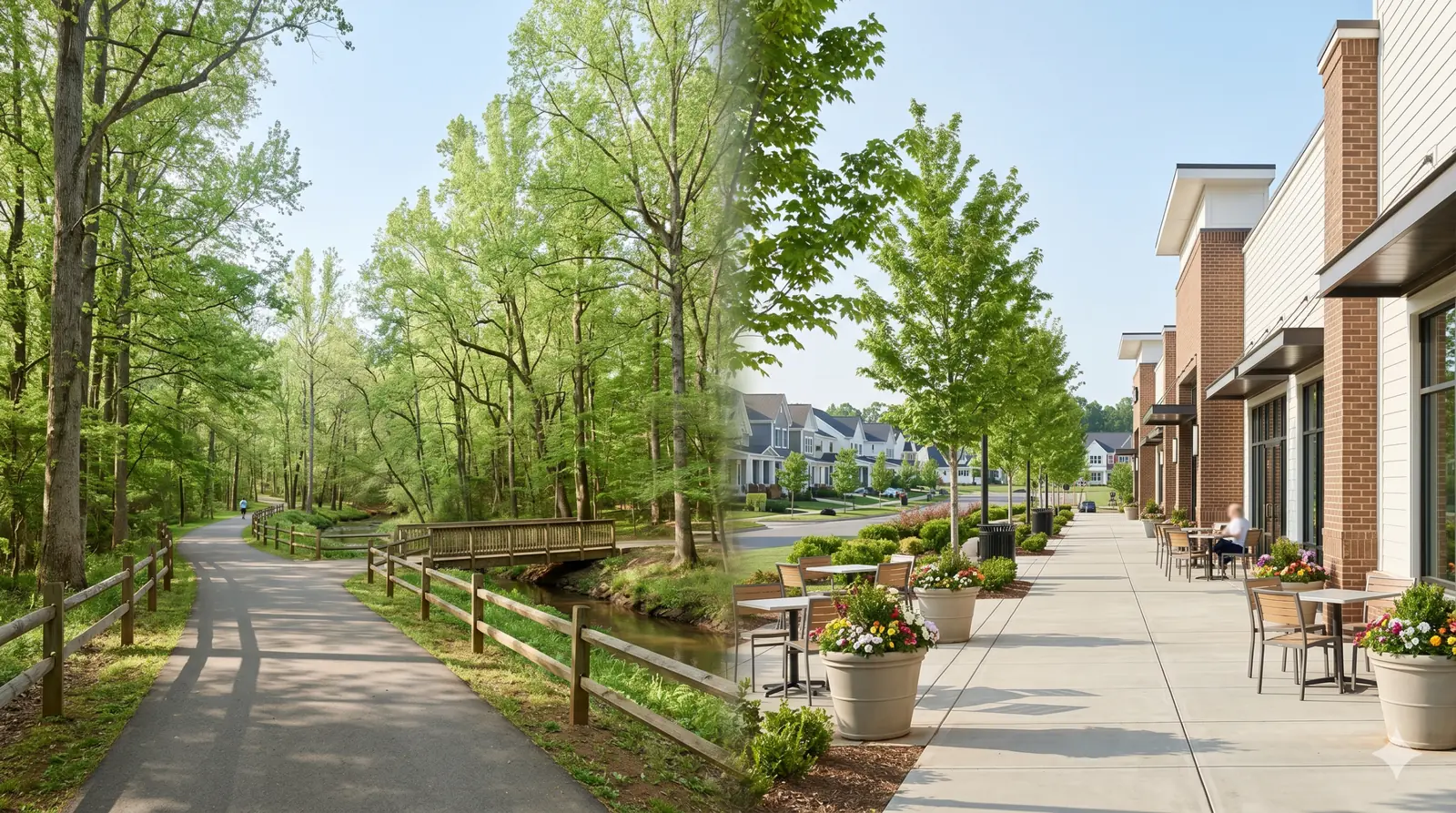
If you have already decided to move to the Charlotte area and you are weighing the South Carolina side of the state line, the decision usually narrows to two markets: Fort Mill and Indian Land. I hear the Fort Mill vs Indian Land question almost every week from relocating buyers, and the answer is rarely a coin flip. These two communities sit a short drive apart on the SC side of the border, but they shop differently, commute differently, school differently, and price differently. As an agent who covers the South Charlotte and Union County footprint, including the SC suburbs that pull Charlotte buyers across the state line, I want to walk through the real differences so you can decide where to focus your home search.
11 min read | By Steve Jarrell, The Longleaf Group at eXp Realty | Updated August 2026
The Short Answer
Fort Mill feels like a town; Indian Land feels like a corridor. Fort Mill has a downtown grid, mature neighborhoods and its own town government inside York County. Indian Land is unincorporated Lancaster County stretched along Highway 521 south of Ballantyne — which is the appeal for some buyers and the friction for others. That single difference drives a surprising number of downstream decisions.
The core difference:
- Fort Mill sits inside York County with its own town government; Indian Land is unincorporated Lancaster County with none
- Fort Mill is served by Fort Mill School District, long one of the highest-rated on the South Carolina side; Indian Land is served by the Indian Land cluster inside Lancaster County School District
- Boundaries shift and lottery zones change — two homes a mile apart in Indian Land can feed different schools, and the same is true on the Fort Mill side
- The Anne Springs Close Greenway is the headline attraction, with over 2,000 acres of trails, lakes, equestrian facilities and a nature center
- Both are in South Carolina, so owner-occupied primary residences are assessed at a 4% ratio and non-owner-occupied at 6%
Fort Mill vs Indian Land at a Glance
Fort Mill is the older and more established of the two. It has a defined downtown grid, mature neighborhoods, and a town identity that goes back generations. Indian Land is a newer, faster-growing corridor stretched along Highway 521 just south of the Ballantyne business district. Indian Land does not even have its own incorporated town government. It is part of unincorporated Lancaster County, which is part of the appeal for some buyers and part of the friction for others. Fort Mill sits inside York County. That single difference, county and town versus county only, drives a surprising number of downstream decisions.
For a relocating buyer, the simplest framing is this. Fort Mill feels like a town. Indian Land feels like a corridor. Both serve the same population of Charlotte commuters, both offer newer housing in the price range most relocating buyers target, and both attract residents pouring out of Ballantyne, Pineville, and the southern Charlotte job centers.
Schools and School Districts: Moving to Fort Mill SC vs Indian Land
The school question is the single most common question I get from buyers comparing these two markets. Fort Mill is served by Fort Mill School District, which has long been one of the highest-rated districts in the Charlotte metro area on the SC side. Indian Land is served by Lancaster County School District, specifically the Indian Land cluster of schools.
Both districts have schools that draw relocating buyers, but the reputations are different. Fort Mill is the legacy name buyers recognize before they even arrive. Indian Land has built up its school footprint quickly to keep pace with the population, with Indian Land Elementary, Middle, and High operating as a self-contained cluster inside the larger Lancaster County district.
If you have school-age residents in your household and the school district reputation is going to drive your offer price, plan to spend time on the actual elementary and middle assignments before you commit to either market. Boundaries shift. Lottery zones change. Two homes a mile apart in Indian Land can feed different schools, and the same is true on the Fort Mill side closer to the river. I will pull the current attendance zones for any specific address you are considering.
Commute and Daily Drive
This is where the Fort Mill vs Indian Land choice gets very practical.
Indian Land is closer to Ballantyne and the I-485 outer loop. If your job is at Ballantyne Corporate Park, the SouthPark corridor, or anywhere in the southern Charlotte business core, Indian Land typically delivers a shorter daily drive. Highway 521 is the artery, and traffic on 521 has gotten heavier as the corridor has grown, but it is still a straightforward run into Charlotte.
Fort Mill sits a bit further south and west. The drive into uptown Charlotte runs up I-77, which is the primary commuter route for the entire Lake Wylie and Tega Cay corridor. Fort Mill buyers who commute to uptown have access to express lanes on I-77, which can shave significant time off the morning drive if you are willing to pay the toll. Buyers who work in SouthPark, Ballantyne, or the south Charlotte campuses generally find Indian Land a faster reach than Fort Mill.
If you are working from home full time, the commute differential matters less, and the lifestyle differences become the deciding factor.
A lot of buyers landing here from out of state rent for a year before they commit to either town, and South Carolina’s 4 percent owner-occupied assessment is what makes that year cost more than they planned. I worked the math through in should you rent or buy in Fort Mill SC.
Housing Stock and Price Range: Buying in Indian Land SC vs Fort Mill
Both markets serve the relocating buyer well in the price band most of my clients target. The character of the housing stock is different.
Fort Mill has a wider mix of older and newer construction. You will find true established neighborhoods with mature trees, larger lots, and resale homes that have been lived in for fifteen or twenty years. You will also find new construction in the planned communities on the edges of town, including Massey, Baxter Village, and Springfield. Springfield is a notable example of master-planned living in Fort Mill with golf, a clubhouse, and amenity infrastructure on site.
Indian Land is heavily new construction. The Highway 521 corridor has filled in with builder communities over the last decade, with names like Walnut Creek, Sun City Carolina Lakes, and a long list of newer subdivisions further south. If you want a brand new home with everything under warranty, Indian Land has more inventory at any given moment in the relocating buyer price range. If you want a true neighborhood with a downtown nearby and some history in the streets, Fort Mill is the stronger fit.
If you are also weighing the NC side of the border, the South Charlotte and Union County markets compete for the same relocating buyer pool, and the choice between sides of the state line is usually one of the first questions to settle in the search.
Lifestyle, Community, and What It Feels Like to Live There
Fort Mill has a real downtown. Main Street has restaurants, the Anne Springs Close Greenway is one of the finest greenway systems in the Carolinas, and the town hosts the kind of community events that make residents feel like they belong somewhere. It punches well above its size for cultural amenities.
Indian Land does not have a downtown in the traditional sense. The corridor experience is shopping centers, restaurants along 521, and Redstone Commons style retail nodes that anchor different stretches of the highway. For some buyers, that is exactly right. They want big box convenience, a Costco, a Harris Teeter, and a short drive to the Ballantyne shopping district without the formality of a town center. For other buyers, the lack of a defined downtown is a deal-breaker.
The amenity-driven lifestyle in Indian Land is concentrated inside the master-planned communities themselves. Sun City Carolina Lakes, for example, runs as its own active adult community with its own clubhouse, pickleball, and social calendar. Buyers who want that experience typically gravitate to the planned communities rather than the standalone subdivisions.
Things to Do in Fort Mill vs Indian Land
Schools and commute decide a lot of relocating buyer searches, but weekend life decides whether you actually like the place six months in. Here is how the two markets stack up on parks, dining, and kid-friendly activities.
Fort Mill: Things to Do
Fort Mill leans hard on its outdoor footprint and historic downtown. The Anne Springs Close Greenway is the headline attraction, with over 2,000 acres of trails, lakes, equestrian facilities, and a nature center that runs seasonal programming. It is the kind of asset that pulls people out of bed on a Saturday morning. Downtown Fort Mill on Main Street has a walkable mix of independent restaurants, breweries, and small shops anchored around the historic town square. Walter Elisha Park hosts community events and outdoor concerts in the warmer months, and the historic Captain John Steele House and Springfield Plantation give the town a real sense of place that newer corridors do not match.
Indian Land: Things to Do
Indian Land is built around the Highway 521 corridor, so the dining and entertainment cluster along it. Redstone Commons and the surrounding retail nodes hold the bulk of the restaurants, with national favorites and locally owned spots side by side. Indian Land buyers also benefit from a quick run over the state line into Ballantyne Backyard for outdoor concerts, food trucks, and community events on the lawn. The Lancaster County parks system, including Six Mile Creek Park, gives residents trails and athletic fields a short drive from home, and Sun City Carolina Lakes residents have an extensive on-site amenity calendar with pickleball, fitness, and ongoing social programming.
Kid-Friendly Activities Near Fort Mill and Indian Land
Both markets share access to the same regional kid-friendly anchors. Carowinds, the major amusement park on the SC/NC line, sits closer to Fort Mill but is reachable from either community in well under thirty minutes. The Anne Springs Close Greenway nature center on the Fort Mill side runs seasonal kid programming, splash areas, and field trips throughout the year.
Indian Land buyers tend to use the Ballantyne and South Charlotte side for kid-friendly day trips, including Discovery Place Science in uptown Charlotte for hands-on STEM exhibits. Day-trip options reachable from both markets include the Daniel Stowe Botanical Garden, the U.S. National Whitewater Center with its rope courses and rafting, and the McAdenville Christmas lights drive-through in December. Between the two markets, you have a deep bench of activities for kids of every age without needing to drive into uptown unless you want to.
If you are weighing South Carolina against a North Carolina town instead, the same tax math plays out in Fort Mill against Matthews.
Property Taxes and the SC Owner-Occupied Advantage
This is the conversation that surprises most relocating buyers, especially those moving from North Carolina or from out of state.
South Carolina assesses owner-occupied primary residences at a 4% assessment ratio, while non-owner-occupied properties are assessed at 6%. The practical effect is that homeowners who file the legal residence application with the county pay materially less in property tax than a buyer who fails to file or owns the property as an investment. Both Fort Mill (York County) and Indian Land (Lancaster County) follow the SC framework.
For a relocating buyer, this means two things. First, check your county tax estimate based on the 4% rate, not the 6% rate that often shows up on the listing detail page. Second, make sure to file the legal residence application after closing. A lot of buyers pay the higher rate in their first year because no one walked them through the paperwork. I do this with every SC client.
If you are coming from North Carolina, you will also notice that South Carolina has a state income tax. The two systems trade off in ways that depend heavily on your income profile. This is a CPA conversation, not an agent conversation, but it is worth raising before you commit to a market.
Choosing Between Fort Mill vs Indian Land: Which Charlotte Border Town Fits
Here is how I usually frame the Fort Mill vs Indian Land choice for a relocating buyer in our first conversation.
Choose Fort Mill if you want an established town with a real downtown, a long-tenured school district, and a mix of resale homes and new construction. Buyers who value community identity, mature neighborhoods, and proximity to Lake Wylie and Tega Cay typically end up in Fort Mill.
Choose Indian Land if you want newer construction at a higher concentration, a shorter drive to Ballantyne and the south Charlotte job centers, and a corridor lifestyle built around shopping, restaurants, and master-planned communities. Buyers who prioritize home age, warranty coverage, and commute time often end up in Indian Land.
Neither market is wrong. They are different products serving an overlapping but not identical buyer.
If you want a deeper read on how I work with relocating buyers, my agent bio page walks through my background, designations, and process. For buyers also considering Weddington as a NC alternative, my Weddington agent guide covers the upper-end NC side of the same metro buyer pool.
Frequently Asked Questions: Fort Mill vs Indian Land
Is Fort Mill or Indian Land cheaper to live in?
The two markets price similarly within the relocating buyer band. Indian Land tends to skew toward newer construction at slightly higher per-square-foot prices on brand new homes, while Fort Mill has more established resale inventory that can come in at a lower price per foot for comparable square footage. The total cost of ownership conversation also has to include property taxes, HOA fees, and lifestyle differences inside specific subdivisions.
Is Fort Mill or Indian Land closer to Ballantyne?
Indian Land is closer to Ballantyne. The Highway 521 corridor runs directly into the Ballantyne business district. Fort Mill is further south and west, and the natural commute path runs up I-77 toward uptown Charlotte rather than across to Ballantyne.
Are the schools better in Fort Mill or Indian Land?
Fort Mill School District has the longer-standing reputation among relocating buyers. The Indian Land cluster inside Lancaster County School District has built up quickly and serves the corridor well, but the brand recognition still favors Fort Mill among buyers shopping with a school priority. Either way, run the specific address through the assigned attendance zones before you commit, because boundary shifts can change your assignment without changing your home.
What are the best things to do in Fort Mill and Indian Land for kids?
Carowinds, the Anne Springs Close Greenway nature center, Discovery Place Science in uptown Charlotte, and the U.S. National Whitewater Center are the regional kid-friendly anchors that both markets share. Fort Mill buyers also have the greenway in their backyard for everyday outdoor time, and Indian Land buyers tend to default to the Ballantyne and South Charlotte side for indoor and event-based kid activities.
Do I have to pay South Carolina income tax if I live in Indian Land or Fort Mill?
Yes. Both are South Carolina addresses, so SC income tax applies to residents. If you commute into Charlotte for work, the tax interplay between SC and NC requires a CPA to walk through your specific situation.
Which side of the state line is right for a relocating buyer who works from home?
If you work from home, the commute factor disappears, and the choice comes down to lifestyle. Buyers who want a downtown, mature neighborhoods, and community identity typically lean Fort Mill. Buyers who want new construction, retail convenience, and master-planned amenities typically lean Indian Land.
Still Weighing Fort Mill vs Indian Land?
Pick a time and we will walk through schools, commute, taxes, weekend life, and the right communities for your specific search. No pressure, just a clear path forward.
Buyers who are leaning toward Indian Land and want a deeper look at what’s driving the demand there will find the Why Are People Moving to Indian Land SC breakdown useful: it covers the lifestyle dynamics, school considerations, and the specific buyer profile that Indian Land consistently attracts.
See our full Indian Land real estate guide for the complete local picture.
 |
Free · 26-Page Insider Guide Which South Charlotte Town Is Right for You? Towns, villages, and cities compared, NC vs SC taxes and schools, and the 5 mistakes out-of-state buyers make. Everything you’d want a local to tell you before you move. Get the free guide → |