

If you are relocating to the Charlotte area and looking at Monroe, the first question almost everyone asks me is the same: how bad is the drive? It is a fair question. The Monroe to Charlotte commute is the single biggest tradeoff buyers weigh when they consider this part of Union County, and the answers floating around online are all over the map. Some sites tell you it is a quick 30 minutes. Others make it sound like you will spend two hours a day in gridlock. The truth sits in between, and it depends almost entirely on where you work and when you leave.
I live in Weddington, just up the road, and I drive this corridor constantly. I have helped buyers relocating from out of state who needed to be in Uptown by 8 a.m., and others who work from home and only head into the city twice a week. The Monroe to Charlotte commute looks completely different for those two people. This guide breaks down the real distances, the real drive times, the toll road, the transit options, and the real tradeoff so you can decide whether Monroe fits your life before you ever tour a home.
18 min read | By Steve Jarrell, The Longleaf Group at eXp Realty | Updated August 2026
What This Guide Covers
- The short answer: how far Monroe really is from Charlotte
- Mapping the Monroe to Charlotte commute: your three main routes
- Drive times to the places you will actually go
- The Monroe Expressway: is the toll worth it?
- Public transit and park-and-ride on the Monroe to Charlotte commute
- What rush hour really feels like
- The real tradeoff: why buyers accept the Monroe to Charlotte commute
- Frequently asked questions
The Short Answer
Monroe to Uptown Charlotte is about 25 to 29 miles and takes 33 to 46 minutes when traffic is light, but a standard 9-to-5 schedule puts you at 45 to 65 minutes in the morning. The Monroe Expressway is what makes it workable. If you can shift your hours even thirty minutes, the drive changes character entirely.
Real drive times:
- Monroe sits about 25 to 29 miles southeast of Uptown Charlotte
- Light traffic: roughly 33 to 46 minutes
- Standard morning hours into Uptown: plan on 45 to 65 minutes door to door
- A drive that is easy on a Tuesday can become a 55 to 70 minute crawl at 8 a.m.
- Monroe to Ballantyne: about 28 to 30 miles, roughly 40 to 50 minutes
- NCDOT projects drivers taking the full length of the Monroe Expressway save about 20 minutes versus the old road
The Short Answer: How Far Is Monroe From Charlotte, Really?
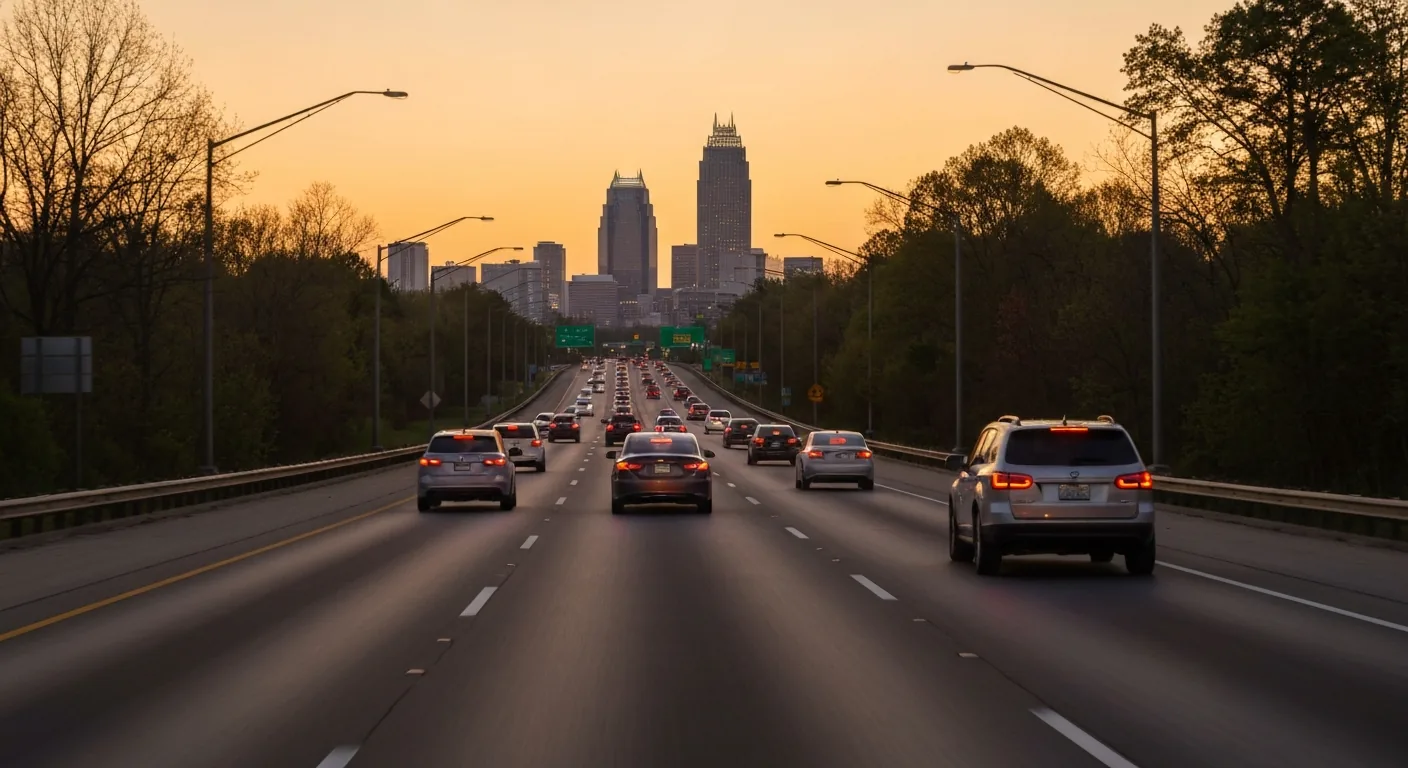
Monroe sits about 25 to 29 miles southeast of Uptown Charlotte (the city’s downtown core, where the banking towers and most large employers are). That distance translates to roughly 33 to 46 minutes of driving when traffic is light, according to routing data from sources like Rome2Rio. So the number itself is not scary. Plenty of people in big metros would happily take a 35 minute drive.
The catch is the word “really.” A 35 minute trip at 10 a.m. on a Tuesday can become a 55 to 70 minute crawl at 8 a.m. on that same Tuesday. The Monroe to Charlotte commute is not defined by distance. It is defined by timing and by which road you take. That is the part the mileage figure on a listing page will never tell you.
Here is the way I frame it for relocating buyers. If your job is in Uptown and you keep standard 9-to-5 hours, plan for 45 to 65 minutes door to door in the morning. If you have any schedule flexibility, leaving before 7 a.m. or after 9 a.m. can shave 15 to 20 minutes off that. And if you work from home most days, the Monroe to Charlotte commute becomes a non-issue that you only deal with a couple of times a week. Your work pattern matters more than your address.
Where Monroe sits on the map
Monroe is the county seat of Union County, the fast-growing county directly southeast of Mecklenburg County (where Charlotte is). To picture it, imagine drawing a line from Uptown Charlotte heading southeast through Matthews, then through Indian Trail, and Monroe is the next stop. Everything between Charlotte and Monroe has been filling in with homes for the last decade, which is both why the area is popular and why the roads carry the traffic they do.
That position is the whole story behind the Monroe to Charlotte commute. You are far enough out to get more land and a newer home for your money, but you are still on a direct path into the city. There is no river to cross, no mountain to climb, no single chokepoint bridge. It is a straight shot northwest on one of two parallel roads, which I will map out next.
Mapping the Monroe to Charlotte Commute: Your Three Main Routes
There are three realistic ways to make the Monroe to Charlotte commute by car, and knowing the difference between them is the single most useful thing in this guide. People who are new to the area default to the free road and then wonder why their drive is so long. Locals mix and match depending on the day.
Route 1: US-74 (Independence Boulevard), the free road
US-74, known locally as Independence Boulevard, is the original artery connecting Union County to Charlotte. It runs straight from Monroe through Indian Trail and Matthews and into east Charlotte. It is free, it is direct, and at the wrong time of day it is the slowest option you have. This is the road with the stoplights, the strip centers, and the stop-and-go pattern through the suburbs. For the Monroe to Charlotte commute during rush hour, US-74 alone is usually the worst choice.
The good news is that NCDOT (the North Carolina Department of Transportation) is in the middle of a major US-74 widening and express-lane project on the Charlotte end of the corridor, adding both toll express lanes and general-purpose lanes between I-277 near Uptown and I-485 in Matthews. When that work is finished it will give drivers the option to pay for a faster, more reliable trip on the stretch closest to the city. During construction, expect some disruption on this segment.
Route 2: The Monroe Expressway, the toll bypass
The Monroe Expressway is the game-changer most out-of-town buyers do not know about. It is an 18.68-mile controlled-access toll road, officially the US-74 Bypass, that opened in November 2018. It bypasses the congested surface stretch of US-74 through Indian Trail, Monroe, and Wingate, letting you cruise at highway speed instead of catching every light. NCDOT data projects that drivers traveling the full length save about 20 minutes versus the old road.
For someone making the Monroe to Charlotte commute from the eastern or southern side of Monroe, the Expressway is often the smartest piece of the trip. You take it to skip the suburban grind, then connect to I-485 or US-74 for the final push into the city. I will cover exactly what the toll costs and whether it pencils out in a dedicated section below, because it is the question I get asked most.
Route 3: The I-485 connector approach
I-485 is Charlotte’s outer beltway, the loop that circles the entire city. Many Monroe commuters do not drive straight into Uptown at all. Instead they take US-74 or the Monroe Expressway to I-485 and then ride the loop to wherever they actually work, whether that is Ballantyne in the south, the airport on the west side, or University City to the north. For any destination that is not dead-center downtown, getting onto I-485 quickly is usually the fastest version of the Monroe to Charlotte commute. Think of the Expressway and US-74 as the on-ramps and I-485 as the distribution highway.
Drive Times to the Places You Will Actually Go
“Charlotte” is not one place, and that matters enormously for your commute math. Uptown is the obvious target, but a huge share of the region’s jobs sit in office parks well outside downtown. Here is what the Monroe to Charlotte commute actually looks like to the four destinations buyers ask me about most. All times assume normal traffic and can stretch in the morning peak.
Monroe to Uptown Charlotte
About 25 to 29 miles, roughly 33 to 46 minutes off-peak. This is the classic Monroe to Charlotte commute and the one most affected by rush hour. If your office is in the center city and you work standard hours, this is the trip to test-drive at 8 a.m. before you commit to a home. Budget closer to an hour for the morning rush.
Monroe to Ballantyne
About 28 to 30 miles, roughly 40 to 50 minutes. Ballantyne is the large corporate office park in far south Charlotte, near I-485 and Johnston Road, and it is a major employer hub. Counterintuitively, the distance is similar to Uptown but the drive can feel easier because you are riding I-485 rather than fighting your way into the downtown core. For Ballantyne workers, the Monroe to Charlotte commute is very manageable.
Monroe to University City and UNC Charlotte
About 29 miles, roughly 36 minutes by the fastest route. University City, in northeast Charlotte, is home to UNC Charlotte and a cluster of corporate campuses. The trip leans heavily on I-485, which keeps it moving. If you work in this part of town, your version of the Monroe to Charlotte commute is one of the more reasonable ones on this list.
Monroe to Charlotte Douglas International Airport (CLT)
About 32 to 34 miles, roughly 46 to 48 minutes. If you are a frequent flyer or you work near the airport on the west side of town, this is the longest of the common trips because you are crossing nearly the entire metro. The Monroe Expressway plus I-485 is the route that keeps it from being worse. Frequent travelers should weigh this drive carefully, since it is the one that adds up over a year of trips.
The pattern here is clear. The Monroe to Charlotte commute is most painful when your destination is dead-center Uptown at rush hour, and most reasonable when your job sits along the I-485 loop. Before you fall in love with a Monroe home, get specific about where you will actually be driving every morning.
The Monroe Expressway: Is the Toll Worth It?
This is the question I field more than any other about the Monroe to Charlotte commute, so let me give you the real numbers. The Monroe Expressway uses all-electronic, flat-rate tolling, meaning there are no toll booths and you pay one set fee regardless of where you enter or exit the 18.68-mile road.
What the toll actually costs
As of January 1, 2026, a two-axle vehicle (a normal car or SUV) pays $2.96 for a full-length trip if you have a transponder like NC Quick Pass, E-ZPass, or a compatible pass. If you do not have a transponder, the system photographs your plate and mails you a bill at double the rate, which works out to $5.92 plus added fees. The lesson is simple: if you will use the Expressway regularly for the Monroe to Charlotte commute, get an NC Quick Pass transponder. It cuts the cost in half and it is free to set up.
The math on a daily basis
If you ran the full Expressway both ways every weekday with a transponder, you would spend roughly $5.92 a day, or about $30 a week. That is real money over a year. But most commuters do not run the entire length both directions every day, and the flat rate means a partial trip costs the same as a full one, so people tend to use it strategically on the mornings that matter most. Where I land is this: the toll is worth it on days you are time-crunched and skipping it is fine on days you are not. You are buying back about 20 minutes, and only you can decide what 20 minutes is worth on a given morning.
For buyers weighing the Monroe to Charlotte commute against a closer-in suburb, I always point out that the toll is a flexible, pay-as-you-go cost, not a fixed one. On a relaxed day you skip it and save the money. On a high-pressure day you pay under three dollars to protect your schedule. That optionality is part of why the corridor works as well as it does.
The toll you’d pay depends on the exit nearest the house, and I’ve priced the Monroe Expressway toll cost exit by exit, from $0.30 to $2.96 one way with NC Quick Pass in 2026.
Public Transit and Park-and-Ride on the Monroe to Charlotte Commute
Plenty of relocating buyers, especially those coming from cities with strong transit, ask whether they can skip driving altogether. Here is the straight answer for the Monroe to Charlotte commute: there is a bus option, but it does not start in Monroe itself, and there is no rail, at least not yet.
The CATS 74X Union County Express bus
The Charlotte Area Transit System (CATS) runs the 74X Union County Express, a weekday commuter bus from the Union Towne Center Park and Ride in Indian Trail (at 5850 W. Highway 74) into Uptown Charlotte. The ride takes about 45 minutes and the one-way fare has been $4.40, though CATS was finalizing a fare modernization update in mid-2026 that may adjust express pricing.
The key detail for Monroe residents is that the park-and-ride is in Indian Trail, not Monroe, so you would drive 10 to 15 minutes to the lot first, then ride the bus. For a true downtown worker who hates driving in traffic, parking once and letting someone else handle the Monroe to Charlotte commute can be a genuine quality-of-life upgrade.
Park-and-ride and carpool options
The Union Towne Center lot in Indian Trail is the established park-and-ride that feeds the 74X. There is no equivalent lot inside Monroe at this time, so if transit is central to your plan, the western edge of Union County closer to Indian Trail puts you nearer that option. Carpooling among neighbors is also common in the newer Monroe-area subdivisions, simply because so many people are making the same drive at the same time.
Will there ever be a train?
This is where it gets interesting for long-term buyers. The planned LYNX Silver Line, a proposed 29-mile light rail route, is designed to run from Belmont through Center City Charlotte and Matthews and into Stallings and Indian Trail in western Union County. It is still in early pre-project development, so it is years away and not something to bank on for your move. Just as important: even as drawn, the Silver Line would reach Stallings and Indian Trail, not Monroe. For now, the Monroe to Charlotte commute is a road commute, full stop. If rail access matters deeply to you, the western Union County towns are positioned closer to that future line than Monroe is.
Want the bigger picture on how I help relocating buyers weigh location against lifestyle? I cover exactly this kind of decision in my video “The BIGGEST Mistake People Make Moving to South Charlotte (And How to Avoid It)” on my YouTube channel, Welcome to Charlotte NC, where the commute-versus-home-size tradeoff comes up constantly.
What Rush Hour Really Feels Like
Numbers on a page are one thing. Sitting in traffic is another. So let me give you a realistic sense of what the morning and evening peaks feel like across the Charlotte region, because that context shapes every version of the Monroe to Charlotte commute.
Charlotte’s traffic, in context
According to the INRIX 2025 Global Traffic Scorecard, the Charlotte metro ranked as the 18th-worst U.S. city for congestion, and the average local driver lost about 48 hours to traffic that year. That is real, but it is also middle-of-the-pack for a major American metro. If you are relocating from Atlanta, Washington, or any large Northeast city, Charlotte traffic will feel light. If you are coming from a small town, it will feel like an adjustment. Either way, the Monroe to Charlotte commute lands squarely in that “real but manageable” zone, closer to a routine drive than to the gridlock horror stories you may have read.
During the worst of the peak in 2025, average speeds on some core Charlotte highways dropped into the 26 to 40 mph range at the busiest interchanges. That is the difference between a 35 minute drive and a 60 minute one. It is also exactly why the Monroe Expressway and the I-485 loop strategy matter so much for keeping your trip predictable.
The timing trick that changes everything
The biggest lever you control is your departure time. Leaving Monroe before 7 a.m. or after 9 a.m. routinely turns a stressful drive into a smooth one. Many of the relocating buyers I work with negotiate a slightly shifted schedule with their employer specifically so the Monroe to Charlotte commute falls outside the heaviest window. Hybrid and remote workers, who can pick their in-office days and times, barely feel the commute at all. If your work has any flexibility, use it, because it is worth more than any route hack.
The cost side is worth a quick mention too. With North Carolina gas averaging around $3.75 per gallon in mid-2026, a daily round trip of 50 to 58 miles in a vehicle getting 25 miles per gallon runs roughly $7.50 to $8.60 a day in fuel, or about $37 to $43 a week, before any tolls or vehicle wear. That fuel figure is a genuine part of the true cost of the Monroe to Charlotte commute, and it is worth factoring into your budget when you compare Monroe against a home closer to the city.
The Real Tradeoff: Why Buyers Accept the Monroe to Charlotte Commute
After all the routes and toll math, the question underneath everything is simple: why do so many people choose to live in Monroe and drive instead of buying closer in? The answer is the oldest one in real estate. You drive until you qualify, and Monroe gives you more home, more land, and more breathing room for your money than the suburbs sitting between it and Charlotte.
Space and value versus minutes
Union County has been one of North Carolina’s fastest-growing counties for years, with a 2026 estimated population around 271,644 and steady in-migration. Monroe itself sits near 44,000 residents. People keep moving here for a reason: the same budget that buys a tight lot closer to the city often buys a larger, newer home on a bigger parcel in the Monroe area. For buyers prioritizing square footage and a yard, accepting the Monroe to Charlotte commute is a rational trade, not a compromise.
Lower residential property tax burdens in parts of Union County compared with some closer-in options add to the appeal. Buyers who run the full picture, including the home, the lot, the taxes, and the commute, frequently conclude that the extra minutes on the road pay for themselves several times over in what they get at the house. That calculation is personal, and it is exactly the kind of thing I walk through with relocating buyers before we ever set foot in a property.
Who Monroe fits, and who it does not
The Monroe to Charlotte commute fits buyers who work hybrid or remote, who work along the I-485 loop rather than dead-center Uptown, who value space over proximity, or who simply do not mind a 45 minute drive in exchange for a better home. It fits poorly for someone who must be in downtown Charlotte at 8 a.m. five days a week, hates driving, and would trade square footage for a 15 minute commute without hesitation. Neither answer is wrong. The point is to know which buyer you are before you choose a town.
If you are still weighing the corridor, it helps to look at the towns between Monroe and Charlotte too. I have written a detailed look at the Indian Trail NC housing market, which sits right on this route, and a guide to new construction homes in Monroe NC if a newer build is on your list. For the wider regional context, my overview of Union County development in 2026 shows where the growth and the road projects are headed. And when you are ready to start the search itself, my guide to buying a home with The Longleaf Group walks through how I represent relocating buyers from first call to closing.
Frequently Asked Questions About the Monroe to Charlotte Commute
How long is the Monroe NC commute to Charlotte during rush hour?
Off-peak, the Monroe to Charlotte commute to Uptown runs about 33 to 46 minutes over 25 to 29 miles. During the morning rush, plan for 45 to 65 minutes door to door depending on your exact route and how far into downtown you go. Using the Monroe Expressway and the I-485 loop, plus leaving before 7 a.m. or after 9 a.m., keeps you toward the lower end of that range.
How much is the Monroe Expressway toll?
As of January 1, 2026, a two-axle car or SUV pays $2.96 for a full-length trip with an NC Quick Pass or compatible transponder. Without a transponder, the bill-by-mail rate is double, about $5.92 plus fees. The Expressway uses flat-rate, all-electronic tolling, so a partial trip costs the same as the full 18.68 miles. Getting a transponder is the easy way to cut the cost in half on the Monroe to Charlotte commute.
Is there public transportation from Monroe NC to Charlotte?
Yes, but it starts in Indian Trail, not Monroe. The CATS 74X Union County Express bus runs weekdays from the Union Towne Center Park and Ride in Indian Trail to Uptown Charlotte in about 45 minutes. There is currently no rail service to Monroe or anywhere in Union County. The proposed LYNX Silver Line light rail would reach Stallings and Indian Trail, but it is still in early planning and years away.
Is Monroe NC affordable compared to Charlotte suburbs?
Generally, yes. The reason buyers accept the Monroe to Charlotte commute is that the same budget tends to buy more home, more land, and lower property taxes than the suburbs sitting between Monroe and the city. The tradeoff is the drive. Whether the math works depends on where you work and how often you go in, which is the personal calculation I help relocating buyers run.
What is the best route for the Monroe to Charlotte commute?
For most destinations, the smartest route combines the Monroe Expressway to skip the surface-street congestion with I-485 to reach your specific job, whether that is Uptown, Ballantyne, University City, or the airport. Straight US-74 (Independence Boulevard) is free but the slowest at peak times. Match the road to your destination rather than defaulting to the free option.
How far is Monroe NC from Charlotte Douglas Airport?
Charlotte Douglas International Airport (CLT) is about 32 to 34 miles from Monroe, roughly a 46 to 48 minute drive using the Monroe Expressway and I-485. It is the longest of the common trips because the airport sits on the far west side of the metro, so frequent travelers should weigh that drive when choosing between Monroe and a more central location.
Does the Monroe to Charlotte commute get easier if I work in Ballantyne?
Often, yes. Ballantyne is about 28 to 30 miles from Monroe, similar to Uptown by distance, but the drive can feel easier because you ride I-485 instead of pushing into the downtown core. For workers in the south Charlotte office parks, the Monroe to Charlotte commute is one of the more comfortable versions on the map.
About the Author
I am Steve Jarrell, a licensed REALTOR in North Carolina and South Carolina with The Longleaf Group at eXp Realty, and I live in Weddington, right on the corridor between Monroe and Charlotte. I drive these roads constantly and I help relocating buyers weigh exactly this kind of commute-versus-home tradeoff every week. Before real estate, I spent a decade building real estate marketing technology used by agents nationwide, which is why I lean on real data and clear explanations rather than sales talk. If you are trying to decide whether the Monroe to Charlotte commute fits your life, I am glad to walk you through it with the specifics of your job and your priorities.
Thinking About a Move to Monroe or Union County?
Let’s talk through your Monroe to Charlotte commute, your budget, and the neighborhoods that actually fit how you live. I help relocating buyers across Monroe, Indian Trail, Weddington, Waxhaw, and the rest of South Charlotte make confident decisions, and there is no pressure to do anything but get your questions answered.
Steve Jarrell, REALTOR | The Longleaf Group at eXp Realty
704-774-7170 | steve@jarrellhomes.com | thelongleafgroup.com
For the complete local picture, see our Monroe real estate guide.
 |
Free · 26-Page Insider Guide Which South Charlotte Town Is Right for You? Towns, villages, and cities compared, NC vs SC taxes and schools, and the 5 mistakes out-of-state buyers make. Everything you’d want a local to tell you before you move. Get the free guide → |