

Moving from Houston to Charlotte NC is a different kind of trade than most Sun Belt moves, because you are not chasing lower prices, you are rebalancing what you pay for. Texas gives you no state income tax; North Carolina gives you a flat one. Houston hands you brutal property tax bills; Charlotte cuts them by more than half. You leave a flat, sprawling, hurricane-exposed metro and land in a hilly, wooded one with four real seasons. I am Steve Jarrell, a broker with The Longleaf Group at eXp Realty, and I help people relocate from Texas to south Charlotte regularly. This guide compares the two places directly, the wins and the tradeoffs, so you can decide with real numbers instead of a hunch.
Houston runs from the Energy Corridor and the Medical Center out to Katy, The Woodlands, Sugar Land, and Cypress, and if you are reading this you already know the pattern: cheap gas, no income tax, endless freeways, and property tax bills that never quit. Charlotte offers a different bargain. This is a comparison a Houstonian actually needs, not a generic “move to the Carolinas” pitch.
21 min read | By Steve Jarrell, The Longleaf Group at eXp Realty | Updated August 2026
Free · 26-Page Insider Guide
Coming from Houston? Start here.
Towns compared, NC vs SC taxes and schools side by side, and the 5 mistakes out-of-state buyers make.
What This Guide Covers
- Moving from Houston to Charlotte NC: the quick verdict
- Cost of living: Houston vs Charlotte compared
- Housing: what your money buys in each city
- Taxes compared: the trade Texans do not expect
- Schools: Houston districts vs Union County and Fort Mill
- Weather, pace, and lifestyle: what changes
- Getting around, flights home, beaches and mountains
- Differences Houston buyers do not expect
- Where Houston buyers land in south Charlotte
- How a Houston to Charlotte move actually works
- Frequently asked questions
Moving from Houston to Charlotte NC: The Quick Verdict
The Short Answer
Steve Jarrell of The Longleaf Group works with Texas transplants regularly, and moving from Houston to Charlotte NC usually means trading Texas’s zero income tax for North Carolina’s flat 3.99% rate in 2026, while cutting your property tax bill by more than half, per NCDOR and county rate schedules. You give up cheap Houston home prices and Gulf beaches, and you gain mild four-season weather, far less flood and hurricane risk, and shorter commutes. For most Houston buyers, the property tax savings and the lifestyle upgrade outweigh the new income tax and the higher sticker price on a home.
Key numbers right now:
- Texas has no state income tax; North Carolina charges a flat 4.25% for 2025, dropping to 3.99% for 2026 (NCDOR).
- Harris County effective property tax runs roughly 1.8% to 2.2% of value; the Charlotte area runs about 0.65% to 0.80% depending on county.
- Houston-area single-family median is about $335,000; the Charlotte metro median is about $415,000 (2025-2026).
- Houston averages close to 100 days a year at 90°F or hotter; Charlotte averages about 44, with a fraction of the flood and hurricane exposure.
- You can fly Charlotte to Houston Bush Intercontinental (IAH) nonstop in about 2 hours and 15 minutes.
Here is where I land after doing this move with Texas buyers. If your priorities are lower property taxes, milder weather, real seasons, less flood risk, and a shorter commute, moving from Houston to Charlotte NC is a strong trade. What makes it different from a Northeast move is that you are not escaping a high-tax, high-price trap; Houston is already affordable and income-tax free. So the math is subtler. You take on a new state income tax and a higher home price, and in return you shed a punishing property tax bill and a climate that keeps you indoors five months a year. For most of my Houston clients, that swap is worth it, but you should go in with both columns filled out.
The framing matters here, because Houston is not a place people flee for cost reasons the way they flee the Northeast or California. Houstonians usually move for weather, water risk, quality of life, a job, or to be near relatives. So this guide spends less time selling you on savings and more time on the tradeoffs that actually decide a Texas-to-Carolina move: the tax structure flip, the climate change, and whether the schools and space match what you have now.
Talk to a local broker
Thinking through a move from Houston to Charlotte?
I will run the tax math with you, walk the school zones, and show you where your budget actually goes here. No pressure, just answers.
Schedule a 15-Minute Introductory Call →704-774-7170 · steve@jarrellhomes.com · thelongleafgroup.com
Cost of Living: Houston vs Charlotte Compared
Start with the top line, because Houston buyers often assume the Carolinas will be cheaper, and that is not quite the story. On a cost-of-living index, Houston sits around 95.5 and Charlotte around 95.7 against a national baseline of 100, so both metros run just under the national average. City to city, Charlotte actually comes out slightly more expensive than Houston, on the order of 6% to 9% higher, driven mostly by home prices. If you are moving to save on everyday costs, that is not the reason to make this move.
Where the two cities diverge is in the shape of the costs, not the total. Houston loads more of your budget into property taxes, car dependence over vast distances, and summer cooling bills that run five months long. Charlotte shifts the weight into a modest state income tax and a higher home price, while giving back on property taxes, shorter drives, and a shorter, milder cooling season. The bottom-line number is close; the composition is very different, and the composition is what you feel month to month.
Groceries, utilities, and healthcare land within a few points of each other in both metros, all sitting near or slightly below the national average. Utilities can actually run lower in Charlotte because you are not cooling a home through a Houston August. The practical takeaway on cost of living for anyone moving from Houston to Charlotte NC: expect a wash on daily expenses, a higher mortgage, a smaller property tax bill, and a new line item for state income tax. The move is about lifestyle and tax structure, not a lower cost of living.
Housing: What Your Money Buys in Houston vs Charlotte
This is the section where Houston buyers get their first surprise. As of 2025, the Houston-area single-family median sale price sat around $335,000, per Houston Association of Realtors market reporting. The Charlotte metro median reached roughly $415,000 in the spring of 2026. In plain terms, the same budget buys a bit less house in Charlotte than in Houston, and that catches a lot of Texans off guard, because they are used to Houston being one of the most affordable big cities in America.
| Housing snapshot | Houston area | Charlotte area |
|---|---|---|
| Median single-family price | ~$335,000 | ~$415,000 metro |
| Typical suburban lot | 0.15 to 0.25 acre, MUD-served | 0.25 to 1+ acre in the outer suburbs |
| Effective property tax rate | ~1.8% to 2.2% | ~0.65% to 0.80% |
| Flood / hurricane exposure | High, much of Harris County near floodplains | Low, inland, remnant rain only |
But the sticker price is only half the story, and this is where moving from Houston to Charlotte NC starts to pencil out. In Houston, that lower purchase price comes attached to a property tax bill that can run 1.8% to 2.2% of value every single year, often boosted by Municipal Utility District (MUD) taxes in newer master-planned communities. In the Charlotte suburbs, the effective rate is roughly a third of that. On a comparable home, the annual tax difference can run several thousand dollars, which offsets a chunk of the higher price and the new income tax over the years you own.
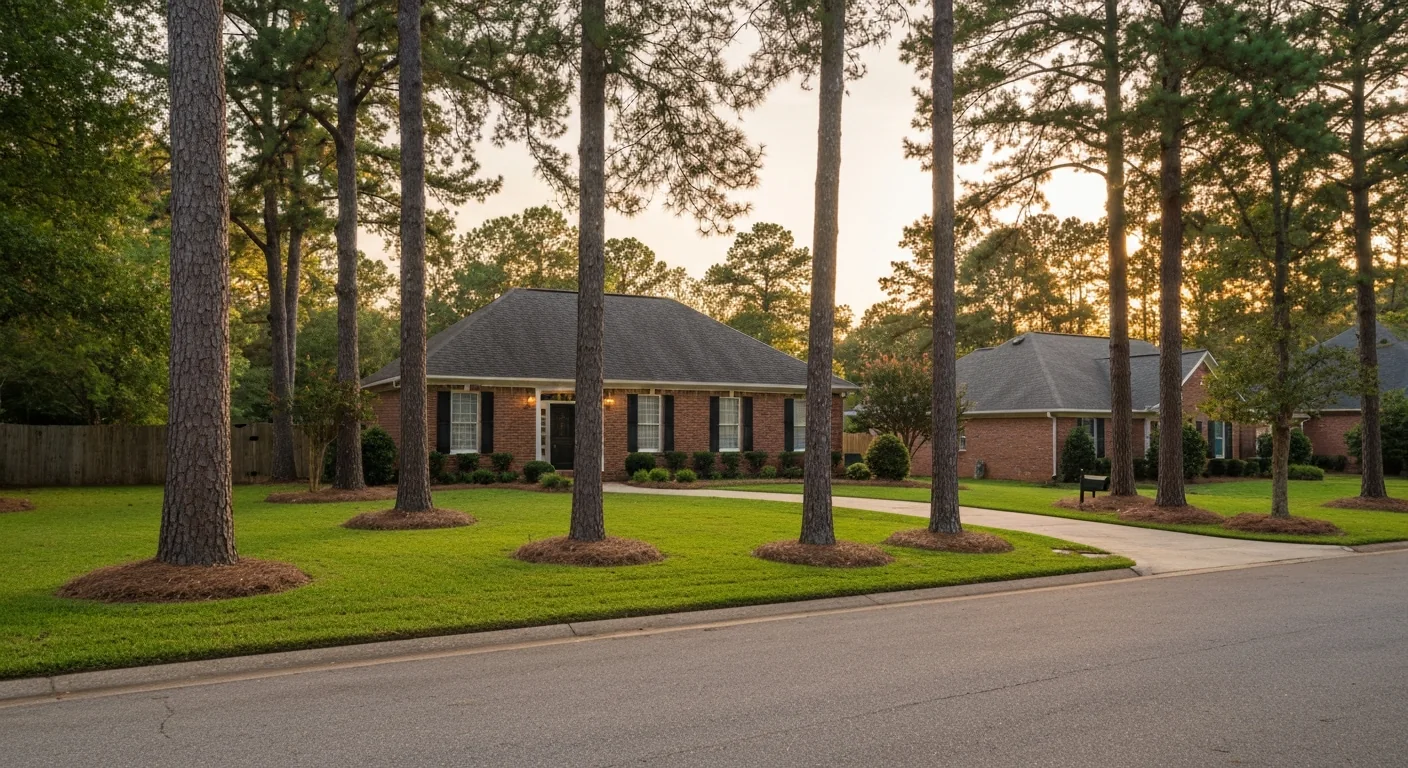
The housing stock itself feels familiar and different at once. Like Houston’s suburbs, south Charlotte has a large share of homes built after 2000 with open floor plans and two or three-car garages. What changes is the land and the setting: instead of flat lots on a grid carved out of coastal prairie, you get rolling, wooded lots with mature hardwoods and pines, and in towns like Weddington and Marvin, one-acre lots are normal rather than rare. You trade the master-planned MUD community for a wooded suburb, and many Houston buyers consider that a real upgrade in feel.
One practical note on the swap. Houston sellers are usually moving up in home price and down in property tax at the same time, which changes how you should plan the transaction. If you sell in Houston first and rent briefly here, you can buy in a strong, low-contingency position, which matters in south Charlotte’s best school zones where good homes still move quickly. I walk through this sequencing on every relocation call, because getting it right can save you a rate point and a bidding war.
Taxes Compared: The Trade Texans Do Not Expect
Taxes are the heart of any move from Houston to Charlotte NC, and this is where Texas pride runs into some math. Texans are rightly proud of no state income tax, but Texas pays for that with some of the highest property taxes in the country. North Carolina is the mirror image: it charges income tax but keeps property taxes low. Which structure wins depends on your income and your home value, so let me lay out all three taxes.
State income tax
This is the clear negative in the trade. Texas has zero state individual income tax, written into its constitution. North Carolina charges a flat individual income tax rate of 4.25% for 2025, dropping to 3.99% for 2026, with a scheduled path toward 3.49% in 2027 if revenue targets are met. There is no local income tax anywhere in North Carolina. On a $150,000 household income, the 2026 rate works out to roughly $6,000 a year that you simply did not pay in Texas. That is a real cost, and you should budget for it rather than pretend it away.
Property tax
This is where you win it back, and then some for many buyers. Harris County effective property tax rates commonly run 1.8% to 2.2% of market value once you stack county, city, school district, and MUD rates, and newer master-planned areas can run even higher. North Carolina’s effective rates are a fraction of that. In Union County, the county rate for fiscal year 2025-26 is 43.42 cents per $100 of assessed value; add the town rate and Weddington lands near 46.92 cents, Marvin near 49.05 cents, and Waxhaw near 72.42 cents. Charlotte inside Mecklenburg County runs a combined rate near 76.68 cents per $100. On a $450,000 home, a 2% Houston bill is around $9,000 a year; a 0.65% Union County bill is closer to $2,900. That gap is the engine of the whole trade.
South Carolina takes it even further for owner-occupants. Across the state line in Fort Mill and Indian Land, primary residences are assessed at just 4% of market value, which produces some of the lowest effective owner-occupied property tax bills in the region, often near 0.5% to 0.7%. For a Houston buyer used to writing a five-figure property tax check, the SC side can feel almost unreal, and it is a genuine reason many Texas transplants end up looking at Fort Mill and Indian Land, covered more in the “where to land” section below.
Sales tax
Sales tax is close to a wash. Houston’s combined sales tax is 8.25%. In the Charlotte metro, Mecklenburg County moved to 8.25% as well after a 1% transit tax took effect July 1, 2026, while Union County NC runs 6.75% and York County SC about 7%. So in the city proper the rate matches Houston, and in the suburbs where most Texas buyers actually land, it is lower. Groceries and prescriptions are largely exempt from the general rate in North Carolina. Sales tax will not decide your move, but it does not work against you.
If you want the tax question in plain terms, I break down the North Carolina versus South Carolina side of the state line in a short video on my channel, comparing living on the NC side versus the SC side on taxes, which is a useful primer before you pick a side. The short version: for a Houston buyer, the property tax relief is dramatic on either side, and whether NC or SC wins overall comes down to your income and which schools you want.
Talk to a local broker
Want your own Houston vs Charlotte tax comparison?
A quick call with a broker who works both the NC and SC sides of this market every week.
Book a 15-minute call →Schools: Houston Districts vs Union County and Fort Mill
Houston buyers tend to be sophisticated about schools, because in Houston the district and the specific zone make all the difference. You already know the drill: the big urban district has strong and struggling campuses side by side, while the prized suburban districts like Katy ISD, Cypress-Fairbanks, Fort Bend, and Conroe (The Woodlands) are the reason people pay up for certain zip codes. The 2023 Texas Education Agency takeover of Houston ISD only sharpened that suburban-district instinct for a lot of buyers.
The good news is that south Charlotte’s public districts hold up to what you are used to. Union County Public Schools is consistently among North Carolina’s top-performing districts, and its flagship high schools rank with the best in the state. Marvin Ridge High in Waxhaw sits in North Carolina’s top 1% and near the top of the Charlotte-area rankings, and Weddington High is close behind. These are the schools that anchor the towns most Houston buyers gravitate toward. Across the state line, Fort Mill School District in York County SC is regularly ranked the number one district in South Carolina and lands in the national top 1% on Niche for 2026, with three strong high schools.
Two mechanics differ from Texas. First, both North Carolina and South Carolina assign public schools by home address, so the house you buy determines the school, and there is generally no open-transfer cushion the way some Texas households work it. Second, Charlotte-Mecklenburg Schools, which covers Charlotte proper and Ballantyne, is large and varied, so the zone matters a lot inside it. Always verify the exact assignment for a specific address before you fall for a house, because a single street can straddle a boundary. If schools are your top filter, and for most Houston buyers they are, the strong options here are a genuine match for the suburban districts you are leaving, not a downgrade.
Weather, Pace, and Lifestyle: What Changes
The weather trade is the one that surprises Houston transplants most, in a good way. Houston has a humid subtropical climate with brutal length to its summer: it averages close to 100 days a year at 90°F or hotter, with oppressive humidity from May into October and a muggy-day probability that peaks above 90% in midsummer. Charlotte is also humid subtropical, but its inland elevation gives it a real four-season rhythm. It averages about 44 days a year at 90°F or above, a genuine spring and fall, mild winters, and only about 2 to 3.5 inches of snow a year. You trade a five-month indoor season for a long, usable outdoor spring and fall.
Then there is water risk, which is not a small thing coming from Houston. FEMA has ranked the Houston area at the top of the nation for hurricane risk, and Harris County has hundreds of thousands of properties in designated floodplains. Hurricane Harvey in 2017 dumped a historic amount of rain and caused roughly $125 billion in damage, and the memory of it shapes how Houstonians think about a heavy rain. Charlotte is inland and does not take direct hurricane hits; the worst it usually sees is the weakened remnant of a storm passing through as heavy rain and wind. For buyers who have lived through flood anxiety, that peace of mind is one of the quiet reasons this move sticks.
Pace and scale change too. Houston is the fourth-largest city in the country, a sprawling, endlessly diverse global metro of more than 7 million people with a world-class food scene, major museums, and big-league everything. Charlotte’s metro is roughly 2.7 to 2.9 million, meaningfully smaller and easier to navigate, with a growing but more compact restaurant and arts scene. What Houston transplants tell me they miss most: the incredible ethnic food diversity, the size and energy, and the Gulf an hour away. What they say they gained: milder weather, shorter commutes, wooded hills instead of flat prairie, and a calmer daily rhythm. Neither reaction is wrong; be clear with yourself about which one you are.
Getting Around, Flights Home, Beaches and Mountains
Both cities are driving cities, but the driving is not the same. Houston is famous for sprawl and its lack of traditional zoning, and in the 2025 INRIX traffic scorecard Houston drivers lost about 70 hours to congestion, ranking it the 8th most congested city in the country. Charlotte drivers lost about 48 hours, ranking 19th. The main arteries here are I-485, the loop around the city, plus I-77 north-south and I-85 toward the northeast. Charlotte has one light rail line, the LYNX Blue Line, but it serves a single corridor, so plan on a car. For a Houstonian used to the Katy Freeway and 45-minute one-way commutes, the daily driving here is noticeably shorter.
Getting back to Houston is easy, which matters when you still have people and maybe a job tether there. Charlotte Douglas International, CLT, is American Airlines’ second-largest hub, and it offers frequent nonstop service to Houston Bush Intercontinental (IAH), which is a United hub, on American, United, and Frontier. Flight time is about two hours and fifteen minutes. Nonstop service to Houston Hobby (HOU) has thinned out, so IAH is your reliable connection. You can leave south Charlotte in the morning and be at a Houston lunch table the same day.
Your weekend geography changes in an interesting way. In Houston, Galveston and the Gulf beaches are about an hour away, and that easy beach access is a real loss. In exchange, Charlotte puts the Blue Ridge Mountains around Asheville about two to two-and-a-half hours west, and the Carolina coast at Myrtle Beach or Wilmington about three-and-a-half to four hours east. You lose the one-hour Gulf beach, but you gain real mountains you never had near Houston, plus a drivable Atlantic coast. It is a different weekend menu, not a smaller one.
Differences Houston Buyers Do Not Expect
Every Houston buyer hits a few surprises when moving from Houston to Charlotte NC. Getting ahead of them makes the transition smoother.
- Hills and trees, not flat prairie. Charlotte is genuinely rolling and heavily wooded. After Houston’s dead-flat terrain, the hills, mature hardwoods, and pine canopy are the first thing most Texans notice, and usually love.
- You pay income tax now, and it shows on every paycheck. The flat North Carolina rate comes out of withholding, so your take-home changes even though your property tax bill drops. Plan the whole picture, not just the closing costs.
- Zoning exists here. Houston famously has no traditional zoning; Charlotte and its suburbs do, plus active HOAs in most newer neighborhoods. It keeps things tidy, but it is a layer of rules and dues Texans are not always used to.
- Well and septic exist outside town. In the more rural parts of Union County, some homes are on a private well and septic system rather than public water and sewer. It is manageable, but it changes inspections and maintenance, so know what a specific property has.
- Pollen season is a spectacle. Spring coats everything in a yellow film of pine pollen for a few weeks. It is harmless and it passes, but no one warns you about the first time your car turns chartreuse.
- The NC versus SC state line is a real decision. The metro straddles two states with different taxes, vehicle rules, and school districts. Fort Mill and Indian Land are in South Carolina; Weddington and Waxhaw are in North Carolina. Which side you choose changes your tax bill and your DMV.
Where Houston Buyers Land in South Charlotte
Here is how I match Houston priorities to specific south Charlotte submarkets. Most Texas buyers coming from a strong suburban district are optimizing for schools, space, and a reasonable commute, and that points to a short list.
- Weddington, NC: Large lots, top Union County schools, and a quiet, established feel. This is the closest thing to a premium master-planned Houston suburb without the MUD tax bill.
- Waxhaw, NC: A walkable historic downtown plus newer neighborhoods and Marvin Ridge schools. Houstonians who want a real Main Street to walk to often click with Waxhaw.
- Marvin, NC: Small, upscale, one-acre lots, and the Marvin Ridge zone. A favorite for buyers coming from The Woodlands or Sugar Land who want space and top schools.
- Matthews and Indian Trail, NC: More attainable price points, a genuine town feel in Matthews, and quick access to Charlotte. Good for buyers who want value without going far out.
- Ballantyne, NC: The polished south Charlotte corner inside Mecklenburg, with corporate offices, dining, and amenities. Appeals to buyers who want a shorter commute and a built-up, Energy-Corridor-style feel.
- Fort Mill and Indian Land, SC: Cross the state line for South Carolina’s very low owner-occupied property taxes and top-ranked Fort Mill schools. This is where many tax-focused Houston buyers end up.
If I had to generalize, the Houston buyer chasing the best schools and the most land leans Weddington, Marvin, or Waxhaw. The buyer optimizing purely for the lowest tax bill leans Fort Mill or Indian Land in South Carolina. The buyer who wants a shorter commute and a more built-up, amenity-rich setting leans Ballantyne or Matthews. There is a right answer for you; it depends on which Houston habit, the space, the school, or the low tax bill, you are least willing to give up.
How a Move from Houston to Charlotte NC Actually Works
Relocating from out of state is a different process than a local move, and moving from Houston to Charlotte NC has a few specific wrinkles worth planning for. The first is sequencing: do you sell in Houston first and rent here, or buy here before you sell? Because Houston homes often sell quickly and Charlotte prices run higher, most of my Texas clients sell first, land the equity, and buy in a strong position without carrying two mortgages. That also makes your offer more competitive in the better school zones, where good homes still move fast.
The second wrinkle is the search itself. You cannot drive over every weekend from 1,000 miles away, so we compress the home search into focused visits, use video walkthroughs between trips, and lean on my read of neighborhoods, school zones, build quality, and which lots drain well, things you cannot judge from Houston. The third is timing the two closings and the moving logistics across that distance, plus the temporary-housing question if the dates do not line up. None of it is hard with a plan; all of it is stressful without one.
This is where working with a broker who does relocation regularly pays for itself. I am dual licensed in North Carolina and South Carolina, I live in south Charlotte, and I help Texas buyers navigate exactly this move, including the tax-structure flip that trips people up. You can see how I work with relocating buyers on my buying page, and you can watch more market and neighborhood breakdowns on my YouTube channel, Living in South Charlotte. When you are ready to map it to your own numbers, a short call is the fastest way to get clarity.
Frequently Asked Questions About Moving from Houston to Charlotte NC
Is moving from Houston to Charlotte NC worth it?
For most Houston buyers, yes, if the priorities are milder weather, lower property taxes, less flood risk, and shorter commutes. You take on a new North Carolina income tax and a somewhat higher home price, and in return you cut your property tax bill by more than half and gain four real seasons. If cheap home prices, no income tax, and quick Gulf beach access are your non-negotiables, the move is harder to justify.
Is Charlotte cheaper than Houston?
Not really, and that surprises people. Overall cost of living is close, with Charlotte running roughly 6% to 9% higher than Houston, mostly because of home prices. The Charlotte metro median home is about $415,000 versus roughly $335,000 in the Houston area. Charlotte wins big on property taxes and loses on income tax, so the move is about tax structure and lifestyle, not a lower cost of living.
Do you save on taxes moving from Houston to Charlotte?
It depends on your income and home value. You start paying North Carolina’s flat income tax, 4.25% in 2025 and 3.99% in 2026, which Texas does not charge. But you shed Houston’s property tax, which commonly runs 1.8% to 2.2% of value, for a Charlotte-area rate around 0.65% to 0.80%. For buyers with a valuable home and moderate income, the property tax savings often outweigh the new income tax; for very high earners with a modest home, the math can flip.
Is Charlotte weather better than Houston?
Most transplants think so. Charlotte averages about 44 days a year at 90°F or above versus close to 100 in Houston, with far less oppressive humidity and a real four-season rhythm. Charlotte is inland, so it avoids direct hurricanes and the flood exposure that defines much of Harris County. You do get a few inches of snow a year and an occasional ice day, which Houston rarely sees.
Should I buy in North Carolina or South Carolina?
It depends on your priorities. North Carolina towns like Weddington, Waxhaw, and Marvin offer top Union County schools and larger lots. South Carolina towns like Fort Mill and Indian Land offer very low owner-occupied property taxes and top-ranked Fort Mill schools. Many Houston buyers optimizing for the lowest tax bill choose the SC side; those chasing specific NC schools and land stay north of the line.
Can I fly nonstop from Charlotte to Houston?
Yes. Charlotte Douglas is American Airlines’ second-largest hub, with frequent nonstop flights to Houston Bush Intercontinental (IAH) on American, United, and Frontier. The flight is about two hours and fifteen minutes, so staying connected to family, friends, and work in Houston is easy. Nonstop service to Houston Hobby (HOU) has thinned out, so IAH is the reliable route.
What will I miss most moving from Houston?
Most transplants miss Houston’s incredible food diversity, the size and energy of a top-five metro, and the Gulf beach an hour away. You gain milder weather, lower property taxes, wooded rolling terrain, shorter commutes, and mountains within a couple hours. Charlotte will not replicate Houston, but for buyers making the move for climate, water risk, and quality of life, the tradeoff generally works.
About the Author
I am Steve Jarrell, a licensed real estate broker with The Longleaf Group at eXp Realty and a south Charlotte resident. I am dual licensed in North Carolina and South Carolina, which is exactly what a Houston buyer weighing the state line and the tax trade needs, and I spent a decade in real estate marketing technology before going all-in as a broker. I specialize in helping relocating buyers land in the right south Charlotte town with the right school zone and the right tax setup. Reach me at 704-774-7170, steve@jarrellhomes.com, or thelongleafgroup.com, and learn more about The Longleaf Group.