
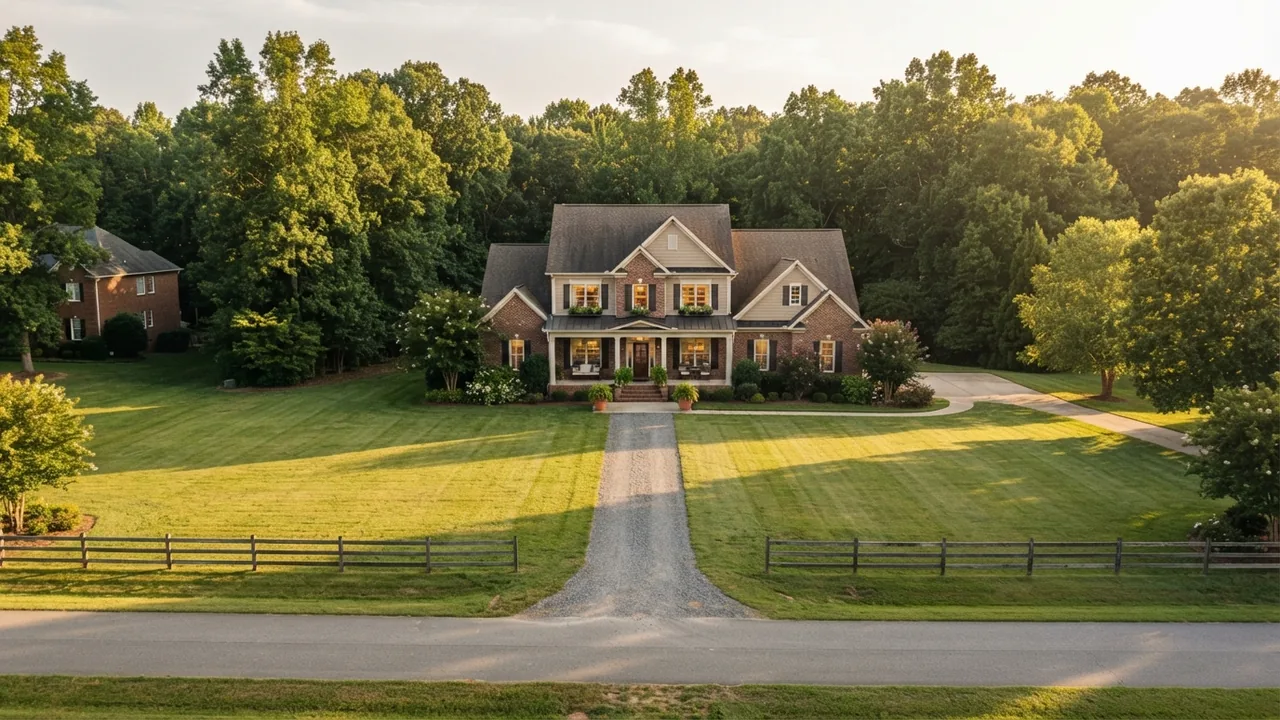
If you’re relocating and Weddington is on your short list, there’s a good chance someone has already told you that you need an acre to build here. It’s an easy thing to believe, because the lots really are large compared with most Charlotte suburbs. The rule itself just isn’t quite what people think: the district covering most of Weddington’s homes asks for 40,000 square feet, and an acre is 43,560.
That district is R-40, one of seven separate residential standards in Weddington’s Unified Development Ordinance. So the most common lot in town lands about 3,560 square feet short of the acre everyone quotes, and another district in the same ordinance allows 18,000.
None of that makes Weddington a small lot town. It means lot sizes in Weddington are set district by district rather than by one blanket rule, and which district your parcel falls under decides more than the size of your back yard. It drives how wide the lot is, how far off the road the house sits, whether you’re on county water or drilling a well, and whether you can add a guest house or a barn later.
I’m Steve Jarrell, I lead The Longleaf Group at eXp Realty, and Weddington is the town I live in and sell in. Everything below comes out of the town’s own ordinance, the August 2025 edition in force right now.
15 min read | By Steve Jarrell, The Longleaf Group at eXp Realty | Updated September 2026
Free · 26-Page Insider Guide
Weighing lot size against price across South Charlotte?
Towns compared, NC vs SC taxes and schools side by side, and the 5 mistakes out-of-state buyers make.
What This Guide Covers
- So how big are lot sizes in Weddington, really?
- The seven standards, and the 62,000 square foot spread between them
- Why the minimum is not the number that decides your yard
- Water, septic, and the half mile rule that decides which one you get
- What the big lot costs you, and what it quietly saves you
- Horses, barns and guest houses: what the land lets you do
- Frequently asked questions about lot sizes in Weddington NC
So how big are lot sizes in Weddington, really?
Start with the figure you’ll run into most often. Weddington sits in Union County about 20 miles southeast of Uptown Charlotte, and across most of its residential land the floor is 40,000 square feet. That’s the minimum in R-40, R-40(D) and the conventional side of R-CD, and it works out to 0.92 acres. Go up to R-60 and the floor is 60,000 square feet, or 1.38 acres. Go up again to R-80 and it is 80,000 square feet, which is 1.84 acres. Those are minimums, not averages, so what you actually walk on is usually bigger than what the ordinance requires.
The Short Answer
Weddington sets lot sizes by zoning district, not by a blanket one acre rule. The most widely applied minimum is 40,000 square feet, which is just under an acre, per Table 2 of the Town of Weddington Unified Development Ordinance in force as of August 2025.
Minimum lot size by district, Weddington NC, UDO Table 2 (source: Town of Weddington):
- R-80: 80,000 sq ft (1.84 acres), 150 ft minimum lot width
- R-60: 60,000 sq ft (1.38 acres), 125 ft minimum lot width
- R-40 and R-40(D): 40,000 sq ft (0.92 acres), 120 ft and 100 ft width
- R-CD conventional: 40,000 sq ft; R-CD conservation: 18,000 sq ft, averaging 20,000
- RE: 20,000 sq ft (0.46 acres), 100 ft minimum lot width
- Combined property tax rate: 46.92 cents per $100, NCDOR fiscal year 2025-2026 table
The acre question is one of the more common misconceptions I run into with relocating buyers, and I understand why. What I’d actually pull up on a listing is the zoning district on the parcel record rather than the acreage in the description, because the two tell you different things. Nearly an acre in R-40 is a conforming lot. That same nearly an acre in R-80 sits under the district minimum, and being under the minimum changes what you’re allowed to add down the road. Look up the district before you fall for the yard.
Talk to a local broker
Want to know what a specific Weddington lot allows?
Send me an address and I’ll pull the zoning district, the setbacks and the water situation before you write an offer.
Schedule a 15-Minute Introductory Call →704-774-7170 · steve@jarrellhomes.com · thelongleafgroup.com
The seven standards, and the 62,000 square foot spread between them
This is where the acre assumption really comes apart. Weddington’s ordinance carries seven residential lot standards, and the distance between the biggest and the smallest is 62,000 square feet. R-80 asks for 80,000. The conservation side of R-CD allows 18,000. Both are Weddington. Both are legal. If you arrive assuming every lot here is close to an acre, the second one will catch you off guard.
Here’s the full table as the ordinance writes it. Height is capped at 35 feet in every residential district.
| District | Minimum lot size | In acres | Minimum lot width | Front setback | Side setback | Rear setback |
|---|---|---|---|---|---|---|
| R-80 | 80,000 sq ft | 1.84 | 150 ft | 65 ft | 25 ft | 60 ft |
| R-60 | 60,000 sq ft | 1.38 | 125 ft | 60 ft | 25 ft | 60 ft |
| R-40 | 40,000 sq ft | 0.92 | 120 ft | 50 ft | 15 ft | 40 ft |
| R-40(D) | 40,000 sq ft | 0.92 | 100 ft | 40 ft | 12 ft | 40 ft |
| R-CD conventional | 40,000 sq ft | 0.92 | 120 ft | 50 ft | 15 ft | 40 ft |
| R-CD conservation | 18,000 sq ft | 0.41 | 100 ft | 40 ft | 12 ft | 40 ft |
| RE | 20,000 sq ft | 0.46 | 100 ft | 40 ft | 12 ft | 40 ft |
Two notes on reading that table against the ordinance. The front and side figures above are the residential ones; Table 2 sets a 75 foot front setback for non-residential uses in R-80, R-60 and R-40, and a larger side setback on corner lots in those three districts, at 45, 45 and 25 feet.
The conservation line is the one that catches people. R-CD lets a developer cluster homes on smaller lots and keep the rest of the tract as undivided open space, and the ordinance requires the lots in each major subdivision approved by Town Council to average at least 20,000 square feet. You get less ground of your own and more ground you share, and the shared part stays undeveloped. Some buyers want exactly that. Others come here expecting close to an acre of their own and don’t want a shared tract instead.
One more detail before you tour a clustered neighborhood. Where the lots run tight, the ordinance requires 30 feet of separation between the sides of each dwelling, measured house to house rather than to the property line. That is what governs how close your neighbor’s wall actually sits.
Why the minimum is not the number that decides your yard
Two lots can both be 40,000 square feet and give you completely different homes. The reason is width and setbacks, and in Weddington those move independently of lot size.
R-40 wants 120 feet of lot width and pushes the house back 50 feet from the front line, 15 feet off each side and 40 feet off the back. R-40(D) has the identical 40,000 square foot minimum but only asks for 100 feet of width, 40 feet in front and 12 feet on the sides. Same acreage on paper. Twenty feet narrower, and the house can sit 10 feet closer to the road. If you are picturing a wide frontage with trees on both sides, the district letter matters more than the square footage does.
Take the deepest case. In R-80 the ordinance holds the house at least 65 feet off the front line and 60 feet off the rear, so 125 feet of the lot’s depth is spoken for before you draw a wall. The 65 feet in front is the part you see from the street, and it’s why so many Weddington homes sit well back behind their own driveway.
The ordinance also carries a quiet requirement most buyers never read: every lot created has to have at least one existing or planted canopy tree for every 40 feet of street frontage, or fraction of it. On 150 feet of frontage, that’s four trees. Corner and cul-de-sac lots measure frontage differently from lot width, so read it off the plat. It’s why a new Weddington street has trees on it before anyone moves in.

Water, septic, and the half mile rule that decides which one you get
Here’s a question that rarely comes up until someone is already under contract: is this house on city water or a well? Weddington runs no water system of its own. Water and sewer in this part of Union County come from Union County Water, the county utility, and whether a given neighborhood is connected to it comes down to a distance test written into the town ordinance.
The rule is specific. If county or municipal water lines sit within one half mile of a subdivision of 10 to 39 lots, or within one mile of a subdivision of 40 lots or more, measured along the roadway to the nearest edge of the property, the developer has to connect. Outside those distances, homes go on private wells. That one measurement is why two neighborhoods on the same road can sit on different systems.
There’s a second path that shows up in newer neighborhoods. When the county can’t issue water permits for lack of capacity, the town may allow individual wells, but only if the developer still installs water lines built to county specification for fire flow, and only as an interim step. Those lots carry a condition requiring them to connect once capacity is available, and the homeowner pays the county’s fees to do it. Buy in one of those neighborhoods and you’re buying a well today and a connection bill at a date nobody can give you.
Septic is the other half of the picture, and a big part of why the lots are large at all. Weddington operates no sewer system of its own, so on an unsewered tract a buildable lot has to hold a house, a driveway and a working drainfield with room for a replacement field.
The town’s own conservation subdivision rules acknowledge this directly: they tell designers to check the suitability of soils for subsurface sewage disposal, and they allow individual wells and septic systems to be placed in the shared conservation land when there is not enough room on the lot itself. For a deeper read on how that works at the property level, see our guide to well and septic in Weddington NC.
Talk to a local broker
Comparing Weddington against Marvin or Waxhaw?
A quick call with a broker who works these Union County towns every week.
Book a 15-minute call →What the big lot costs you, and what it quietly saves you
Here is the part that surprises people who arrive expecting big land to mean a big tax bill. Only five of Union County’s fifteen municipalities charge a lower town tax rate than Weddington’s 3.5 cents, and the large lots and the low rate are the same decision.
The town’s rate for 2026 is 3.5 cents per $100 of valuation. The town spells out the math on its own tax page: a home assessed at $500,000 owes $175 to the Town of Weddington, and the solid waste fee is already inside that rate. Union County’s rate for fiscal year 2025-2026 is 43.42 cents, which puts the combined rate at 46.92 cents per $100, per the North Carolina Department of Revenue’s published county and municipal rate table. Union County did its most recent reappraisal in 2025, and it handles all assessments; you get two separate bills, and they are due September 1 and payable without penalty through January 5. One caveat on all of these figures: the NCDOR table excludes special district rates, and many Union County addresses also carry a fire district rate on top of the combined number, so price the specific parcel rather than the town.
Now compare that with the towns people usually shop against. On the same NCDOR table, Indian Trail’s combined rate is 60.42 cents and Waxhaw’s is 72.42. Take a home assessed at $1,000,000. In Weddington the combined bill is $4,692. In Indian Trail it’s $6,042. In Waxhaw it’s $7,242. That’s $2,550 a year against Waxhaw on the same assessed value, for crossing a town line.
That rate is low because the town runs almost nothing. Weddington operates no water system and no sewer system of its own, and solid waste is contracted, paid for inside the 3.5 cents. Union County does the assessing and most of the servicing. My read is that the two facts hold each other up: without town sewer you don’t get dense lots, and without dense lots there isn’t much for a town budget to do. The big lots and the 3.5 cents are two sides of one arrangement, and taking the lot means taking the service model with it.
The other side of that low rate is real. It buys you fewer town services, a well or a county tap instead of a utility you can call about, and a septic system you are responsible for maintaining. And Weddington’s tax edge shrinks fast against its closest neighbor: Marvin runs a combined 49.05 cents, or $4,905 on that same $1,000,000 home, just $213 more. If you’re choosing between the two, Marvin’s lot size rules are worth reading side by side.
Horses, barns and guest houses: what the land lets you do
Owning the land and being allowed to use it the way you pictured are not the same thing, and the ordinance is more specific here than most buyers expect.
If you’re picturing a barn or a paddock, start with the acreage floor. Agricultural use carries its own minimums: 80,000 square feet in R-80, 60,000 in R-60, and 40,000 in R-40 and R-CD. On top of that, any agricultural use with one or more livestock animals of 250 pounds or more at mature adult weight requires five acres.
Horses get a carve out. A lot whose agricultural use is exclusively one horse needs 40,000 square feet of contiguous fenced land set up to accommodate the animal. Two horses need 80,000 square feet of contiguous fenced land. Note the word contiguous: it is fenced, usable ground, not the total parcel with the house and driveway counted in.
Structures come with their own distances. Anything housing poultry or livestock has to sit at least 150 feet from every property line. A structure housing horses can come closer, at 60 feet. Corrals for cattle and horses are exempt from those setbacks entirely.
Guest houses are the other common question. The ordinance’s own term for them is “accessory family dwelling.” They’re allowed only on lots that meet the full minimum lot area for the district, one per deeded lot, and the guest house’s heated floor area cannot exceed 30 percent of the principal home’s gross floor area. They also have to meet the same setbacks as the main house and add an off street parking space.
On a home with 4,000 square feet of gross floor area, that caps the guest house at 1,200 heated square feet. Gross floor area is not the heated number on a listing, so pull the measurement the town uses.
Put those together and you get the rule I’d give anyone shopping land here: in Weddington the district is what you’re actually buying, and the square footage is just one line in it. Two listings a mile apart can look identical in the photos and allow completely different things in the back yard.
If you want a horse, start with the fencing, not the deed acreage. Weddington counts contiguous fenced land, and 40,000 square feet of it for one horse is a very different shape of lot than 40,000 square feet total with a house, a driveway and a drainfield already sitting on it. I’d want to see the fence line and the drainfield location on a survey before I trusted the acreage number on a listing.
If you are still deciding which South Charlotte town fits, the Weddington community page has schools, commute and neighborhood detail, and the South Charlotte communities hub lets you compare all thirteen areas we cover side by side.
Frequently asked questions about lot sizes in Weddington NC
What are the minimum lot size requirements for residential homes in Weddington NC?
As of the August 2025 Unified Development Ordinance, Weddington sets minimums by district: 80,000 square feet in R-80, 60,000 in R-60, 40,000 in R-40, R-40(D) and conventional R-CD, 20,000 in RE, and 18,000 in conservation R-CD with a 20,000 square foot subdivision average. There is no blanket one acre requirement anywhere in the ordinance. The most common floor, 40,000 square feet, is 0.92 acres.
Does Weddington NC have municipal water and sewer, or is it mostly well and septic?
Weddington runs no water or sewer system of its own. Water service, where it exists, comes from Union County Water. Under the town’s ordinance a developer must connect to county or municipal water lines if they are within one half mile of a subdivision of 10 to 39 lots, or within one mile for 40 lots or more, measured along the roadway. Outside those distances homes use private wells, and most of the town remains unsewered and on septic as of September 2026.
Can I have horses or other livestock on my property in Weddington NC?
Yes, within limits the ordinance sets, and they’re tighter than buyers expect. For one horse you’ll need 40,000 square feet of contiguous fenced land, and for two horses you’ll need 80,000 square feet of contiguous fenced land. Any agricultural use involving one or more livestock animals with a mature adult weight of 250 pounds or more requires at least five acres. Structures housing poultry or livestock must be 150 feet from any property line, and structures housing horses must be 60 feet from any property line.
What are the property tax rates in Weddington NC and Union County?
The Town of Weddington’s rate for 2026 is 3.5 cents per $100 of valuation, with the solid waste fee included, per the town’s tax page. Union County’s rate is 43.42 cents on the most recently published North Carolina Department of Revenue table, the one covering fiscal year 2025-2026, giving a combined rate of 46.92 cents per $100. If your home is assessed at $1,000,000, your combined property tax is $4,692. Union County performs all assessments and last reappraised in 2025.
Are there areas in Weddington NC that allow smaller lot sizes through conservation or cluster development?
Yes. The R-CD conservation option allows individual lots as small as 18,000 square feet, about 0.41 acres, provided the lots in each major subdivision approved by Town Council average at least 20,000 square feet. In exchange you get less private ground, and the rest of the tract stays undivided open space. Where those lots run tight, the ordinance requires 30 feet of separation between the sides of each dwelling.
What are the setback requirements for building on a residential lot in Weddington NC?
Your setbacks depend on which district your lot sits in, under UDO Table 2. For residential uses, R-80 requires 65 feet in front, 25 feet on the sides and 60 feet at the rear. R-60 requires 60, 25 and 60. R-40 requires 50, 15 and 40. R-40(D), conservation R-CD and RE all require 40 feet in front, 12 feet on the sides and 40 feet at the rear. Corner lots carry a larger side setback in R-80, R-60 and R-40, at 45, 45 and 25 feet. Maximum building height is 35 feet in every residential district.
About the Author
Steve Jarrell is a licensed North Carolina and South Carolina broker and the team lead of The Longleaf Group at eXp Realty, which he co-leads with his wife Amanda. He lives in Weddington, which means the zoning districts, the well and septic questions and the two separate tax bills in this guide are the same ones he works through with his own clients here. Before real estate, Steve joined VisualTour as President, led its rebrand to Paradym, and led the company to its acquisition by Constellation Software in 2020.
The Longleaf Group is an eXp ICON Team and a RealTrends Verified Top Team by Volume for 2026, with 140+ five-star reviews. If you want the zoning district, setbacks and water situation pulled on a specific Weddington address before you write an offer, call Steve at 704-774-7170.
Sources used in this guide: the Town of Weddington Unified Development Ordinance (August 2025 edition) for every district minimum, setback and land use rule; the Town of Weddington tax page for the municipal rate and billing dates; and the North Carolina Department of Revenue fiscal year 2025-2026 county and municipal tax rate table for the county and combined rates. All three were checked on September 18, 2026.