
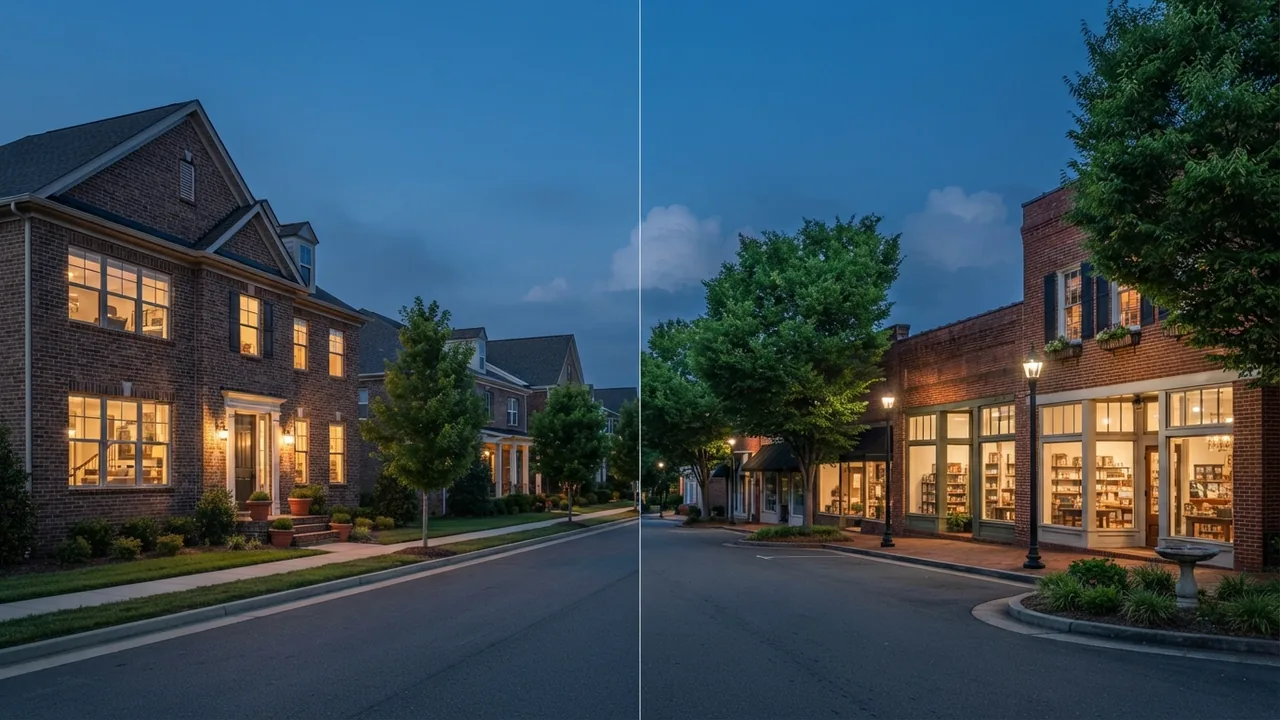
There’s a good chance someone has already told you that Monroe is the cheaper way into Union County. On the sticker price they’re right: the median home in Monroe sold for $388,643 over the three months ending August 2026, against $446,704 in Indian Trail, a gap of $58,061 (Redfin, August 2026). Nobody mentions the second bill. The City of Monroe levies 44.0 cents per $100 of assessed value and the Town of Indian Trail levies 17 cents. Union County charges both towns the same rate on top of that, so the municipal gap is the whole story, and it’s wide enough that the cheaper house in Monroe carries the bigger yearly tax bill.
Getting that reversal wrong is why a price-per-square-foot chart is the wrong tool for this decision. I’m Steve Jarrell. I live in Weddington, and I work both of these towns.
13 min read | By Steve Jarrell, The Longleaf Group at eXp Realty | Updated September 2026
Free · 26-Page Insider Guide
Choosing between two Union County towns?
Towns compared, NC vs SC taxes and schools side by side, and the 5 mistakes out-of-state buyers make.
What This Guide Covers
- So which town is actually cheaper?
- What you pay for the house
- What you pay every year after that
- Who sends your utility bills
- The drive, and how often you make it
- Schools, and the part people get wrong
- Two towns the same size, going different directions
- Frequently asked questions about Indian Trail vs Monroe
So which town is actually cheaper?
That turns on which bill you’re looking at, and you’ll be paying both. At each town’s median, Monroe saves you $58,061 on the purchase price and then costs you about $699 more in property tax every year you own the place. Indian Trail asks more up front and less afterward. One town takes it once and the other takes it a month at a time, so the question is which of those two your budget would rather absorb.
The Short Answer
Monroe is cheaper to buy into and more expensive to hold. Indian Trail is the reverse. The figures below cover Indian Trail and Monroe, North Carolina, for the three months ending August 2026 (Redfin) and fiscal year 2026 to 2027 (Town of Indian Trail, City of Monroe, NC Department of Revenue).
Key numbers, Indian Trail and Monroe, NC:
- Median sale price: $446,704 in Indian Trail, $388,643 in Monroe
- Combined tax rate per $100: $0.6042 in Indian Trail, $0.8742 in Monroe
- Tax on each town’s median home: $2,698.99 versus $3,397.52 a year
- Median days on market: 49 in Indian Trail, 60 in Monroe
- Free-flow drive to Uptown Charlotte: 18.4 miles, 24.7 miles
Here’s the thing buyers expect to matter here and it doesn’t: how long you’re staying. On the medians above, the tax gap would need more than eighty years to give back the $58,061 you saved on the purchase price, so no realistic holding period flips that. What I’d actually check is the monthly payment, because if your loan escrows, that tax difference gets collected twelve times a year whether or not you think about it again. My point isn’t that Monroe wins. It’s that the annual tax gap, real as it is, shouldn’t be the thing that decides this for you.
Talk to a local broker
Weighing Indian Trail against Monroe?
Fifteen minutes on the phone and you’ll have both tax bills, both drive times and a straight read on which town fits. No pressure, just answers.
Schedule a 15-Minute Introductory Call →704-774-7170 · steve@jarrellhomes.com · thelongleafgroup.com
What you pay for the house
Start with the purchase price. Indian Trail runs 14.9 percent above Monroe on the median sale price and 12.5 percent above it per square foot. Over the three months ending August 2026, Redfin put Indian Trail’s median at $446,704 and $198 per square foot, and Monroe’s at $388,643 and $176 per square foot. Same county, same school district, and a $22 gap on every square foot you buy.
The gap is also closing. Indian Trail’s median was down 5.1 percent against the same period a year earlier while Monroe’s was up 3.4 percent. Indian Trail is the market giving ground on price; Monroe is the one still gaining. If you’re reading a chart from eighteen months ago, the gap between these two towns was wider than it is now.
Sales volume tells you how much company you’ll have at a showing. Indian Trail recorded 254 sales in August 2026, up 42.9 percent year over year. Monroe recorded 175, down 11.4 percent. More homes are changing hands in the more expensive town, and it’s part of why Indian Trail listings clear in a median of 49 days against Monroe’s 60. If you already own in Indian Trail and are thinking about listing, here is what those numbers mean for a seller.
Eleven days is not a dramatic difference. It does mean that in Indian Trail you’re more likely to be deciding quickly on a house other people are also looking at, and in Monroe you’re more likely to have a weekend to think.
What you pay every year after that
Here’s the bill most buyers price in last, and it’s the one that runs backwards. Every property in both towns pays the same Union County rate, which the NC Department of Revenue lists at $0.4342 per $100 of assessed value for fiscal year 2026 to 2027, with the last reappraisal in 2025 and the next scheduled for 2029. That part is identical. The municipal rate on top of it is not.
Indian Trail adds 17 cents per $100 as its town rate. Its adopted FY2027 budget says so in the levy section, in words: seventeen cents per one hundred dollars of valuation. The budget also notes that this keeps Indian Trail among the lowest municipal rates of the fifty largest municipalities in North Carolina. The City of Monroe adds 44.0 cents per $100, held flat in its FY27 budget, with a further 16.0 cents on addresses inside the downtown district.
Add them up and Indian Trail comes to $0.6042 per $100 while Monroe comes to $0.8742, a difference of 27 cents per $100, or $2.70 a year for every $1,000 of assessed value. On a $400,000 house that’s $1,080 a year out of your pocket, $90 a month, for two houses at the same price.
Buy inside Monroe’s downtown district and the combined rate goes to $1.0342, which on Monroe’s median home works out to $4,019 a year against Indian Trail’s $2,699. That’s the widest version of this gap, and the district boundary is worth a look before you fall for a downtown address.
| Measure | Indian Trail | Monroe |
|---|---|---|
| Median sale price | $446,704 | $388,643 |
| Median price per square foot | $198 | $176 |
| Median days on market | 49 | 60 |
| Homes sold, August 2026 | 254 | 175 |
| Municipal tax rate per $100 | $0.17 | $0.44 |
| Union County rate per $100 | $0.4342 | $0.4342 |
| Combined rate per $100 | $0.6042 | $0.8742 |
| Annual tax on that town’s median home | $2,698.99 | $3,397.52 |
| Population | 45,030 | 43,081 |
Run it on each town’s own median and you can see the reversal plainly. The Indian Trail median home owes $2,698.99 a year. The Monroe median home, $58,061 cheaper to buy, owes $3,397.52. That’s $698.53 more every year on the less expensive house. Over a ten-year hold it’s just under $7,000, which is real money but still well short of what you saved at closing.
Who sends your utility bills
Monroe is one of a small group of North Carolina cities that runs its own utilities, and in Monroe that means all of them. The city provides electricity through six distribution substations and 296 miles of line, and it also provides natural gas, water and sewer. One local government bills you for everything, and its electric division carries the American Public Power Association’s Reliable Public Power Provider designation. In practice that means an outage is a call to a city department rather than to a national utility’s hotline.

Indian Trail works the other way. The town’s own utilities page lists two electricity providers inside town limits, Duke Energy and Union Power Cooperative, and which one serves a given house depends on the neighborhood. Water and sewer come from Union County Water for most of the town, with a small part of the Beacon Hills and Crismark neighborhoods served by Carolina Water Service instead. Natural gas comes from Piedmont Natural Gas. That’s four different companies, and the combination is set by your address, not by the town.
Ask for the last twelve months of bills on any house you’re serious about, in either town. In Indian Trail it’s the only reliable way to learn which power company you’re inheriting. In Monroe it tells you what a city-run system actually costs you, and a published rate sheet won’t tell you that.
There’s a second reason this matters. Because Monroe owns its water supply and Indian Trail is on the county system, the two have been under different conservation rules this year. Union County moved its system to Stage 2 restrictions during the drought in May 2026, and as of September 2026 Monroe is at Stage 1, voluntary. If you’re putting in a new lawn, check where each system stands the month you close.
The drive, and how often you make it
Indian Trail sits closer to Charlotte, and the gap is about ten minutes. Measured free-flow, without traffic, it’s 18.4 miles and about 26 minutes from the center of Indian Trail to Uptown Charlotte, and 24.7 miles and about 36 minutes from the center of Monroe. Ten minutes each way, on a good day.
Drive it five days a week and ten minutes each way adds up. Drive it twice and it mostly doesn’t. Rush hour on US-74 (the Independence Boulevard corridor, the main road from both towns toward Charlotte) stretches both of those numbers, and it stretches the Monroe number more because Monroe rides more of the congested stretch. If you’re in an office two days a week, which is how most people relocating here now work, you’re deciding whether $58,061 up front is worth forty extra minutes behind the wheel each week and about $699 a year in tax.
One thing Indian Trail does is put money behind that commute. Its FY2027 budget continues funding the 74X express bus for town residents who commute to Charlotte, which is a town-level commitment the county does not fund everywhere.
Schools, and the part people get wrong
Both towns are in Union County Public Schools, the sixth-largest public school system in North Carolina by the district’s own count. There is no separate Monroe district and no separate Indian Trail district. The town line on a listing tells you almost nothing about which schools a house is zoned for.
What does tell you is the address, and the answer is less tidy than the town names suggest. Schools are filed under the city of their mailing address rather than the town they serve, which is why the GreatSchools listing for Monroe includes Sun Valley, Piedmont, Parkwood and Wesley Chapel schools, several of which serve addresses nobody would call Monroe. Run the specific address through the UCPS school locator before you assume anything, and do it again before you write an offer. Zoning changes, and a listing sheet is not a source.
The mistake I see most often on a comparison like this one is treating it as a single decision when it’s really two. The money question and the daily-life question have different answers here, and I’d separate them on purpose. Monroe gives you a downtown, its own utilities and a lower price per square foot. Indian Trail gives you ten minutes back each way, a lower annual tax bill, and a market that’s currently clearing homes eleven days faster. So run the real tax number on two actual addresses instead of on two medians. Then pick on the drive, because that’s the one you’ll feel every week, and the tax gap is the one you’ll have stopped noticing by March.
Talk to a local broker
Want the tax math run on two real addresses?
A quick call with a broker who works Indian Trail and Monroe every week.
Book a 15-minute call →Two towns the same size, going different directions
The two towns are within about 2,000 people of each other. Indian Trail’s FY2027 budget puts its population at 45,030, citing the State Demographer, and ranks it the 25th most populous town in North Carolina. Monroe’s own economic development office put the city at 43,081 as of May 2025. The two counts are about a year apart, so read the 1,949 person gap as a close call rather than a precise margin.
What differs is character and trajectory. Monroe calls itself the county seat and commercial hub of one of the fastest-growing counties in North Carolina, and it has the downtown, the utility departments and the city government to match. Its FY27 budget passed with no rate increase and commits more than $20 million over four years to street paving and resurfacing.
Indian Trail is the newer of the two, a suburb that grew into a town, which is why it has two power companies and a county water system instead of its own. Monroe’s budget maintains a downtown. Indian Trail’s is still building one. You can see the age difference in the price per square foot, $198 against $176, which is usually what newer construction looks like in the numbers.
So you’re not choosing between a cheap town and an expensive one. You’re choosing between paying more once and paying more annually, between an established downtown and a newer one being built, and between one utility bill and four. If you want to see how both sit against the rest of the area, the South Charlotte market data hub tracks all thirteen towns and areas on the same figures, and the Indian Trail community page and Monroe community page go deeper on each one.
Frequently Asked Questions About Indian Trail vs Monroe
What is the cost of living difference between Indian Trail and Monroe NC?
Housing is the largest line in most budgets, and there Monroe was cheaper as of the three months ending August 2026: a median sale price of $388,643 against $446,704 in Indian Trail, and $176 per square foot against $198. Your property tax runs the other way. The combined county and municipal rate for fiscal year 2026 to 2027 is $0.8742 per $100 in Monroe and $0.6042 in Indian Trail, so an identical $400,000 house costs you $1,080 more per year in tax in Monroe.
What are the property taxes in Indian Trail vs Monroe NC?
For fiscal year 2026 to 2027, Union County levies $0.4342 per $100 of assessed value wherever you buy. Your town rate goes on top: $0.17 from the Town of Indian Trail, $0.44 from the City of Monroe, plus an extra $0.16 if your address sits in Monroe’s downtown district. Combined, that is $0.6042 per $100 in Indian Trail and $0.8742 in Monroe.
How long is the commute from Indian Trail to Charlotte compared with Monroe?
Measured free-flow in September 2026, you’re 18.4 miles and roughly 26 minutes from Uptown Charlotte starting in central Indian Trail, and 24.7 miles and roughly 36 minutes starting in central Monroe. Both figures lengthen at rush hour on the US-74 corridor, and the Monroe number lengthens more because it covers a longer stretch of it. Indian Trail’s FY2027 budget also funds the 74X express bus for residents commuting to Charlotte.
How do the Indian Trail and Monroe NC real estate markets compare?
Over the three months ending August 2026, Indian Trail’s median sale price was $446,704, down 5.1 percent year over year, with a median of 49 days on market and 254 sales in August. Monroe’s median was $388,643, up 3.4 percent year over year, with 60 days on market and 175 sales in August. Indian Trail is the larger and faster market; Monroe is the one still gaining on price.
What utilities serve Indian Trail NC versus Monroe NC?
Buy in Monroe and one bill comes from the city, which runs its own electric, natural gas, water and sewer utilities. Buy in Indian Trail and your electricity comes from either Duke Energy or Union Power Cooperative depending on the neighborhood, your water and sewer from Union County Water unless you land in the part of Beacon Hills or Crismark served by Carolina Water Service, and your natural gas from Piedmont Natural Gas.
Which areas of Indian Trail and Monroe NC should buyers look at first?
The address decides almost everything here, so start there. In Indian Trail that means confirming the power provider and the water provider, since both vary by neighborhood, and in Monroe it means checking whether the address falls inside the downtown district that adds $0.16 per $100 to the tax rate. In both towns, verify the school assignment through the Union County Public Schools locator rather than a listing sheet.
Is Indian Trail NC or Monroe NC safer?
That one belongs to a public dataset, not to an agent’s impression, because the numbers move and the definitions vary by reporting agency. Pull the reported figures for each town from the FBI Crime Data Explorer or the North Carolina State Bureau of Investigation and compare the same offense categories over the same years. The town-level breakdowns for each are covered separately in the Indian Trail crime rate and Monroe write-ups.
Where is there more new construction, Indian Trail or Monroe NC?
Indian Trail, on the indirect evidence. It moved 254 homes in August 2026 against Monroe’s 175, with volume up 42.9 percent year over year while Monroe’s fell 11.4 percent, and it carries a price per square foot 12.5 percent higher, $198 against $176, which is usually what a newer housing stock looks like in the numbers. These are all sales figures rather than permit counts, so for an actual new-construction count you’ll want Union County’s building inspections office.
About the Author
Steve Jarrell is team lead of The Longleaf Group at eXp Realty, which he co-leads with his wife Amanda. He lives in Weddington, inside Union County, which means he pays the same county rate discussed above and has spent years untangling which power company, water system and school zone actually attaches to a given address on this side of the county. Before real estate he joined VisualTour as President, led its rebrand to Paradym, and led the company to its acquisition by Constellation Software in 2020. He spent that career watching how listing data gets packaged for buyers, which is why he doesn’t take a price-per-square-foot number at face value.
Licensed in North Carolina and South Carolina, he leads an eXp ICON Team that holds 140+ five-star reviews. If you want the tax math run on your two actual addresses instead of on two medians, that’s a short conversation: 704-774-7170.