
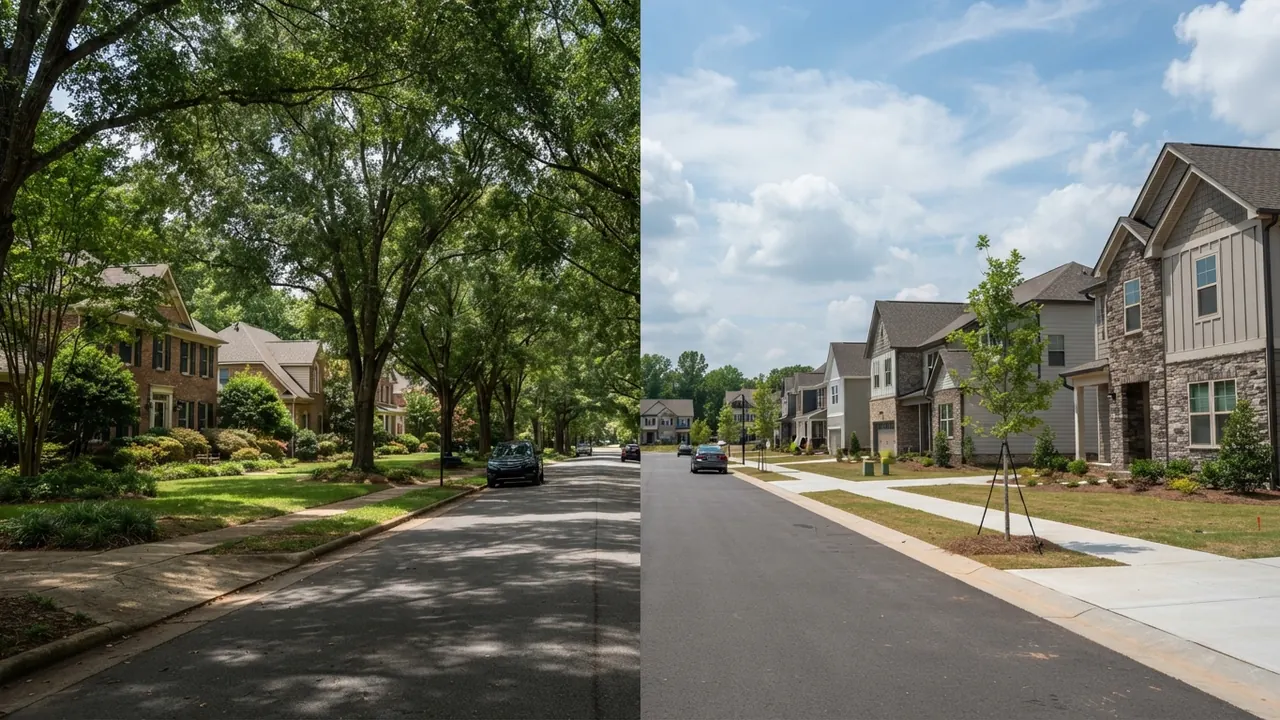
Matthews and Indian Trail sit on opposite sides of the Mecklenburg and Union County line, close enough that the road connecting them is named Matthews-Indian Trail Road. Buyers relocating to Charlotte shortlist both and then get stuck. Here’s the short version. Matthews is older and closer in, and it costs more. Indian Trail is newer and cheaper per square foot, and it has more people. The county line between them changes your school district and your tax bill, and it changes how new your house is likely to be.
How big is the money gap? About $96,000. Zillow’s Home Value Index put the typical Matthews home at $514,763 on July 31, 2026 against $418,576 in Indian Trail, and I pulled both figures on August 26, 2026. That is the headline, and it is not the whole decision. The median Matthews house was built in 1994 against 2004 in Indian Trail, while household incomes in the two towns land within $128 of each other.
So the question isn’t which town is nicer. It’s which set of tradeoffs you’d rather live with for the next decade. I’ll walk you through price, taxes, the drive to Charlotte, schools and growth, then tell you where I think each town wins.
Before the numbers, one framing that saves people a lot of time. Matthews and Indian Trail are not really competing on quality, they are competing on age. Matthews is largely built out with a median build year of 1994; Indian Trail is still filling in at 2004. Almost every difference below follows from that single fact, including the price gap, the school assignments, and how much active construction you end up living beside.
17 min read | By Steve Jarrell, The Longleaf Group at eXp Realty | Updated September 2026

Free · 26-Page Insider Guide
Weighing Mecklenburg County against Union County?
Towns compared, NC vs SC taxes and schools side by side, and the 5 mistakes out-of-state buyers make.
What This Guide Covers
- Matthews vs Indian Trail NC: The Short Answer
- What Does a House Cost in Matthews vs Indian Trail?
- Property Taxes: Why Comparing the Rates Misleads You
- How Long Is the Drive to Charlotte From Each Town?
- Schools: One County Line, Two Separate Districts
- Growth, New Construction, and Which Town Fits You
- Matthews vs Indian Trail: Common Questions
- About the Author
Matthews vs Indian Trail NC: The Short Answer
The Short Answer
Matthews vs Indian Trail comes down to age and price. Matthews, in Mecklenburg County, is the older and closer-in town, with a typical home value of $514,763 and a median build year of 1994. Indian Trail, in Union County, is newer and cheaper, with a typical home value of $418,576 and a median build year of 2004, and it has grown to 42,036 residents against Matthews at 30,577. Figures pulled August 26, 2026 from Zillow’s Home Value Index and the Census Bureau’s 2020 to 2024 American Community Survey.
The numbers that decide it:
- Typical home value: $514,763 in Matthews, $418,576 in Indian Trail, a gap of $96,187.
- Median year built: 1994 in Matthews, 2004 in Indian Trail.
- Union County’s tax rate is 43.42 cents per $100 for 2026 to 2027; Mecklenburg County’s is 49.27 cents.
- Mean commute to work: 25.2 minutes from Matthews, 28.2 minutes from Indian Trail.
- Matthews is served by Charlotte-Mecklenburg Schools; Indian Trail by Union County Public Schools.
- Median household income is nearly identical: $108,611 and $108,483.
That last number is the one that reframes everything. Two towns on either side of one county line, with household incomes $128 apart. On paper, the buyers choosing between Matthews and Indian Trail are the same buyers. They’re buying different things with the same money.
In Matthews they’re buying proximity and a downtown that already exists. In Indian Trail they’re buying square footage and a newer roof at a lower county tax rate, paid for with three extra minutes each way and a town still being built around them. Neither is the right answer in the abstract. One is the right answer for you.
Talk to a local broker
One county line, two very different sets of tradeoffs.
Tell me what matters most in your move and I’ll tell you which side of the line fits.
Schedule a 15-Minute Introductory Call →704-774-7170 · steve@jarrellhomes.com · thelongleafgroup.com
What Does a House Cost in Matthews vs Indian Trail?
Matthews costs about 23 percent more. Zillow’s Home Value Index for July 31, 2026 read $514,763 in Matthews and $418,576 in Indian Trail, a spread of $96,187, and closings tell the same story from a lower base: a June 2026 median sale price of $472,244 against $404,175. Whichever measure you use, you’re looking at a high five-figure difference between towns that share a border.
This is where most out-of-state buyers guess wrong. They assume the pricier town has bigger houses. Often it doesn’t. Matthews filled in through the 1980s and 1990s, so much of what sells there is a two-story under mature hardwoods near a downtown grid. Indian Trail grew later and outward, and its subdivisions were platted when builders were putting up larger floor plans on comparable or bigger lots. You frequently pay more in Matthews for less finished space.
The Census Bureau’s 2020 to 2024 American Community Survey puts it plainly. Median owner-reported home value: $445,100 in Matthews, $385,000 in Indian Trail. Median year of construction: 1994 against 2004. Ten years of building code and mechanical standards separate the typical house in one town from the typical house in the other.
Momentum flipped recently too. Matthews values were up 0.48 percent year over year in July 2026 while Indian Trail was down 2.39 percent. One year is not a trend, and I’d be careful reading much into a two-point swing either way, but it cuts against the reflex that the faster-growing town automatically appreciates faster. Stretch the window to five years and the ranking holds. Matthews went from $384,880 in July 2021 to $514,763, roughly a third. Indian Trail went from $336,091 to $418,576, about a quarter.
Why? Supply. Indian Trail still has land, and Union County keeps approving subdivisions on it. Matthews is close to built out and has been publicly selective about what it approves. Scarcity does what scarcity does. If your primary goal is the largest possible house for the dollar today, Indian Trail wins by a wide margin. If your primary goal is the tightest possible supply constraint under your resale value, that argument runs the other way, and it runs toward Matthews.
Our deeper breakdowns of cost of living in Matthews and cost of living in Indian Trail go line by line on the rest of the monthly picture.
Property Taxes: Why Comparing the Rates Misleads You
Union County taxes at a lower rate than Mecklenburg, and the gap is smaller than it looks. For fiscal year 2026 to 2027, Union County set its rate at 43.42 cents per $100 of assessed value and Mecklenburg County set its rate at 49.27 cents. On a home assessed at $500,000, that is $2,171.00 to the county in Indian Trail and $2,463.50 to the county in Matthews, a difference of $292.50 a year.
Then each town adds a municipal rate on top. Indian Trail held its rate at 17 cents per $100 for 2026 to 2027, which adds $850 on that same assessment and brings the Union County side to $3,021.00. Matthews levies 27.95 cents per $100, which adds $1,397.50 on that same assessment and brings the Mecklenburg side to $3,861.00. That is $840.00 a year more than Indian Trail, from the North Carolina Department of Revenue county and municipal rate table, checked August 31, 2026.
Here’s the part almost nobody accounts for, and it matters more than the rate spread. A rate is meaningless until you know what year the assessed value under it came from. North Carolina counties revalue on their own schedules. Mecklenburg County’s current values took effect January 1, 2023, on a four-year cycle. Union County’s took effect January 1, 2025. Union’s assessments are two years fresher, which in a market that kept climbing through 2023 and 2024 means they sit closer to what houses actually sell for.
Follow that through and your conclusion changes. Comparing 43.42 cents to 49.27 cents flatters Union County, because Union’s lower rate sits on a value that has already caught up to the market while Mecklenburg’s higher rate still sits on a 2023 number. When Mecklenburg revalues, the county typically drops its rate to offset the jump, though individual bills move in both directions depending on how much a specific neighborhood appreciated. Do not build a ten-year budget around today’s rate gap.
Do this instead. Pull the current tax bill for the exact address you’re considering from the county tax office, on both sides of the line, and compare those two numbers rather than the two rates. A real bill already accounts for the assessment, the municipal rate, the service district, and any solid waste fee. Two houses at the same list price on opposite sides of this county line can carry annual bills that differ by more than a thousand dollars, and a rate comparison will never show you that.
On the Matthews side of that line, here is the rate a Matthews address carries this year and what it works out to at a few common price points, so you have one of the two numbers before you start calling the tax office.
How Long Is the Drive to Charlotte From Each Town?
Three minutes. That is the average difference, and it surprises almost everyone. The Census Bureau’s 2020 to 2024 American Community Survey puts the mean travel time to work at 25.2 minutes for Matthews commuters and 28.2 minutes for Indian Trail commuters. Those figures cover 13,061 Matthews workers and 18,629 Indian Trail workers, so they are not small samples, and they include every kind of trip, not only the run into Uptown Charlotte.
Why so close, when Indian Trail sits several miles further out? Because much of this commute has nothing to do with distance. Matthews sits inside Interstate 485, the beltway ringing Charlotte, and Indian Trail sits outside it, yet both feed the same two corridors: US-74, which becomes Independence Boulevard running into Charlotte, and the slower surface route along Monroe Road. Merge onto Independence and you are in the same line of cars either way.
That shared bottleneck cuts both ways. When Independence backs up it backs up for both towns, and Matthews loses the advantage its shorter distance should give it. When it flows, Matthews wins clearly. Plan around the variance, not the mileage.
Matthews has one real structural advantage and one long-dated one. The real one is optionality: from Matthews you can reach SouthPark or Ballantyne without touching Independence at all, which gives you a working alternative on a bad morning. The long-dated one is the LYNX Silver Line, the light rail corridor the Charlotte Area Transit System has planned running east through Matthews. It sits in pre-project development and it is not funded all the way out to Matthews, with no construction date set. Treat it as possible upside, not a reason to buy. I cover where it stands in our post on the Matthews to Charlotte commute.
Indian Trail has a structural advantage of its own that gets misread. The Monroe Expressway, the NCDOT toll road that opened on November 27, 2018, runs from US-74 near I-485 southeast toward Marshville. It will not speed up your trip into Charlotte. What it does is pull through traffic bound for Monroe and points east off the old surface route, which takes pressure off the stretch of US-74 that Indian Trail residents actually use. Commuting the other direction, it is a real time saver. You can see the route and the tolls on NCDOT’s Monroe Expressway page.
Neither town is a hard commute by the standards of the cities most relocating buyers are leaving, and both are worse than the map suggests at 7:45 on a weekday. Our breakdown of the Indian Trail to Charlotte commute walks the routes one at a time.
Talk to a local broker
Still torn between Matthews and Indian Trail?
A quick call with a broker who works both sides of this county line.
Book a 15-minute call →Schools: One County Line, Two Separate Districts
This is the cleanest difference of the lot. Matthews is served by Charlotte-Mecklenburg Schools, the countywide district covering Charlotte and its Mecklenburg County towns. Indian Trail is served by Union County Public Schools, the countywide district for Union County. Crossing the county line does not move you between two schools. It moves you between two entire systems, with separate calendars, assignment rules, and administrations. That is a bigger deal than it sounds.
That distinction carries more weight than any single school comparison. Charlotte-Mecklenburg Schools is one of the largest districts in the country and runs a magnet and choice program alongside neighborhood assignment, so a Matthews address gives you a home school plus applications you can make elsewhere in the county. Union County Public Schools is smaller and its assignment is more strictly geographic. In Indian Trail, the address you buy is close to the final answer.
On performance, I’ll point you at the source rather than characterize it myself. The North Carolina Department of Public Instruction publishes an annual school report card for every public school in the state, with growth, proficiency, and demographic data for each one. Both districts appear there under the same measures, which makes it the only apples-to-apples comparison available to you. Look up the specific schools attached to the specific address, not the district average, because both districts contain a wide range.
Two warnings, and they cost buyers real money every year. Boundaries change. Both districts redraw attendance zones as schools fill and new ones open, and Union County redraws more often because it absorbs more growth, so a listing advertising a school assignment is describing today rather than next August. Verify assignment through the district’s own locator tool using your exact street address, never the subdivision name and never a portal. Subdivisions get split down the middle by attendance lines more often than you would expect.
The practical takeaway is this. If you want the option to apply outside your neighborhood school, Matthews and the Charlotte-Mecklenburg system give you more doors. If you would rather buy an address and be done thinking about it, the Union County model in Indian Trail is simpler to plan around.
Indian Trail’s lower rate shows up against Mint Hill too, and there Union County’s water and sewer bill closes more than half of the tax gap; here is which of Mint Hill or Indian Trail costs less to own once every yearly bill is counted.
Growth, New Construction, and Which Town Fits You
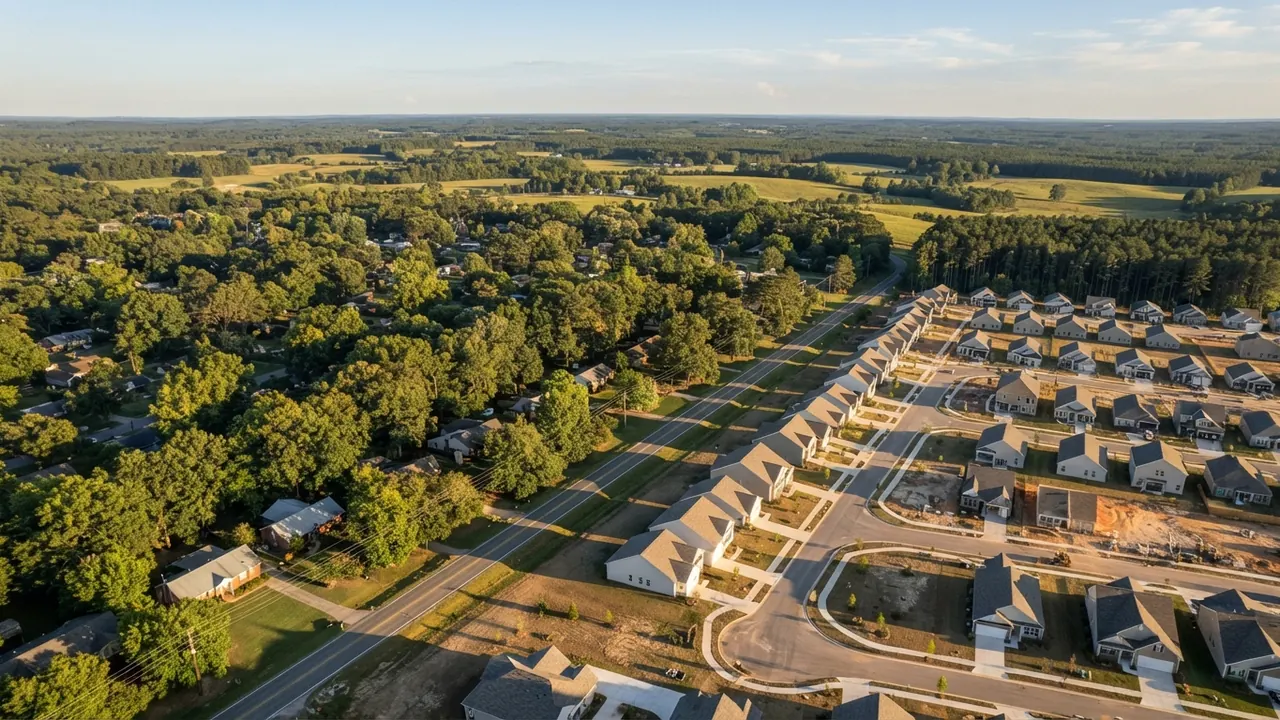
Indian Trail is the bigger town now, which catches people off guard. The American Community Survey puts it at 42,036 residents against 30,577 in Matthews, and two decades ago that ranking ran the other way. Indian Trail absorbed the growth pushing southeast out of Charlotte because Union County had land where Mecklenburg had run out.
That one fact drives almost everything else you have read here. New construction concentrates where land is available, which is why Indian Trail’s median build year sits a decade later, and why Indian Trail is still adding road capacity while Matthews maintains what it has. Indian Trail’s town facilities include parks like Crooked Creek and Crossing Paths, and the newer ones went in as the subdivisions around them filled. Matthews built its civic life earlier. The Matthews Community Farmers’ Market runs on Saturdays year-round, and the walkable Trade Street core it anchors is the kind of thing a town cannot retrofit.
Growth has a cost, and in Indian Trail you pay it in construction. Roads get widened while you live on them. If you buy a new build backing onto trees, ask what is zoned for those trees, because in Union County the answer is often more houses. Check the zoning map before you fall for a lot.
The zoning check is the piece of homework I would not skip. In Union County a treeline behind a new build is frequently the next phase rather than a permanent buffer, and the parcel data is public. Pull the zoning map for the lots behind the one you like before you fall for the view, because that view is priced into what you are paying and nothing guarantees it stays.
Matthews has the opposite problem. A town that is close to built out cannot grow its way into new amenities quickly, and its inventory skews older, so more of your budget goes to systems that are due for replacement. Buyers who want new frequently land in Indian Trail for that reason, and our guide to new construction homes in Indian Trail covers what the builders there are actually delivering. If you want to see the town before you shortlist it, I walked through the whole place in my Indian Trail relocation video.
So where does that leave the decision? Choose Matthews if proximity beats square footage for you and you are comfortable with an older house in a tighter market. Choose Indian Trail if you want more house and newer systems for the money, and three extra minutes of average commute plus years of construction are acceptable trade.
Here is the tradeoff stated plainly, because it decides most of these. Matthews is better for proximity, walkability, and supply-constrained resale value, and it is worse for house size, house age, and what you will spend on deferred maintenance. Indian Trail is better for square footage and newer construction, and it is worse for commute variability and construction disruption. You are picking which of those you would rather live with.
Matthews vs Indian Trail: Common Questions
How do commute times to Uptown Charlotte compare from Matthews and Indian Trail during rush hour?
Closer than you would guess from the mileage. Census Bureau figures for 2020 through 2024 put mean travel time to work at 25.2 minutes from Matthews and 28.2 minutes from Indian Trail. Both towns funnel you onto US-74, called Independence Boulevard on the Charlotte end, so at peak you sit in the same bottleneck either way. Matthews pulls ahead when traffic flows, because it sits inside the Interstate 485 beltway and gives you more ways around a backup.
Which town has better public schools, Matthews or Indian Trail?
They sit in different districts, so this is a district question first. A Matthews address puts you in Charlotte-Mecklenburg Schools. An Indian Trail address puts you in Union County Public Schools. Rather than characterize either one, look them up on the North Carolina Department of Public Instruction school report cards, which publish growth and proficiency data for every public school in the state on the same measures. Check the schools assigned to your exact address, because both districts span a wide range.
What are the differences in property taxes and cost of living between Matthews and Indian Trail?
Union County set its 2026 to 2027 rate at 43.42 cents per $100 and Mecklenburg County set 49.27 cents, so on a $500,000 assessment your county portion runs $2,171.00 in Indian Trail against $2,463.50 in Matthews. Indian Trail adds 17 cents of municipal rate, bringing that side to $3,021.00, and Matthews adds its own on top. Watch the assessment year too. Mecklenburg’s values date to January 1, 2023 and Union’s to January 1, 2025, which makes a straight rate comparison flatter Union County.
What is the lifestyle like in each town, including dining, shopping, and community events?
Matthews gives you a walkable core around Trade Street, where the Matthews Community Farmers’ Market runs on Saturdays year-round. Indian Trail’s public life is newer and more spread out, built around town parks rather than a historic main street. Indian Trail is working on a town center. Matthews already has one.
Does Indian Trail have more newer homes and larger lots than Matthews?
Yes, and you can measure the gap. The median Indian Trail home was built in 2004 against 1994 in Matthews, which is a decade of difference in building code and mechanical systems. Indian Trail also has land Matthews does not, so its subdivisions were platted with more room and builders remain active there today.
How do parks, greenways, and recreation compare between Matthews and Indian Trail?
Both towns invest, on different timelines. Indian Trail’s municipal facilities include Chestnut Square Park, Crooked Creek Park, and Crossing Paths Park, most of them built as the subdivisions around them filled. Matthews layers its town parks over the Mecklenburg County greenway network, which is more extensive because the county has been building it longer. If connected greenway mileage matters to you, that tilts toward Matthews.
What are the growth trends for each town, and how might that affect traffic?
Indian Trail has already passed Matthews in population, 42,036 to 30,577, and it keeps adding rooftops because Union County still has land to build on. Expect road work there for years. Matthews grows slowly now, so what you feel on a Matthews commute is through traffic on US-74 rather than new subdivisions inside town.
Which town gives better access to job centers outside Uptown Charlotte?
Matthews, clearly. From a Matthews address you can reach SouthPark and Ballantyne without ever touching Independence Boulevard, which matters if your office sits anywhere on Charlotte’s south side. Indian Trail’s advantage runs east instead. The Monroe Expressway, the NCDOT toll road that opened November 27, 2018, makes your trip toward Monroe and eastern Union County considerably faster.
About the Author
I’m Steve Jarrell, a broker and REALTOR with The Longleaf Group at eXp Realty, and I live in Weddington, which puts me on the Union County side of this exact line. Matthews and Indian Trail are both core markets for our team, and I serve buyers on both sides of the Mecklenburg and Union County border, which is the line this whole comparison turns on. Before real estate I led Paradym, a real estate marketing technology company, through its acquisition by Constellation Software in 2020, so I came into this business already thinking about how buyers research a market before they ever call anyone. If you want a straight read on which side of the line fits your situation, reach out. Call or text 704-774-7170, email steve@jarrellhomes.com, or visit thelongleafgroup.com.