
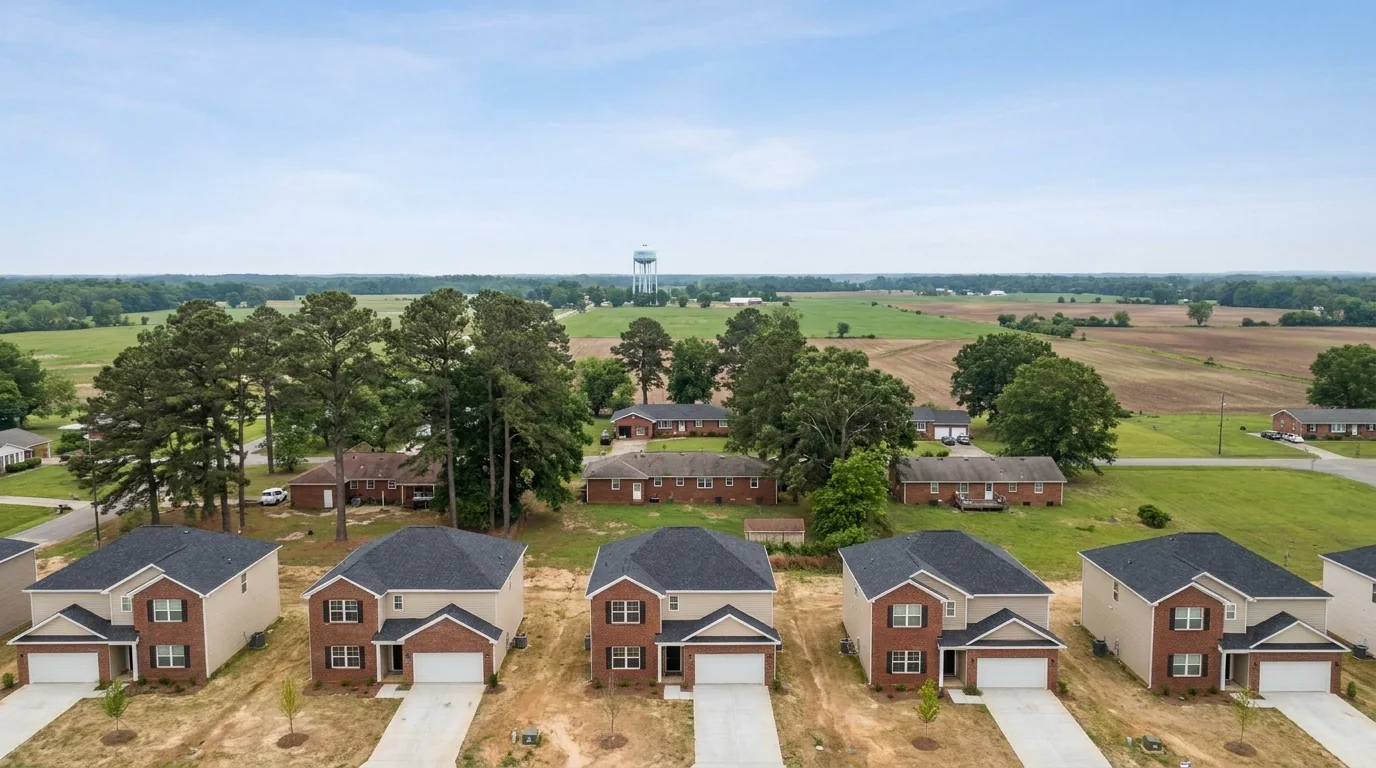
If you’re researching Monroe NC growth from another state, you’ve probably noticed two things that seem to contradict each other. Monroe is one of the fastest expanding cities in the Charlotte region, yet homes here still cost far less than the towns a few exits west. That gap is the whole story. Monroe NC growth is what makes the value possible, and it’s also what creates the traffic, the construction dust, and the school crowding that longtime residents grumble about. This guide walks through the real numbers behind Monroe NC growth so you can decide whether it’s a reason to buy here or a reason to look elsewhere.
17 min read | By Steve Jarrell, The Longleaf Group at eXp Realty | Updated September 2026
Free · 26-Page Insider Guide
Which South Charlotte town is right for you?
Towns compared, NC vs SC taxes and schools side by side, and the 5 mistakes out-of-state buyers make.
What This Guide Covers
- Monroe NC Growth at a Glance: Is It Too Fast?
- How Fast Is Monroe NC Growing? The Population Numbers
- What Is Driving Monroe NC Growth: Jobs, Land, and the Expressway
- The Growing Pains: Traffic, Schools, and Roads
- Downtown Monroe: Growth You Can Actually See
- What Monroe NC Growth Means for Home Buyers
- Is Monroe Growing Too Fast? Where I Land
- Monroe NC Growth FAQ
Monroe NC Growth at a Glance: Is It Too Fast?
The Short Answer
Steve Jarrell of The Longleaf Group tracks Monroe as one of the fastest growing cities in the Charlotte region, up from 34,699 residents in the 2020 census to roughly 44,000 in 2026, about 27% in six years, according to U.S. Census Bureau counts and World Population Review estimates. That Monroe NC growth is mostly a buyer advantage: more homes, more jobs, and prices well below the towns to the west. The tradeoff is traffic and school crowding the county is still catching up on.
Key numbers right now:
- Monroe population: about 34,699 in 2020 to roughly 44,000 in 2026, near 27% growth (U.S. Census Bureau, World Population Review)
- Union County: about 238,267 in 2020 to roughly 267,674 in 2025, the fastest growing county in the Charlotte metro (U.S. Census Bureau estimates)
- Median home sale price: about $395,000 to $400,000 (Redfin, 2026), well under the towns a few exits west
- Monroe Expressway: an 18 mile toll bypass that opened in 2018 and saves up to 25 minutes off old U.S. 74 (NCDOT)
- New investment: the 769,880 square foot Union Logistics Park and an approximately $300 million ATI Specialty Materials expansion approved in 2026 (City of Monroe)
- Schools: Union County Public Schools serves 41,241 students, the 6th largest district in the state
Here’s the plain read on Monroe NC growth. It’s fast, it’s real, and for most relocating buyers it works in your favor. The reason towns like Weddington and Marvin cost double is that they finished growing years ago and locked their large lots in place. Monroe still has open land, so builders are still building, and that keeps prices honest. When people ask whether Monroe is growing too fast, what they usually mean is whether the roads and schools can keep up. That’s the fair question, and the answer depends on which side of the city you land on.
Monroe is the Union County seat and sits about 25 miles southeast of Uptown Charlotte. For most of its history it was a quiet textile and county-government town. The current wave of Monroe NC growth is the ripple of Charlotte pushing outward, meeting a city that had the land and the water and sewer capacity to absorb it. That combination is why Monroe NC growth has been steady rather than a one-year spike, and why I expect it to continue through the rest of the decade.
Talk to a local broker
Trying to read the Monroe, NC market before you commit?
I work both sides of the Charlotte border every week and can tell you which parts of Monroe are worth the growth and which to think twice about. No pressure, just answers.
Schedule a 15-Minute Introductory Call →704-774-7170 · steve@jarrellhomes.com · thelongleafgroup.com
How Fast Is Monroe NC Growing? The Population Numbers
Start with the city itself. The 2020 census counted 34,699 people in Monroe. By 2026, World Population Review and Census Bureau estimates put the city near 44,000, which is roughly 27% growth in six years. Very few cities in North Carolina are adding population at that clip. That single figure is the clearest way to picture Monroe NC growth: more than one in four residents you pass on the street today were not here when the last census was taken.
Zoom out to the county and the trend is just as strong. Union County held about 238,267 residents in the 2020 census and reached an estimated 267,674 by 2025. Local reporting has pointed to Union County as the fastest growing county in the Charlotte metro, and one of the fastest in the entire state. You can read the county-level breakdown in the Enquirer-Journal coverage of the Union County population report. Monroe NC growth is the county trend concentrated in its largest city.
Why does the population math matter to a buyer? Because population growth is what tells you whether values will hold. A shrinking town is a risky place to sink your money. A city adding thousands of residents a year has built-in demand for housing, which supports resale value even in a soft market. That’s the quiet upside of Monroe NC growth that rarely makes the headlines. You’re buying into rising demand rather than fighting a fading one.
Where the new residents are landing
Not every part of the city feels the growth equally. The newer subdivisions cluster on the north and west sides of Monroe, toward the Wesley Chapel and Stallings line, where the land was open and the school assignments tend to be stronger. Prices step up in those areas accordingly. The older, more established neighborhoods closer to downtown and to the east have seen less new construction and hold the lower end of the price range. When you tour Monroe, you’re really touring two cities: the fast-changing western edge and the settled historic core.
This split matters for anyone weighing Monroe NC growth as a buyer. If you want brand new construction with a two-car garage and a warranty, you’ll be shopping the west side, and you’ll pay for the convenience of a shorter drive toward Charlotte. If you want the most house for your money and don’t mind an older build, the eastern and southern stretches of the city reward you. I walk buyers through both in detail on our best neighborhoods in Monroe guide.
What Is Driving Monroe NC Growth: Jobs, Land, and the Expressway
Population doesn’t rise on its own. Something has to pull people in, and Monroe NC growth is riding three forces at once: available land, a serious jobs base, and a highway that finally fixed the region’s worst bottleneck. Understanding those three drivers tells you whether the growth is a bubble or a foundation. In Monroe’s case, it looks like a foundation, because the jobs and the infrastructure are arriving alongside the rooftops rather than years behind them.
The Monroe Expressway changed the math
For decades, U.S. 74 through Monroe was a stop-and-go slog past roughly two dozen traffic lights, and it capped how far commuters were willing to live from Charlotte. That changed when the Monroe Expressway opened in November 2018. It’s an 18 mile, all-electronic toll bypass running from U.S. 74 near I-485 out to the U.S. 74 corridor between Wingate and Marshville. According to NCDOT, it saves local drivers as much as 25 minutes on a daily commute.
That single road reset what living in Monroe means. A house that felt an hour from the city suddenly felt reachable, and Monroe NC growth accelerated behind it. The expressway is a toll road, so you pay for the time savings, but for a commuter the trade is usually worth it. Business North Carolina has reported on the decades of debate that finally produced the highway, roughly an $800 million project, and the payoff shows up in every new subdivision that has gone up since.
A real jobs base, not just bedrooms
Plenty of fast-growing suburbs are pure bedroom communities where everyone drives somewhere else to work. Monroe is different, and that difference makes its growth more durable. The city has an aviation and manufacturing cluster anchored by the Charlotte-Monroe Executive Airport, and it actively recruits industry through its economic development office. You can see the current pipeline on the city’s Develop Monroe site. Jobs close to home are a big part of why Monroe NC growth has staying power.
The recent wins are concrete. In 2026 the City of Monroe approved an annexation tied to an approximately $300 million investment by ATI Specialty Materials, a metals producer expanding its local footprint. Separately, Edgewater Ventures selected Monroe for Union Logistics Park, a 769,880 square foot Class A industrial development on North Sutherland Avenue, with the first building expected to deliver in early 2027. Those are the kinds of announcements that turn Monroe NC growth from a housing story into an economic one.
Land and price still on your side
The third driver is the simplest. Monroe still has developable land, and land is what most of South Charlotte has run out of. That supply keeps prices reasonable even as demand climbs. The median home sale price in Monroe sits around $395,000 to $400,000 in 2026 according to Redfin, which is roughly $75,000 below the broader Union County median and less than half of what the estate towns to the west command. Monroe NC growth is essentially the market building the homes that the pricier towns no longer can. For a full price breakdown, see our Monroe housing market update.
Before the downside, one thing worth setting straight about growth in a town like this. Fast growth is only a problem for a buyer when the infrastructure is arriving later than the rooftops. That is the question to ask about any Monroe subdivision you tour: not whether the town is growing, but whether the road and the school serving that specific address are on a funded plan or on a wish list. Those are two very different purchases.
The Growing Pains: Traffic, Schools, and Roads
Any real look at Monroe NC growth has to cover the downside, so here it is. Fast growth strains the things that were built for a smaller town. The two pressure points a buyer should look at hardest are traffic on the surface roads and capacity in the west-side schools. Both are real, both are being addressed, and neither is a reason to rule the city out on its own. But you should walk in with clear eyes about where the pressure points sit.
Traffic first. The Monroe Expressway pulled a lot of through-traffic off U.S. 74, but the local arteries feeding the new subdivisions were designed for a quieter era. Roads like Secrest Shortcut, Rocky River, and the stretches near the Wesley Chapel line back up at peak hours, and NCDOT has intersection improvements in the pipeline to catch up. If a short, predictable commute is your top priority, drive your specific route at 8 a.m. before you fall in love with a house. Monroe NC growth has outrun a few of these roads, and you want to know which ones.
Schools are the other pressure point. Union County Public Schools is the 6th largest district in North Carolina and serves 41,241 students across the 2026-2027 year. It’s a strong district overall, but the fastest-growing attendance zones on Monroe’s west side feel the crowding first, which shows up as mobile classroom trailers and periodic redistricting. If schools drive your decision, confirm the exact assignment for any address directly with the district, since Monroe NC growth means those boundaries can shift. Our Monroe schools guide lays out the zones.
There’s also the softer cost of growth: the feeling that the town is changing faster than some residents want. You’ll hear that at community meetings, and it’s worth respecting. New rooftops mean more people at the grocery store, more little league teams, and a downtown that looks different than it did ten years ago. Whether that reads as exciting or unsettling is personal. My job is to make sure you know Monroe NC growth is the tradeoff baked into the price you’re paying.
Talk to a local broker
Want to know which Monroe neighborhoods are worth the growth?
A quick call with a broker who works this market every week, so you buy on the right side of the change.
Book a 15-minute call →Downtown Monroe: Growth You Can Actually See
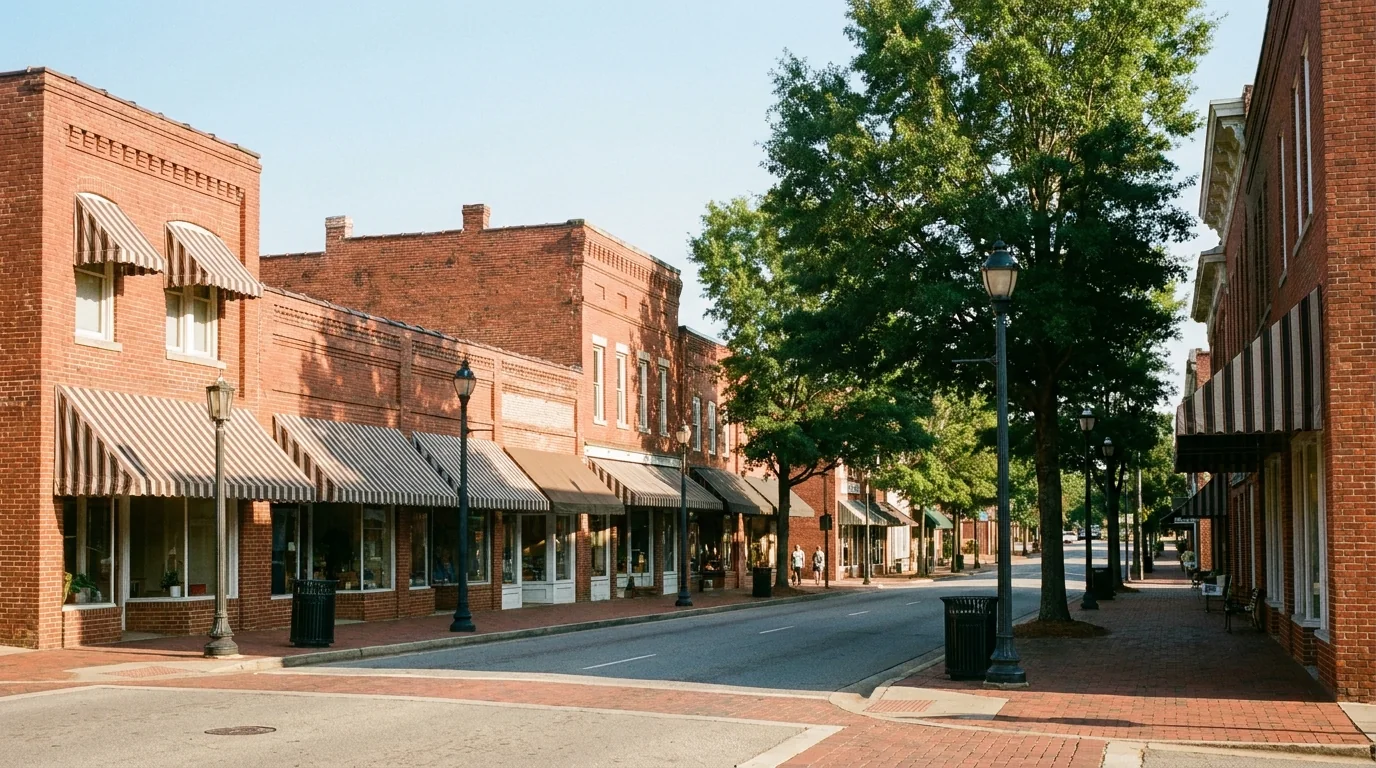
Not all of Monroe NC growth is subdivisions on the edge of town. Some of the most interesting change is happening in the historic core. Downtown Monroe is built around a classic county-seat square with an 1886 courthouse, and the city has been investing to bring it back to life. In late 2025 the City of Monroe kicked off a new Downtown Master Plan that runs through the summer of 2026, guiding development, public spaces, housing, and mobility in the core for years to come.
You can follow that effort on the city’s Downtown Monroe Master Plan page. For a buyer, a revitalizing downtown is more than a nice weekend amenity. Walkable, restaurant-lined cores tend to lift the value of the homes around them, and a city that’s deliberately planning its downtown rather than letting it drift is a city taking its own growth seriously. That planning discipline is part of why I stay optimistic about Monroe NC growth rather than nervous about it.
The practical version of this for buyers: homes within walking distance of a revitalizing downtown are usually a smart long hold. If you like the idea of local coffee, a farmers market, and small-business storefronts a short walk from your door, the older neighborhoods ringing downtown Monroe are worth a look. They give you a front-row seat to the part of Monroe NC growth that adds character instead of just adding traffic.
Want to see how this growth pattern plays out across the wider Union County corridor? I filmed a look at the new construction wave hitting the towns just north of Monroe in this video on our channel, New Construction in Indian Trail NC: The $600K Reality, on the Living in South Charlotte YouTube channel. It’s the same growth story one town over, and it shows what the rooftops actually look like on the ground.
What Monroe NC Growth Means for Home Buyers
Let me translate all of this into what actually matters when you’re writing an offer. Monroe NC growth shapes your buying decision in four practical ways: price, inventory, resale, and timing. Get those four right and the growth becomes your ally instead of your headache.
Price and value
You’re buying in Monroe largely because of what the growth hasn’t yet erased: affordability. At roughly $395,000 to $400,000 median, Monroe gives you meaningfully more square footage and land than the towns closer to Charlotte. The lower tax base helps too, with a city rate near 42 cents per $100 of value on top of the Union County rate. As Monroe NC growth continues and land tightens, that price gap tends to narrow, which is exactly why buying earlier in a growth curve usually beats buying later.
Inventory and choice
Because builders are still active, Monroe gives you something scarce in South Charlotte: real choice between new construction and resale. You can compare a brand new build on the west side against an established home with a mature yard closer to downtown, often within the same budget. That optionality is a direct gift of Monroe NC growth. Just remember that new construction pricing and incentives shift constantly, so having someone who reads builder contracts on your side matters. Start with our home buying page if you want to understand the process first.
Resale confidence
This is the part out-of-state buyers underrate. When you buy in a place with strong, sustained population and job growth, you’re buying built-in future demand for your home. If your life changes in five years and you need to sell, a growing city gives you a deeper pool of buyers than a stagnant one. Monroe NC growth is, in that sense, a form of insurance on your largest asset. It’s one of the strongest reasons I am comfortable steering relocating buyers here rather than talking them out of it.
Where not to overpay
Growth also creates traps. In a hot new subdivision, it’s easy to pay a premium for a lot that will be surrounded by construction for another two years, or to buy on a road that’s about to be widened. This is where local knowledge earns its keep. Before you commit, you want to know the development timeline around your lot, the road plans, and the school assignment. Handled right, Monroe NC growth adds value to your purchase. Handled carelessly, it can cost you at resale.
If you are shopping Monroe on price, here is the check I would run before you write. Pull up the parcel behind and beside the one you like and find out what it is zoned for, because in a city with this much open land the field next door is inventory, not scenery. The price you are getting today is partly a discount for that uncertainty, and knowing exactly what you are accepting is what turns it from a risk into a deal.
Is Monroe Growing Too Fast? Where I Land
After working both sides of the Charlotte border for years, here’s where I land on Monroe NC growth. It’s fast, but it’s not reckless. The jobs, the highway, and the downtown planning are arriving alongside the rooftops, which is the difference between healthy growth and a bubble. For a relocating buyer, the growth is the reason you can still find value here, and value is the whole point of looking at Monroe in the first place.
Is it too fast? On the west-side roads and in the most crowded school zones, some days it feels that way, and the county is playing catch-up in those specific spots. But citywide, Monroe NC growth is the kind of trend that supports your home value rather than threatening it. My advice is simple: buy on the right side of the growth. Pick the neighborhood, the commute route, and the school zone deliberately, and the pace of change works for you. Compare it against the tradeoffs in our full pros and cons of living in Monroe, and check the Monroe crime data for the specific side of town you’re considering.
If you want the full town picture in one place, our Monroe community hub pulls together the market, the neighborhoods, the schools, and current listings. And if you want a human read on whether Monroe NC growth fits your particular move, that’s exactly the conversation I am happy to have.
Monroe NC Growth FAQ
Is Monroe NC growing too fast?
Monroe is growing quickly, about 27% population growth from 2020 to 2026, but the growth is backed by real jobs, the Monroe Expressway, and active downtown planning, so it reads as durable rather than reckless. The strain shows up mainly on the west-side surface roads and in the fastest-growing school zones, which the county is working to catch up on. For most buyers, Monroe NC growth is a net positive because it keeps prices reasonable and supports resale value.
How much has Monroe NC grown recently?
The 2020 census counted 34,699 residents in Monroe, and 2026 estimates put the city near 44,000, roughly 27% growth in six years. Union County overall grew from about 238,267 in 2020 to an estimated 267,674 by 2025, making it the fastest growing county in the Charlotte metro. Monroe NC growth is essentially the county trend concentrated in its largest city.
What is driving growth in Monroe NC?
Three things: available developable land, a genuine jobs base anchored by aviation, manufacturing, and new industrial investment like Union Logistics Park and a roughly $300 million ATI expansion, and the Monroe Expressway, which cut commute times toward Charlotte by as much as 25 minutes. Together those forces make Monroe NC growth more durable than a typical bedroom-community boom.
Is Monroe NC a good place to buy a home in 2026?
For value-focused buyers, yes. Monroe’s median sale price of about $395,000 to $400,000 sits well below the towns to the west, and the ongoing growth supports future resale demand. The key is buying deliberately: pick your commute route, verify the school assignment, and understand the construction timeline around any new-build lot. Handled that way, Monroe NC growth adds value to your purchase.
Which part of Monroe is growing the fastest?
The north and west sides of the city, toward the Wesley Chapel and Stallings line, are where most new subdivisions cluster and where prices run highest, partly because of stronger school assignments and shorter drives toward Charlotte. The historic core and the eastern and southern stretches have seen less new construction and hold the lower end of the price range. Monroe NC growth is very much a tale of two sides of the city.
Does Monroe NC growth hurt traffic and schools?
In specific spots, yes. Surface roads near the western subdivisions back up at peak hours, and the fastest-growing school zones feel crowding first, with mobile classrooms and periodic redistricting. NCDOT has road improvements planned, and Union County Public Schools continues to add capacity. If commute time or a specific school is your priority, verify both for your exact address before you buy, because Monroe NC growth can shift those conditions block by block.
About the Author
Steve Jarrell is a REALTOR and broker with The Longleaf Group at eXp Realty, licensed in both North Carolina and South Carolina, and he works the South Charlotte and Union County markets every week. He lives in Weddington, one town over from Monroe, and has watched Monroe NC growth reshape the corridor firsthand, which is why he focuses on helping relocating buyers separate the hype from the real value. To talk through whether Monroe fits your move, reach Steve at 704-774-7170, email steve@jarrellhomes.com, or visit thelongleafgroup.com.