
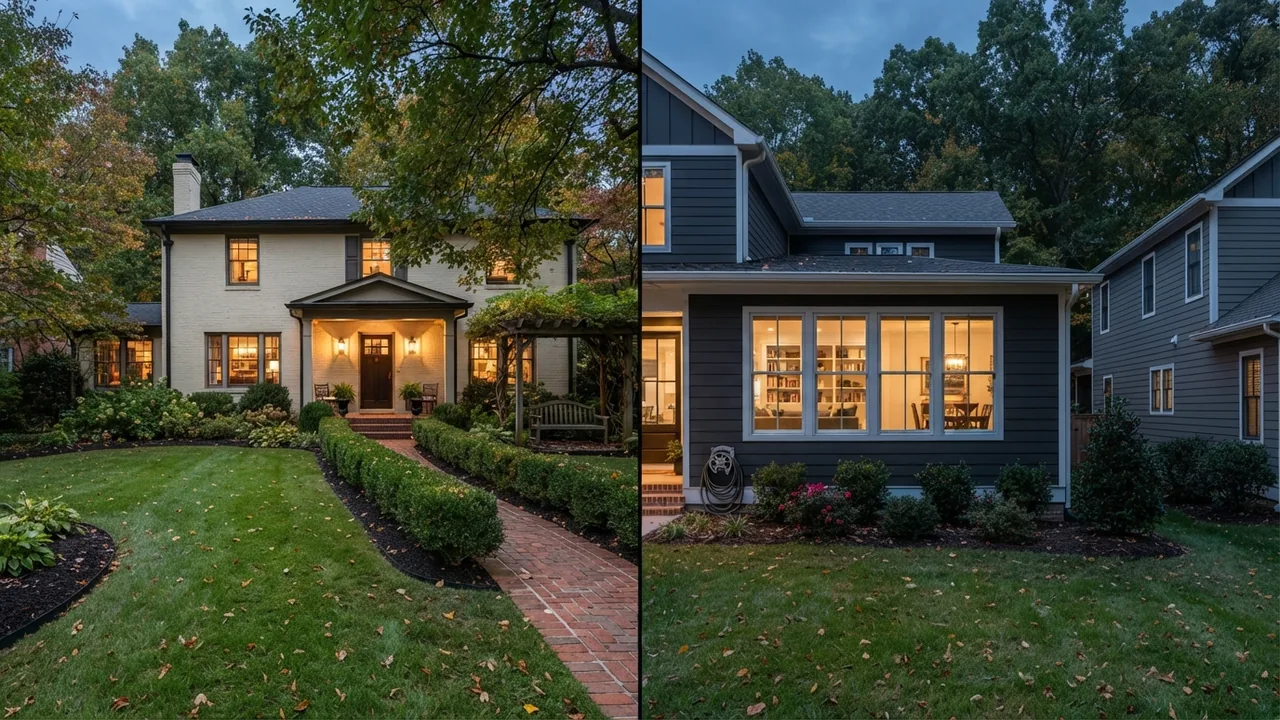
If you’ve been shopping the east side of Charlotte, someone has probably told you that Union County is the cheaper county, and on the county line alone they’re right: Union County held its rate at 43.42 cents per $100 for fiscal 2026-27, against Mecklenburg County’s 49.27 cents. Then you add the town, and it turns over. A house within the Mint Hill town line is taxed at a combined $0.7177 per $100. A Monroe city address is taxed at $0.8742, which is 15.65 cents per $100 more. Those two figures come off Mecklenburg County’s FY 2026-2027 rate chart and the budgets Union County and the City of Monroe adopted this summer.
That gap is $782.50 a year on a $500,000 house, and it isn’t the end of the story, because the two towns bill for water, power and trash in completely different ways and the house itself costs a different amount in each place. So here is the whole bill: county, town, water, sewer, trash and power, with each figure where the county and the two towns publish it. I’m Steve Jarrell, I live in Weddington, and my team sells across both of these towns.
15 min read | By Steve Jarrell, The Longleaf Group at eXp Realty | Updated October 2026

Free · 26-Page Insider Guide
Comparing South Charlotte towns before you pick one?
Towns compared, NC vs SC taxes and schools side by side, and the 5 mistakes out-of-state buyers make.
What This Guide Covers
- Which town costs less, and why the answer splits
- The Mint Hill NC property tax rate against Monroe’s
- What you pay on the house each town really sells
- One city bill in Monroe, five companies in Mint Hill
- So what is the extra 15.65 cents buying?
- Frequently Asked Questions About Mint Hill and Monroe Property Taxes
Which town costs less, and why the answer splits
Mint Hill wins on the rate and Monroe wins on the price, and which one matters to you depends on whether you’re comparing two houses or two budgets. If you put the same $500,000 house in both towns, Mint Hill is cheaper by $782.50 a year before you touch a utility bill. If instead you buy the house each town really sells at its own median, Monroe comes out $385.96 a year cheaper, because the median Monroe sale is $137,729 below the median Mint Hill sale and the lower price more than covers the higher rate.
The Short Answer
Mint Hill taxes you at a lower rate than Monroe for fiscal 2026-27, but Monroe sells a cheaper house, so your own bill turns on which of those two you’re holding fixed.
Key numbers, Mint Hill and Monroe, fiscal 2026-27 and the three months ending August 2026 (sources: Mecklenburg County tax administration, Union County, the City of Monroe, Redfin):
- Combined rate per $100: Mint Hill $0.7177, Monroe $0.8742.
- Your tax on a $500,000 house: Mint Hill $3,588.50, Monroe $4,371.00.
- Median sale price: Mint Hill $522,729, Monroe $385,000.
- Tax on each town’s own median: $3,751.63 and $3,365.67, so Monroe lands lower.
- Trash a year: Mint Hill $61.50, Monroe $339.60.
- Free-flow drive to Uptown Charlotte: 22 minutes from Mint Hill, 37 from Monroe.
Treating the county rate as the answer is one of the more common mistakes on this comparison. Buyers hear that Union County taxes less than Mecklenburg, assume the whole county is cheaper, and never add the municipal line, which in Monroe is nearly double what it is in Mint Hill. Your tax bill is county plus town, and the town line is where the real difference sits.
Talk to a local broker
Want the tax math run on the two houses you’re actually comparing?
Send me the addresses and I’ll come back with the real bill for each one. No pressure, just answers.
Schedule a 15-Minute Introductory Call →704-774-7170 · steve@jarrellhomes.com · thelongleafgroup.com
The Mint Hill NC property tax rate against Monroe’s
Two numbers make your bill, whichever town you land in. Mecklenburg County charges 0.4927 and the Town of Mint Hill adds 0.2250, and the county chart prints the sum for you: the town-limits line reads 0.7177 for 2027. Across the county line, Union County sets 0.4342 and the City of Monroe adds 0.4400, for a combined 0.8742. Mecklenburg publishes all of it in its FY 2026-2027 jurisdiction tax rate chart, and its tax administration office puts the county rate at 49.27 cents per $100 in plain words.
Both halves of a Monroe bill were set a few weeks apart. Union County commissioners approved the fiscal 2026-27 budget on June 16 and held the total rate at 43.42. The Monroe City Council adopted its 2026-27 budget on May 26, and as the council reported, the property tax rate holds at 44 cents per $100 of assessed value. Neither one raised its rate. The gap has been sitting there, and neither budget this year narrows it.
What that means in dollars depends on the house. Run $500,000 through both and Mint Hill charges $3,588.50 a year while Monroe charges $4,371.00, a difference of $782.50. Put another way, the Mint Hill NC property tax rate comes in about 18% under what Monroe asks, which is the same as saying a Monroe bill runs about 22% over a Mint Hill one.
One wrinkle applies only in Monroe, and it tends to show up after closing. The city’s own tax information page says that additional taxes may apply at a rate of 16.0 cents to addresses located within the downtown district, and tells you to contact the Tax Office for address-specific information. Where it applies, 16.0 cents per $100 is another $800 a year on a $500,000 assessed value: the Monroe bill becomes $5,171.00 and the gap over Mint Hill becomes $1,582.50 instead of $782.50. If you’re looking at anything near downtown Monroe, make that call before you write an offer.
| Measure | Mint Hill | Monroe |
|---|---|---|
| County | Mecklenburg | Union |
| County rate per $100 | 0.4927 | 0.4342 |
| Municipal rate per $100 | 0.2250 | 0.4400 |
| Combined rate per $100 | 0.7177 | 0.8742 |
| Annual tax on a $500,000 house | $3,588.50 | $4,371.00 |
| Median sale price, three months to August 2026 | $522,729 | $385,000 |
| Annual tax on that median | $3,751.63 | $3,365.67 |
| Household trash, per year | $61.50 | $339.60 |
What you pay on the house each town really sells
The rate is the half everybody checks. The half that sets your bill is what the county says the house is worth, and these two towns are not selling the same house. Over the three months ending August 2026, Redfin puts the median sale price in Mint Hill at $522,729, down 5.8% against the same stretch last year, with a median of $213 a square foot. Monroe’s median across those same three months was $385,000, up 2.5%, which works out to $177 a square foot.
Run the Mint Hill NC property tax rate against each median
So the two medians sit $137,729 apart, and your square footage is $36 cheaper in Monroe. That also means the median Monroe house is about 280 square feet smaller, roughly 2,175 next to 2,455, which is the part of the discount people forget to price. Apply each town’s own rate to its own median and the ranking flips: $3,751.63 a year in Mint Hill, $3,365.67 in Monroe. Monroe is $385.96 a year cheaper on the house it sells, even though it taxes at the higher rate. That is the reversal most people miss, and it is why “which town has lower taxes” answers less than it sounds like it does.

The two markets are also moving in opposite directions, which matters to what you can negotiate. Mint Hill is taking longer to sell, 52 days where it was 48 a year ago, with prices down 5.8%. Monroe is selling faster, 59 days where it was 62, with prices up 2.5%. Neither shift is dramatic.
One city bill in Monroe, five companies in Mint Hill
Here the two towns stop resembling each other at all. In Monroe your utilities are the city. Through its Energy Services department the city has supplied electricity to residents since 1900 and natural gas to Monroe and parts of Union County since 1957, and its Water Resources department handles water and sewer. One account, one bill, rates published in a fee schedule. Mint Hill owns none of that. Its utilities page lists Char-Meck Utilities, Charlotte Water, Duke Energy, Piedmont Natural Gas, Spectrum and Union Power, so your service comes from whichever of those your address falls to.
On water and sewer the two are closer than you’d guess. Charlotte Water states that its average residential customer using 6 Ccf pays $81.21 a month under the rates effective July 2026 through June 2027, and 1 Ccf is 748 gallons, so that household is using 4,488 gallons.
Put the same 4,488 gallons through Monroe’s published water and sewer rates on a standard three-quarter inch meter in the city and you land at about $75.41 a month: $15.69 to have water, then $15.36 for the water itself, the first 4,000 gallons at $3.35 per thousand and the rest at $4.02, then $20.93 to have sewer and $23.43 for the sewer volume at $5.22 per thousand. Monroe comes in roughly $5.80 a month under Charlotte Water at that volume, call it $70 a year. Real, but not the reason anyone moves.
The trash line is the one that moves real money, and it moves it the other way. Both towns hire the same company. Mint Hill’s contract with Waste Pro gives residents weekly curbside garbage, weekly yard waste and recycling every other week, and that collection is covered by the town tax rate you already pay. What shows up separately on a Mecklenburg tax bill is a $61.50 annual solid waste fee. Monroe also contracts with Waste Pro, and its fee schedule effective July 1, 2026 bills residential collection at $28.30 per cart per month, $339.60 a year. Same hauler, same weekly pickup, $278.10 apart.
Electricity is the one line I can’t give you a clean number on. Monroe’s residential Schedule R carries a $14.00 basic customer charge and an energy charge of $0.10590 per kWh for the first 300 kWh and $0.09880 after that, but the schedule adds a purchased power adjustment rider and state utilities sales tax on top, so the posted figure is a floor rather than a bill. What you can count on is the structure: in Monroe your electric and gas rates are set by a city council you can go watch, and in Mint Hill they come from companies headquartered somewhere else.
Stack the fixed pieces and taxes plus trash on a $500,000 house come to $3,650.00 a year in Mint Hill and $4,710.60 in Monroe. That is $1,060.60, and water and sewer give about $70 of it back.
The trash line is the one that gets missed on this comparison, and it is also the easiest to price. In Monroe, residential collection is $28.30 per cart per month on the city utility bill, which is $339.60 a year, where the Mint Hill side of it is a $61.50 solid waste fee landing once a year on the Mecklenburg tax bill. Same hauler, same weekly pickup, $278.10 a year apart. Put that $278.10 in the Monroe column before you compare monthly numbers, and note what it does and does not do: on the two towns’ own medians it narrows Monroe’s annual advantage to about $108 rather than erasing it.
Talk to a local broker
Still deciding between the east side and Union County?
Tell me your budget and your commute and I’ll show you what each town puts in front of you.
Book a 15-minute call →So what is the extra 15.65 cents buying?
Union County puts most of its rate into schools. The county chairman said so plainly when the budget passed: about 71% of the county’s tax rate supports its education partners, leaving just 12.75 cents for the sheriff’s office, human services, emergency medical services, fire, parks, libraries and everything else. Nearly 31 of those 43.42 cents go to schools, 26.78 to operating them and 3.89 to the debt on the buildings, which is why a Union County tax bill is mostly a school bill.
Monroe’s own 44 cents is mostly public safety. More than 23 cents of it goes there, split 13.05 cents to the Monroe Police Department and 10.59 cents to fire, out of a general fund of $72 million. That is what the municipal half of your Monroe bill buys: a city police department, a city fire department, and the utilities that arrive on one statement.
On schools the dividing line is the county line, so know which district an address falls to before you fall for the house. GreatSchools files Rocky River High, in Mint Hill, under the Charlotte-Mecklenburg School District, and Monroe High School under the Union County Public School District. Two different districts, two different assignment maps, and no amount of proximity moves an address from one to the other. Check the assignment for the specific address, every time.
The fifteen minutes between them
Then there is the drive, which is the part of this you pay for in hours rather than dollars. Mint Hill town hall to Trade and Tryon (the central intersection of Uptown Charlotte, where the office towers are) runs 12.8 miles and about 22 minutes with nothing on the road. Monroe city hall to the same corner is 24.7 miles, roughly 37 minutes, so you sit 11.9 miles and about a quarter of an hour farther out at free flow, and more than that at eight in the morning. Two days a week in an office, that is a fair trade for $137,729 off the purchase price. Five days a week, price the fuel and the hours first.
Monroe is also the bigger of the two, which catches people out. North Carolina’s certified estimates for July 2025 put it at 41,127 residents, where Mint Hill has 29,011. Monroe has grown 18.7% from a 2020 census count of 34,637, while Mint Hill went from 26,450 to 29,011, a rise of 9.7%. Monroe is the Union County seat, with a downtown built around a courthouse square. If you had pictured that the other way round, you are not alone.
Want the rest of the picture on either town? Start with Mint Hill or Monroe. Current figures for every town we cover sit on the South Charlotte market data page, and the full list is on the communities hub.
Frequently Asked Questions About Mint Hill and Monroe Property Taxes
What is the cost of living in Mint Hill NC versus Monroe NC?
Monroe is cheaper to buy into and more expensive to be taxed on. In the three months to August 2026 the median sale was $385,000 there, where Mint Hill’s was $522,729, while the combined rate runs $0.8742 per $100 for a Monroe address and $0.7177 for a Mint Hill one. Your trash costs $339.60 a year in Monroe and $61.50 in Mint Hill, and water and sewer run about $5.80 a month cheaper in Monroe at 6 Ccf.
How do property taxes in Mint Hill NC compare to Monroe NC?
Monroe is higher. For fiscal 2026-27, a house within the Mint Hill town line is taxed at a combined $0.7177 per $100 of assessed value, which is Mecklenburg County at 0.4927 plus the town at 0.2250. A Monroe city address is taxed at $0.8742, Union County at 0.4342 plus the city at 0.4400. That is 15.65 cents per $100 more in Monroe, or $782.50 a year on a $500,000 house. Addresses in Monroe’s downtown district may carry another 16.0 cents per $100, and the city asks you to contact its Tax Office about yours.
What is the median home sale price in Mint Hill NC and Monroe NC?
Across June through August 2026, Redfin reports a median sale of $522,729 in Mint Hill, down 5.8% from a year earlier, at $213 a square foot. Monroe came in at $385,000, up 2.5%, at $177 a square foot. Your two medians sit $137,729 apart, which also buys about 280 square feet less house in Monroe, and applying each town’s own rate to its own median gives an annual tax bill of $3,751.63 in Mint Hill and $3,365.67 in Monroe.
Who provides electricity, water and sewer in Mint Hill NC and Monroe NC?
In Monroe you get all three from the city itself. Its Energy Services department has supplied electricity since 1900 and natural gas since 1957, and its Water Resources department runs water and sewer, so one city bill covers your whole account. Mint Hill buys from outside providers, and as of October 2026 the town’s own utilities page lists Char-Meck Utilities, Charlotte Water, Duke Energy, Piedmont Natural Gas, Spectrum and Union Power. Which of them serves you depends on your address.
How long is the commute from Mint Hill NC to Uptown Charlotte?
Your drive from the Mint Hill town hall to Trade and Tryon in Uptown Charlotte is 12.8 miles and about 22 minutes at free flow, measured in October 2026 with no traffic on the road. Morning peak adds to that. Most buyers looking at Mint Hill drive in one or two days a week rather than five, and that is the number that makes the distance work for them.
How long is the commute from Monroe NC to Uptown Charlotte?
Monroe city hall to Trade and Tryon, the central intersection of Uptown Charlotte, covers 24.7 miles and takes roughly 37 minutes at free flow, measured in October 2026. That puts you 11.9 miles and about a quarter of an hour farther out than the same trip from Mint Hill, before any traffic. Price the extra driving against the $137,729 gap in median sale price before you decide which town is cheaper for you.
Which school district serves Mint Hill NC and which serves Monroe NC?
Two different districts, because the towns sit in two different counties. GreatSchools files Rocky River High, in Mint Hill, under the Charlotte-Mecklenburg School District, and Monroe High School under the Union County Public School District, as GreatSchools lists them in October 2026. Assignment follows your address rather than the town, because the district draws its map by parcel, so check yours before you write an offer.
Is housing in Monroe NC more affordable than Mint Hill NC?
Yes on purchase price, and it stays yes on the annual bill even at the higher rate. The median Monroe sale was $385,000, where Mint Hill’s was $522,729, and the tax on each median works out to $3,365.67 for the Monroe house and $3,751.63 for the Mint Hill one. Add the trash on both sides and Monroe is still about $108 a year cheaper. The answer reverses only when you hold the price fixed: on the same $500,000 house, Monroe costs $782.50 more in tax and another $278.10 in trash.
About the Author
I am a licensed North Carolina and South Carolina broker and the team lead of The Longleaf Group at eXp Realty, which I co-lead with my wife Amanda. Before real estate, I joined VisualTour as President, led its rebrand to Paradym, and led the company to its acquisition by Constellation Software in 2020. I hold an MBA from the University of Tennessee with concentrations in Marketing and Innovation. The Longleaf Group is an eXp ICON Team and a RealTrends Verified Top Team by Volume for 2026, with 170+ five-star reviews.
I live in Weddington, a short drive from both towns in this comparison, and my team writes offers on the Mecklenburg and the Union County side of that line most weeks. If you want the tax and utility math run on two specific addresses before you choose, call me at 704-774-7170.