

If you are weighing moving from Dallas to Charlotte, you have probably already run the obvious numbers: home prices, the job offer, maybe a quick cost of living search. What most Texans miss is the part that decides whether this move actually helps or hurts your budget, and it is not the sticker price on a house. It is the way North Carolina and Texas split the tax bill in completely opposite directions. Get that piece right and moving from Dallas to Charlotte can leave you further ahead than you expect. Get it wrong and you will feel blindsided at closing.
I am Steve Jarrell, a broker with The Longleaf Group at eXp Realty, and I help people relocate from Texas metros like Dallas and Fort Worth into the south Charlotte submarkets every year. This is the numbers-first comparison I wish every relocating buyer had before they signed a lease sight unseen. We will cover cost of living, housing, taxes, schools, weather, getting around, the surprises Texans do not see coming, and exactly where Dallas buyers tend to land once they get here.
18 min read | By Steve Jarrell, The Longleaf Group at eXp Realty | Updated August 2026
Free · 26-Page Insider Guide
Not sure which South Charlotte town fits you?
Towns compared, NC vs SC taxes and schools side by side, and the 5 mistakes out-of-state buyers make.
What This Guide Covers
- The quick verdict: who this move actually fits
- Cost of living: Dallas vs Charlotte compared
- Housing: what your dollar buys in each market
- Taxes compared: the trade no Texan expects
- Schools: Texas suburbs vs Union County and Fort Mill
- Weather, lifestyle, and pace
- Getting around, flights home, beaches, and mountains
- Differences people moving from Dallas to Charlotte do not expect
- Where Dallas buyers tend to land in south Charlotte
- How a Dallas to Charlotte move actually works
- FAQ
Moving from Dallas to Charlotte NC: The Quick Verdict
Key Takeaways
- Charlotte runs about 6% cheaper on overall cost of living than Dallas
- Housing in Dallas runs about 21% higher on the cost index
- Spring 2026 median home price: Dallas-Fort Worth about $395,000 to $410,000 vs Charlotte metro about $435,000
- North Carolina has a state income tax (Texas does not): 4.25% for 2025, dropping to 3.99% for 2026
- Texas property taxes run roughly 3x higher than the Charlotte area, which offsets most or all of the new NC income tax
- You trade flat heat and Tornado Alley for hills, milder winters, mountains 2 hours west, and beaches 3 hours east
Steve Jarrell of The Longleaf Group works with Dallas transplants regularly and rates moving from Dallas to Charlotte a strong move for most buyers. Charlotte runs about 6% cheaper on overall cost of living, offers similar home prices with far more trees and hills, and quietly rebalances your tax bill in a way that usually favors you. The catch: North Carolina has a state income tax and Texas does not, so you will start paying something you never paid before. The offset is that Texas property taxes are roughly three times higher than the Charlotte area’s, so for most households the lower property bill cancels out most or all of the new income tax. You trade wide flat heat and Tornado Alley for green rolling hills, milder winters, mountains two hours west, and beaches three hours east.
If you are a Dallas homeowner or a finance professional relocating with a bank, this move tends to pencil out well, especially in the south Charlotte and Union County submarkets I work in daily. If you are chasing a big city with deep public transit and a huge dining scene at Dallas scale, Charlotte is smaller and slower, and you should know that going in. The rest of this guide gives you the real numbers behind that verdict.
Talk to a local broker
Already leaning toward the move from Dallas?
I help Texas buyers relocate to south Charlotte every year, from the first questions to the keys. Let’s talk through your timeline, your must-haves, and where your Dallas budget actually lands here.
Schedule a 15-Minute Introductory Call →704-774-7170 · steve@jarrellhomes.com · thelongleafgroup.com
Cost of Living: Dallas vs Charlotte Compared
One of the first questions people ask about moving from Dallas to Charlotte is whether it is cheaper to live here, and the answer is a qualified yes. Charlotte is the more affordable of the two cities, though the gap is smaller than people assume. Using a national average of 100, cost of living index data as of early 2026 puts Dallas at about 103.1 and Charlotte at about 97.3, which works out to Charlotte running roughly 6% cheaper overall. That is a meaningful but not dramatic difference, and it lines up with what relocating buyers tell me after their first few months here.
The bigger spreads show up inside the categories. Housing is where Dallas costs the most relative to Charlotte, running about 21% higher on the index once you factor in the full picture of ownership and rent. Groceries in Dallas run about 6% higher, and utilities, transportation, and healthcare each run a percent or two higher than Charlotte. None of those are budget-breakers on their own, but stacked together they explain why a Dallas paycheck usually stretches a little further here, even before you touch the tax question.
One caveat worth stating plainly: the specific south Charlotte towns most Dallas buyers gravitate toward, places like Weddington, Marvin, and Waxhaw, sit above the Charlotte metro average because they are the most sought-after addresses in the region. So your personal cost of living depends heavily on which submarket you pick, which is exactly why the where-to-land section below matters so much.
Housing: What Your Dollar Buys in Dallas vs Charlotte
Here is the number that surprises Dallas buyers most: the two markets are close. As of spring 2026, the Dallas Fort Worth metro median home price sat around $395,000 to $410,000, while the Charlotte metro median was about $435,000. So Charlotte is modestly higher at the metro level, not cheaper. If you were expecting Carolina to be a bargain compared to Texas, adjust that expectation now.
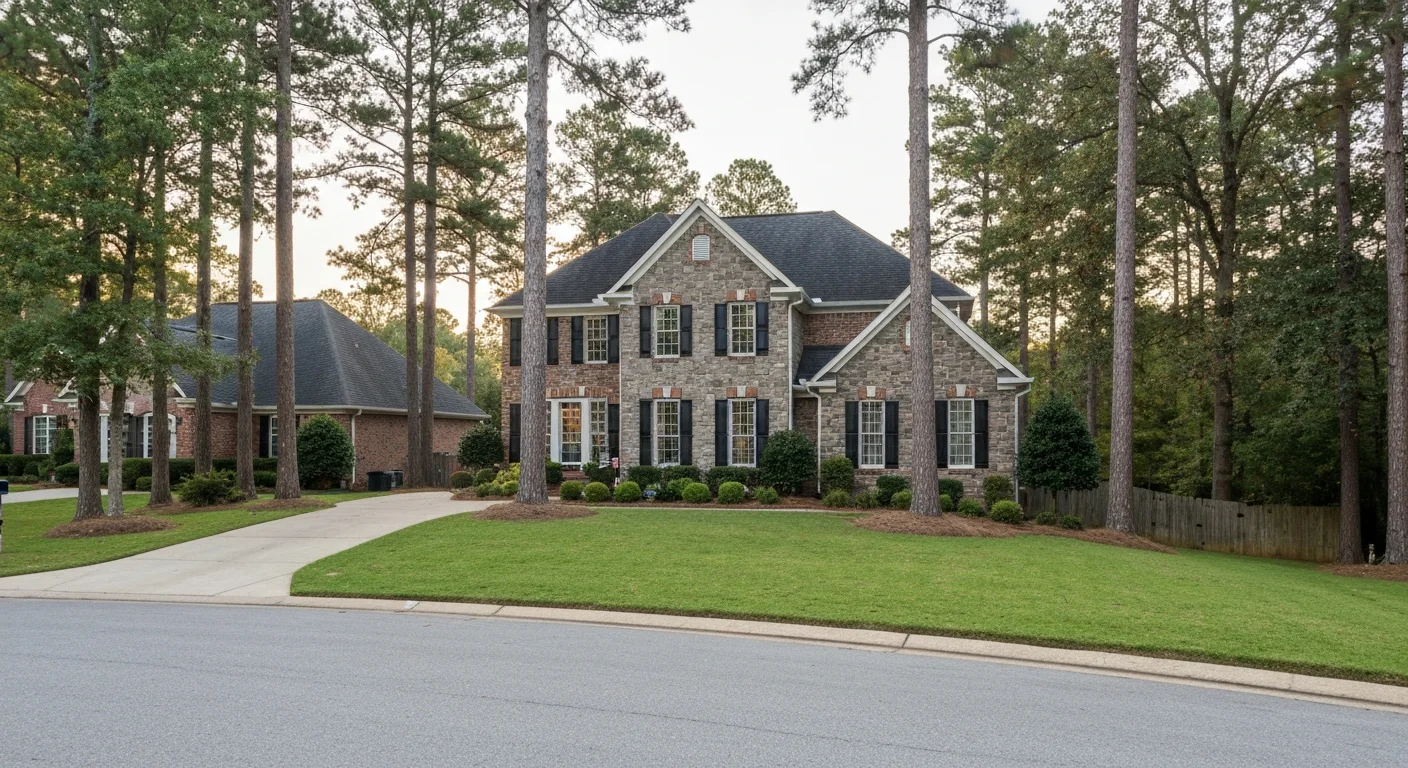
What actually differs is what the house feels like. In DFW, your money often buys newer construction on a flat lot in a master-planned community with little tree cover. In the south Charlotte submarkets, the same budget more often buys a brick home on a wooded lot with rolling topography, mature hardwoods and pines, and more architectural variety. A lot of Texans tell me the homes here simply feel more settled, because the land is green and the trees are old.
Price does climb fast once you target the marquee towns. Waxhaw and Weddington homes commonly run well above the metro median, and estate areas of Marvin can go higher still. But you also have strong options that read as excellent value to a Dallas buyer: Indian Trail and Monroe in Union County, plus Fort Mill and Indian Land just over the South Carolina line, all deliver newer homes and top schools for less than the priciest NC towns. If you want a full walk-through of the trade-offs town by town, my south Charlotte relocation buyer guide lays them out side by side.
Taxes Compared: The Trade No Texan Expects
This is the section that changes the whole calculation, so read it slowly. Texans are used to bragging that they pay no state income tax, and that is true. North Carolina, by contrast, has a flat state income tax of 4.25% for 2025, dropping to 3.99% for 2026 under the state’s scheduled rate cuts, according to the North Carolina Department of Revenue. So yes, when you move from Dallas to Charlotte, you will start paying a state income tax you never owed before. That is a real negative, and I never soft-pedal it.
But here is what almost no one tells you: Texas pays for having no income tax by charging some of the highest property taxes in the country. A typical homeowner inside the City of Dallas faces a combined property tax rate around 2.22% of taxable value once you stack the county, school district, city, hospital, and community college levies. The statewide Texas effective rate for owner-occupied homes runs around 1.25% to 1.4%. In the Charlotte area, the combined City of Charlotte and Mecklenburg County rate is about 0.77% (76.68 cents per $100 of value), and Union County’s effective rate is closer to 0.65%. Charlotte’s property tax is roughly a third of a Dallas city bill.
Put real numbers on it. On a $435,000 home, a City of Dallas owner can pay roughly $9,600 a year in property tax. The same value in Mecklenburg County runs about $3,300, and in Union County about $2,800. That is a swing of roughly $6,300 to $6,800 a year in your favor. Now weigh it against the new income tax: at the 2026 rate of 3.99%, a household with $100,000 of taxable income owes about $3,990, and one with $150,000 owes about $5,985. For a large share of relocating buyers, the property tax savings cancels most or all of the new income tax. Texas is not actually a low-tax state for homeowners. It is a no-income-tax, high-property-tax state, and moving to Charlotte often flips that trade in your favor.
Sales tax is close to a wash. Dallas charges 8.25% combined, and Mecklenburg County reaches the same 8.25% as of July 2026, while Union County, NC sits lower at 6.75%. The real story is the income-versus-property trade, and it is worth modeling with your own income and target price before you decide. I walk through the NC versus South Carolina angle of this in a short video, Living in South Charlotte vs SC: The Truth About Taxes, on my Living in South Charlotte channel.
Talk to a local broker
Curious what your Dallas budget buys in south Charlotte?
It’s free, it’s 15 minutes, and Steve actually picks up.
Book a 15-minute call →Schools Compared: Texas Suburbs vs Union County and Fort Mill
Dallas parents who moved to the suburbs for districts like Frisco ISD and Plano ISD care deeply about schools, so this is often the first question I get. The reassuring answer is that the south Charlotte area holds its own with the best of North Texas. Union County Public Schools ranks around the number two district out of 115 statewide, with a graduation rate above 92%, and Marvin Ridge High in Waxhaw consistently ranks in the top 1% of North Carolina schools and number one in the Charlotte metro, per state and third-party rankings.
Just across the South Carolina line, the Fort Mill School District is rated the number one district in South Carolina and the Charlotte metro by Niche for 2026, with an on-time graduation rate near 96%. So whether you land in Union County, NC or York County, SC, you can find schools that compare favorably to Frisco or Plano. Frisco ISD earns an A+ and ranks among the very top Texas districts, so this is a genuine peer comparison, not a downgrade.
One critical difference from Texas: public school assignment here is by your home address, and boundaries can split within a single neighborhood. Do not assume a subdivision feeds a specific school. Always verify the exact assignment for the exact address before you write an offer, and confirm it directly with Union County Public Schools or the relevant district. This is one of the easiest ways for an out-of-state buyer to get burned, and it is one of the first things I check for anyone relocating.
Weather, Lifestyle, and Pace: Trading Big Sky for Green Hills
Summer highs are actually similar on paper. Dallas averages July highs around 90 to 91 degrees, and Charlotte lands right there too. The difference is the character of the heat and what surrounds it. Dallas is drier but more extreme, averaging around 19 days a year at or above 100 degrees, and it sits squarely in Tornado Alley with real spring tornado and hail exposure plus the occasional winter ice storm. Charlotte is more humid in summer, but it rarely reaches those 100-degree stretches, and it is not a tornado corridor.
Winters are where a lot of Texans quietly relax. Charlotte gets a genuine but mild four-season rhythm, with only about 2 to 6 inches of snow in an average year, mostly a dusting in January or February that melts fast. You get fall color, spring blooms, and a real but short winter, without the ice-storm gridlock that can shut Dallas down. The trade you make is humidity and pollen for milder temperatures and green surroundings nearly year round.
On pace and feel, Charlotte is smaller and calmer than Dallas. The metro is growing fast and the uptown skyline is real, but this is not a sprawling megacity, and that is the point for most people leaving DFW traffic behind. You get a banking-town professional core, a strong dining and brewery scene that keeps improving, and a short drive to genuine nature in almost any direction. If your ideal is a big-hills, big-trees, four-season version of a comfortable Texas suburb, that is close to what south Charlotte delivers.
Getting Around, Flights Home, Beaches, and Mountains
Transportation is one area where moving from Dallas to Charlotte does not change your daily life much. Both metros are car-dependent, so do not expect to give up your vehicle. Dallas actually has more rail: DART runs four light rail lines across more than 90 miles, one of the largest systems in the country, even though most people still drive. Charlotte has a single 19.3-mile LYNX Blue Line that connects uptown to the university area and south toward Pineville. It is useful along its corridor but it will not replace your car in the suburbs. You will use I-485, I-77, and I-85 the way you used the DFW freeways, just with noticeably less total traffic.
Getting back to Texas is easy. Charlotte Douglas is a major American Airlines hub, and so is DFW, so nonstop flights run frequently and take roughly 2 hours and 10 minutes to under 3 hours. If your family or job keeps you tied to Dallas, you are one short, direct flight away, which matters a lot to relocating buyers who still travel back regularly.
The geography upgrade is real and it is something Dallas simply cannot match. From Charlotte, the Blue Ridge Mountains and Asheville are about 2 to 2.5 hours west, and the Atlantic beaches at Myrtle Beach and the Carolina coast are about 3 to 4 hours east. Mountains for a long weekend, ocean for another, both from your driveway. In Dallas, real mountains and an ocean are each many hours away. For a lot of transplants, that access alone reframes what weekends look like.
Differences People Moving from Dallas to Charlotte Don’t Expect
Beyond the headline categories, a handful of smaller surprises catch Texans off guard. Knowing them ahead of time makes the move from Dallas to Charlotte far smoother:
- Your first state income tax return. You will file and pay North Carolina income tax for the first time. Budget for it, and remember the lower property tax on the other side of the ledger.
- Red clay soil. The Carolina Piedmont is dense, iron-rich red clay. It grows grass and trees beautifully but compacts hard and drains slowly, so gardening and drainage work a little differently than sandy or black Texas soil.
- Pine pollen season. For a few weeks in late March and April, a fine yellow dust coats everything outdoors. It looks dramatic on your car and porch. It is largely harmless, but it is a rite of spring here.
- Higher summer humidity. Dallas heat is drier. Charlotte summers are muggier, so the same temperature can feel heavier. Most people adjust within a season.
- NC Tag and Tax on your vehicles. North Carolina bills your annual vehicle property tax together with your registration renewal, so you pay a yearly tax on each car’s value. It is a line item Texans are not used to.
- Milder winters, but real ice. Snow is minimal, but an occasional ice event can still close schools and slow roads for a day. The region simply is not equipped for it the way northern cities are.
- Trees, everywhere. After the open North Texas horizon, the sheer density of mature hardwoods and pines is the first thing many Dallas buyers comment on. It is greener than you are picturing.
Where Dallas Buyers Tend to Land in South Charlotte
This is where my daily work lives, and for anyone moving from Dallas to Charlotte, the match between a buyer’s priorities and a specific submarket is what makes or breaks the relocation. Here is how I usually steer Texas buyers based on what they are optimizing for:
- Weddington and Marvin, NC. If you came from an established Frisco, Southlake, or Highland Park style setting and want larger lots, top-tier schools, and an estate feel, this is your zone. It is the premium end of the NC side.
- Waxhaw, NC. Rolling land, a walkable historic downtown, Marvin Ridge schools nearby, and a mix of price points. A frequent landing spot for Dallas buyers who want character plus schools.
- Indian Trail and Monroe, NC. The value plays in Union County. Newer construction, strong schools, and more house per dollar, ideal if you want your Dallas equity to go further.
- Fort Mill and Indian Land, SC. Just over the state line, with the number one South Carolina schools and a different tax structure worth comparing. Popular with finance professionals commuting to south Charlotte and Ballantyne.
- Ballantyne and Matthews, NC. Closer-in south Charlotte with a corporate job core, dining, and an easier commute. Ballantyne in particular feels familiar to anyone coming from a Legacy or Las Colinas style office park.
Charlotte is also a genuine peer to Dallas on the career side, which is why so many of these moves are corporate relocations. Charlotte is the second-largest banking center in the country, home to Bank of America and Truist, with more than 100,000 financial services jobs and major expansions still landing, including a second U.S. headquarters for a global bank bringing thousands of roles. If your move from Dallas is finance-driven, you are not stepping down in opportunity, you are stepping into the other major U.S. banking hub.
How a Dallas to Charlotte Move Actually Works with a Local Agent
Moving from Dallas to Charlotte is a different process than a local move, and the logistics are where out-of-state buyers lose time and money. The sequencing question is the big one: do you sell in Dallas first and rent here, or buy here before you sell? There is no single right answer, but it depends on your equity, your rate, your job timeline, and how competitive the specific south Charlotte town is when you are ready. I help buyers map that out before they list in Texas, so the two closings do not collide.
The home search itself also runs differently for a relocating buyer. You often cannot tour every weekend, so we lean on video walk-throughs, detailed neighborhood breakdowns, and a tight shortlist built around your must-haves and verified school assignments before you ever fly in. When you do visit, we use the trip to decide, not to start from scratch. Temporary housing, movers, NC vehicle registration and inspection, and utility setup all get sequenced so nothing surprises you at the last minute.
Most of all, an agent who works both the North Carolina and South Carolina sides of this border can tell you the real, lived differences between Waxhaw and Fort Mill, or Weddington and Indian Land, not just what a listing says. That is the whole value of a local specialist on a relocation: you get someone who has driven the commutes, knows which neighborhoods flood or feed which school, and has helped other Dallas buyers make exactly this move. When you are ready, start with my buying page, or if you also need to sell first, my selling page walks through that side.
FAQ: Moving from Dallas to Charlotte NC
Is moving from Dallas to Charlotte worth it?
For most buyers, moving from Dallas to Charlotte is worth it. Charlotte runs about 6% cheaper on overall cost of living, offers comparable home prices with more trees and hills, milder winters, and mountains and beaches within a few hours. The main trade is a new state income tax, which is usually offset by property taxes that run roughly a third of a Dallas city bill.
Will I pay more in taxes moving from Texas to North Carolina?
Not necessarily. You will start paying North Carolina’s flat income tax, 4.25% for 2025 and 3.99% for 2026, which Texas does not charge. But Texas property taxes are much higher, often around 2.2% inside the City of Dallas versus about 0.77% in Mecklenburg County and 0.65% in Union County. For many households the property tax savings cancels most or all of the new income tax. Model it with your own income and target home price.
Are home prices cheaper in Charlotte than Dallas?
They are close. As of spring 2026 the DFW metro median was roughly $395,000 to $410,000, and the Charlotte metro median was about $435,000. Charlotte is slightly higher at the metro level, though the popular south Charlotte towns like Weddington and Waxhaw run above that, while Union County and the South Carolina border towns offer more value.
How are the schools in south Charlotte compared to Frisco or Plano?
Very competitive. Union County Public Schools ranks around number two in North Carolina, Marvin Ridge High sits in the state’s top 1%, and Fort Mill is the number one district in South Carolina. These compare favorably to top Texas districts like Frisco ISD. Just remember assignment is by home address, so verify the exact school for the exact property.
How far is Charlotte from the beach and the mountains?
The Blue Ridge Mountains and Asheville are about 2 to 2.5 hours west, and the Atlantic beaches near Myrtle Beach are about 3 to 4 hours east. That two-directional access to both mountains and ocean is one of the biggest lifestyle upgrades Dallas buyers mention after the move.
Is Charlotte a good move for a finance or banking career?
Yes. Charlotte is the second-largest banking center in the United States, with Bank of America and Truist headquartered there and more than 100,000 financial services jobs. It actively competes with Dallas for corporate relocations, so a finance-driven move is a lateral step into another major banking hub, not a downgrade.
What surprises Texans most when they move to Charlotte?
The first state income tax return, the red clay soil, the yellow pine pollen in spring, higher summer humidity, North Carolina’s annual vehicle property tax billed with registration, and simply how green and tree-covered the region is compared to North Texas. None are dealbreakers, but knowing them ahead of time makes the transition easier.
About the Author
Steve Jarrell is a licensed real estate broker with The Longleaf Group at eXp Realty, based in south Charlotte and licensed in both North Carolina and South Carolina. He specializes in helping relocating buyers move into the south Charlotte and Union County submarkets, and he works both sides of the NC and SC state line every week, so he can speak to the real tax, school, and lifestyle trade-offs Texas buyers weigh. Before real estate, Steve spent a decade in real estate marketing technology. Reach him at 704-774-7170, steve@jarrellhomes.com, or thelongleafgroup.com.