

If you are relocating to the Charlotte area, one of the first questions you run into is where the state line should fall on your map. The metro spreads across two states, and the difference in NC vs SC taxes is one of the biggest reasons buyers end up in Fort Mill or Indian Land instead of Waxhaw or Ballantyne, or the other way around. It is a real number, not a rounding error, and it shows up every year you own the home.
I work both sides of this border every week. I am licensed in North Carolina and South Carolina, I live in Weddington on the NC side, and a large share of the buyers I help are weighing the NC vs SC taxes question as part of a bigger move-up or relocation decision. So this guide is the conversation I have over and over, written down. If you are weighing the move itself and not just the tax line, see my deeper breakdown of why people are leaving Charlotte for South Carolina.
Below I break the NC vs SC taxes comparison into six categories that actually move the needle: state income tax, property tax on your primary home, vehicle tax, sales tax, retirement income, and the one-time costs of moving a car and a household across the line. The short version is that South Carolina usually wins on the home you live in, North Carolina often wins on the car you drive, and the rest depends on your income and your stage of life.
16 min read | By Steve Jarrell, The Longleaf Group at eXp Realty | Updated August 2026
What This Guide Covers
- NC vs SC Taxes: The Short Answer Before You Cross the Line
- 1. State Income Tax: A Moving Target on Both Sides
- 2. Property Tax on Your Primary Home: Where SC Pulls Ahead
- 3. Vehicle Tax: The One Where South Carolina Stings
- 4. Sales Tax: Closer Than People Expect
- 5. Retirement and Social Security Income
- 6. One-Time Costs of Crossing the Line
- How I Help You Pick the Right Side of the Border
- NC vs SC Taxes: Frequently Asked Questions
- About the Author
The Short Answer
For most buyers purchasing a primary residence, the NC vs SC math tilts toward South Carolina — almost entirely because of how South Carolina assesses an owner-occupied home. North Carolina appraises at 100% of market value; South Carolina assesses a primary residence at 4%. Income tax is closer than the old headlines suggest, and both states are moving.
Key numbers right now:
- North Carolina income tax is flat: 4.25% for 2025, scheduled to drop to 3.99% for 2026
- South Carolina taxes its top bracket at 6.0% for 2025, down from 6.2%, with the lowest bracket at 0%
- North Carolina appraises real property at 100% of market value
- South Carolina assesses an owner-occupied primary residence at just 4%; every other property type, including second homes and rentals, at 6%
- That 4% rate only applies once you file for the primary-residence classification with the county assessor
- Union County NC’s county rate is around $0.4342 per $100, before any town rate is added
NC vs SC Taxes: The Short Answer Before You Cross the Line
Here is where I land after running this comparison hundreds of times. For most buyers purchasing a primary residence, the NC vs SC taxes math tilts toward South Carolina, mainly because of how SC taxes an owner-occupied home. A primary home in Fort Mill, Indian Land, Tega Cay, or Lake Wylie is taxed on a much smaller slice of its value than the same-priced home in Charlotte or Union County.
That advantage is not universal. South Carolina taxes vehicles harder than North Carolina does, so if you own several newer cars, part of your property tax savings goes back out the door at registration time. And the income tax picture is shifting under your feet right now, because both states are cutting rates on different schedules. The fair framing of NC vs SC taxes is that it is a bundle, not a single number, and the right answer depends on your home price, your household income, and how many vehicles sit in the driveway.
The good news: this is exactly the kind of thing you can model before you commit to a side. Once we know your price range and your situation, the NC vs SC taxes decision usually becomes clear in about fifteen minutes.
Already leaning toward one side of the line?
Let’s run your actual numbers together and see which side of the border keeps more money in your pocket.
Schedule a 15-Minute Introductory Call →704-774-7170 | steve@jarrellhomes.com | thelongleafgroup.com
1. NC vs SC Taxes on Income: A Moving Target on Both Sides
Start with the paycheck, because state income tax hits every working household. This is the part of the NC vs SC taxes comparison that changes the most from year to year, so the numbers below are tied to specific tax years.
North Carolina uses a single flat rate for everyone. For the 2025 tax year that flat rate is 4.25%, and it is scheduled to drop to 3.99% for 2026. North Carolina has been steadily lowering this rate for several years, and additional reductions are written into state law if revenue targets are met. You can confirm the current figure on the North Carolina Department of Revenue site.
South Carolina has historically used a graduated structure with a higher top rate. For 2025, South Carolina taxes the top bracket at 6.0%, down from 6.2% the year before, with the lowest bracket taxed at 0%. On paper that top rate looks worse than North Carolina, which is why people assume NC wins the income side of NC vs SC taxes. The reality is more nuanced, because South Carolina allows a generous standard deduction and a 44% deduction on long-term capital gains, so the effective rate many households actually pay lands well below 6%.
Here is the part that matters for anyone moving in 2026. South Carolina passed a major income tax overhaul in 2025 (the bill is H. 4216) that restructures the brackets starting January 1, 2026, to roughly 1.99% on taxable income under $30,000 and 5.21% above that, with the state aiming to drop toward a flat 1.99% over time as revenue allows. So the income tax gap inside NC vs SC taxes is narrowing fast, and for lower and middle incomes South Carolina may actually come out ahead in 2026 and beyond.
My takeaway on income: do not lock in your NC vs SC taxes decision based on a stale 6% versus 4% headline. Both states are moving, and the side that wins for a $90,000 household is not necessarily the side that wins for a $250,000 household. For a deeper look at how the broader cost picture compares on one popular SC town, I keep an updated breakdown of the cost of living in Fort Mill, SC.
You can also compare published rates across states at the Tax Foundation, which tracks every state and updates when laws change.
2. NC vs SC Taxes on Your Primary Home: Where South Carolina Pulls Ahead
This is the category that decides the NC vs SC taxes question for most home buyers, so it is worth slowing down. The two states assess homes in fundamentally different ways, and the difference is structural, not just a matter of one rate being a little higher.
How North Carolina assesses a home
North Carolina appraises real property at 100% of market value. Whatever your home is worth, that full value is what gets taxed, multiplied by the combined county and municipal rate. In Mecklenburg County the combined property tax rate for a home inside the City of Charlotte ran about $0.7572 per $100 of value for the 2025 cycle (roughly $0.4831 for the county and $0.2741 for the city). Union County NC, where Waxhaw, Weddington, and Indian Trail sit, had a county rate around $0.4342 per 100, before any town rate is added. You can see the rules behind these assessments at the NCDOR property tax page.
How South Carolina assesses a primary home
South Carolina does something very different, and this is the heart of the NC vs SC taxes advantage on the SC side. An owner-occupied primary residence is assessed at just 4% of its market value, not 100%. Every other property type, including second homes and rentals, is assessed at 6%. On top of that, a 2006 law known as Act 388 exempts owner-occupied primary homes from the school operating portion of the property tax, which is usually one of the largest line items on a tax bill. You can read the assessment rules at the South Carolina Department of Revenue.
Stack those two features together and the result is dramatic. A 4% assessment ratio plus the Act 388 school operating exemption means a primary homeowner in Fort Mill or Indian Land is taxed on a tiny fraction of the home value compared to a North Carolina owner. This is why the NC vs SC taxes comparison so often ends with the South Carolina side winning on the house itself.
When you translate this into effective rates, the median property tax paid as a share of home value lands at roughly 0.79% in Mecklenburg County NC and about 0.65% in Union County NC, versus roughly 0.71% in York County SC and around 0.51% in Lancaster County SC. Those numbers move with reassessments, but the direction holds: the SC primary-home structure usually produces the lower annual bill. For local SC figures, the York County Treasurer and the Lancaster County Auditor both publish current rate and estimator information.
One important warning that I make sure every relocating buyer hears: that 4% rate only applies once you file for the primary-residence classification with the county assessor. If you buy in South Carolina and forget to apply, you get taxed at 6% like an investor, and your bill can more than double. That single piece of paperwork is one of the most valuable parts of the NC vs SC taxes equation, and it is the kind of detail I walk clients through so the savings actually show up.
Here is a simple way to picture it. Take a $500,000 home. In North Carolina that full 500,000 is the taxable base, multiplied by the combined local rate. In South Carolina, a primary home is taxed on 4% of that value, or $20,000 of assessed value, and then the school operating portion is stripped out under Act 388.
Even though South Carolina’s posted millage rates can look high, they are applied to that much smaller base, which is why the SC annual bill on a primary home so often comes in lower. This is the single biggest lever in the entire NC vs SC taxes comparison, and it is the one buyers underestimate most.
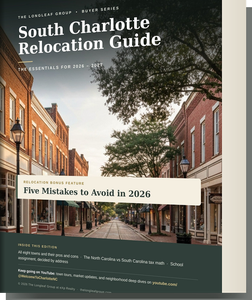 |
Free · 26-Page Insider Guide Which South Charlotte Town Is Right for You? Towns, villages, and cities compared, NC vs SC taxes and schools, and the 5 mistakes out-of-state buyers make. Everything you’d want a local to tell you before you move. Get the free guide → |
Thinking about buying or selling in the Charlotte area?
Free, 15 minutes, and zero sales pitch.
Book a Quick Chat with Steve →3. NC vs SC Taxes on Vehicles: The One Where South Carolina Stings
If South Carolina wins the house, North Carolina usually wins the driveway. This is the category that surprises people and keeps the NC vs SC taxes decision from being a slam dunk for SC.
South Carolina charges an annual vehicle property tax. Personal cars and light trucks are assessed at 6% of their value, and you pay that tax to your county treasurer every year before you can renew your registration. South Carolina is regularly ranked among the states with the highest vehicle taxes in the country, so a household with two or three newer vehicles can owe a meaningful amount each year.
North Carolina also taxes vehicles, but through its combined “Tag and Tax Together” system, where the annual vehicle property tax and the registration renewal are paid together to the DMV. You can see how that works on the North Carolina DMV site. For most households the annual NC vehicle tax comes in lower than the SC equivalent on comparable cars.
This is the offset that makes NC vs SC taxes a real calculation rather than a one-liner. The property tax savings on a South Carolina primary home are often large enough to swallow the higher vehicle tax several times over, but not always, especially for a buyer with a modest home and a fleet of expensive vehicles. When I model NC vs SC taxes for someone on the fence, the cars are usually the swing factor that decides how big the SC advantage really is.
4. NC vs SC Taxes at the Register: Closer Than People Expect
Sales tax rarely decides a move, but it belongs in any complete NC vs SC taxes picture because it touches everyday spending.
North Carolina has a 4.75% state sales tax. With local add-ons, Mecklenburg County lands around 7.25%, while most of Union County NC sits near 6.75%. South Carolina starts higher at a 6% state rate, but the local add-ons are smaller in some counties: York County, which includes Fort Mill, often runs near 7%, while Lancaster County, which includes Indian Land, can reach about 8% because of an added local capital-projects tax.
So on sales tax, the NC vs SC taxes gap is narrow and depends on the exact county. South Carolina also has a few buyer-friendly quirks, including a cap on the sales tax charged on a vehicle purchase, which I cover in the next section. The bottom line is that day-to-day sales tax should not be the deciding factor in your NC vs SC taxes choice, but it is worth knowing your specific county rate before you assume one side is cheaper.
5. NC vs SC Taxes on Retirement and Social Security Income
A large share of the people moving to this area are either retired or planning for it, so the retirement angle of NC vs SC taxes deserves its own section.
Start with the good news that applies to both states: neither North Carolina nor South Carolina taxes Social Security benefits. If Social Security is your main income, that piece of the NC vs SC taxes question is a tie.
Where they differ is other retirement income, such as 401(k) withdrawals, IRA distributions, and pensions. North Carolina taxes that income at its flat rate (4.25% in 2025, scheduled for 3.99% in 2026), with a notable carve-out called the Bailey exemption for certain government and military retirees with long service histories. South Carolina is more generous to retirees across the board: a taxpayer age 65 or older can deduct up to $10,000 of qualified retirement income, and beginning at age 65 there is an additional deduction of up to $15,000 that can be applied against most income. You can confirm both on the South Carolina Department of Revenue site.
For a retired household drawing meaningfully on pensions and retirement accounts, those South Carolina deductions can tilt the NC vs SC taxes comparison further toward the SC side, on top of the primary-home property tax advantage. If you are relocating for retirement specifically, this is one of the clearest cases where running your own numbers pays off.
Households crossing the line often ask whether to lease for a year while they learn the area instead of buying straight away. For Fort Mill I laid out the case for each side in renting a year before you buy.
6. NC vs SC Taxes and the One-Time Costs of Crossing the Line
The categories above are recurring, but there are one-time costs that show up the moment you move, and they belong in a complete NC vs SC taxes accounting.
When you buy a vehicle in North Carolina, the state charges a one-time 3% Highway Use Tax on the purchase price in place of a standard sales tax on cars. When you register an out-of-state vehicle in South Carolina, the state charges a one-time Infrastructure Maintenance Fee of 5% of the value, but it is capped at $500. You can see the registration rules on the South Carolina Department of Revenue site.
For a relocating buyer bringing existing vehicles across the line, that $500 cap is friendlier than it sounds, because it limits what you owe to register even an expensive car in SC. These one-time items will not flip your overall NC vs SC taxes decision, but they are real dollars in your first year, and I would rather you know about them before closing than be surprised at the DMV.
If you want to compare two specific SC border towns that come up constantly in this conversation, I wrote a side-by-side on Fort Mill vs Indian Land, SC. And if you are leaning toward the NC side, my overview of Union County NC property tax rates digs into the numbers on that side of the border.
How I Help You Pick the Right Side of the Border
After all six categories, here is the framework I use with relocating buyers. South Carolina almost always wins the property tax on a primary home thanks to the 4% assessment and the Act 388 school exemption. North Carolina usually wins on vehicle tax. Income tax is close and getting closer as both states cut rates. Retirees often find South Carolina the friendlier overall pick. Sales tax is close enough to ignore. Put those together and the NC vs SC taxes answer for a typical move-up buyer leans SC, but the margin depends entirely on your specific home price, income, and vehicles.
I put together a plain-English walkthrough of the NC vs SC decision for relocating buyers in this video: Moving to South Charlotte? North Carolina vs South Carolina Explained on my YouTube channel, Welcome to Charlotte NC. It pairs well with this guide because it shows the lifestyle side of the line, not just the tax side.
One more thing I tell every relocating buyer: do not let the NC vs SC taxes question paralyze the search. The difference is meaningful and worth planning around, but both sides of this border offer strong towns, good schools, and homes worth owning. Once we have modeled your numbers, the tax piece becomes a known quantity, and you get to make the decision on lifestyle with confidence instead of guessing.
When we talk, I will ask for your price range, your household income range, and how many vehicles you are bringing. From there the NC vs SC taxes picture usually resolves quickly, and we can focus on the part that actually matters, which is finding the right home in the right town for how you want to live. You can start by reaching out through my buyer page or my contact page.
NC vs SC Taxes: Frequently Asked Questions
Is it cheaper to live in SC than NC near Charlotte?
For most buyers purchasing a primary residence, the property tax structure makes the South Carolina side cheaper to own year to year, because SC assesses an owner-occupied home at just 4% of value and exempts it from school operating taxes. The main offset is South Carolina’s higher vehicle tax. Whether SC is cheaper overall in the NC vs SC taxes comparison depends on your home price, income, and how many vehicles you own.
Are property taxes lower in Fort Mill SC than in Charlotte NC?
Usually yes for a primary home. A primary residence in Fort Mill (York County, SC) is taxed on 4% of its market value and is exempt from the school operating millage under Act 388, while a Charlotte home is taxed on 100% of its value. That structural difference typically produces a lower annual property tax bill on the SC side for an equivalent-priced primary home.
Does South Carolina have a car tax that North Carolina does not?
Both states tax vehicles, but South Carolina’s annual vehicle property tax is among the highest in the country and is paid to the county before you can renew your registration. North Carolina taxes vehicles through its combined Tag and Tax Together system and is generally lower on comparable cars. The vehicle category is the part of NC vs SC taxes where North Carolina tends to win.
How do NC and SC income tax rates compare in 2026?
North Carolina uses a flat rate scheduled to fall to 3.99% in 2026. South Carolina restructured its brackets under a 2025 law to roughly 1.99% on income under $30,000 and 5.21% above that for 2026, with a goal of moving lower over time. The income side of NC vs SC taxes is narrowing, and for lower and middle incomes South Carolina may come out ahead.
Do NC or SC tax Social Security benefits?
Neither state taxes Social Security benefits. On Social Security specifically, the NC vs SC taxes question is a tie. The states differ on other retirement income, where South Carolina offers larger deductions for residents age 65 and older.
What is the 4% assessment ratio in South Carolina?
It is the share of your home’s market value that South Carolina actually taxes when the home is your legal, owner-occupied primary residence. You must apply with the county assessor to receive it. Without that application your home is taxed at the 6% ratio used for second homes and rentals, which roughly doubles the bill.
Should I choose NC or SC just to save on taxes?
Taxes should be one factor, not the only one. The NC vs SC taxes difference is real and worth thousands over time, but commute, schools, town feel, and home selection matter just as much. The best approach is to model your specific tax picture on both sides, then choose the town that fits your life. That is exactly the conversation I have with relocating buyers.
About the Author
Steve Jarrell is a REALTOR with The Longleaf Group at eXp Realty, licensed in both North Carolina and South Carolina, which is exactly why the NC vs SC taxes question comes up in so many of his conversations. He lives in Weddington on the NC side and helps relocating buyers compare both sides of the Charlotte border every week, from Waxhaw and Indian Trail to Fort Mill, Indian Land, Tega Cay, and Lake Wylie. Reach Steve at 704-774-7170 or steve@jarrellhomes.com, or visit thelongleafgroup.com.
No pressure. Just a conversation.
Planning a move to the Charlotte area? I’d love to help.
Book a Free 15-Min Chat with Steve →704-774-7170 | steve@jarrellhomes.com | thelongleafgroup.com