
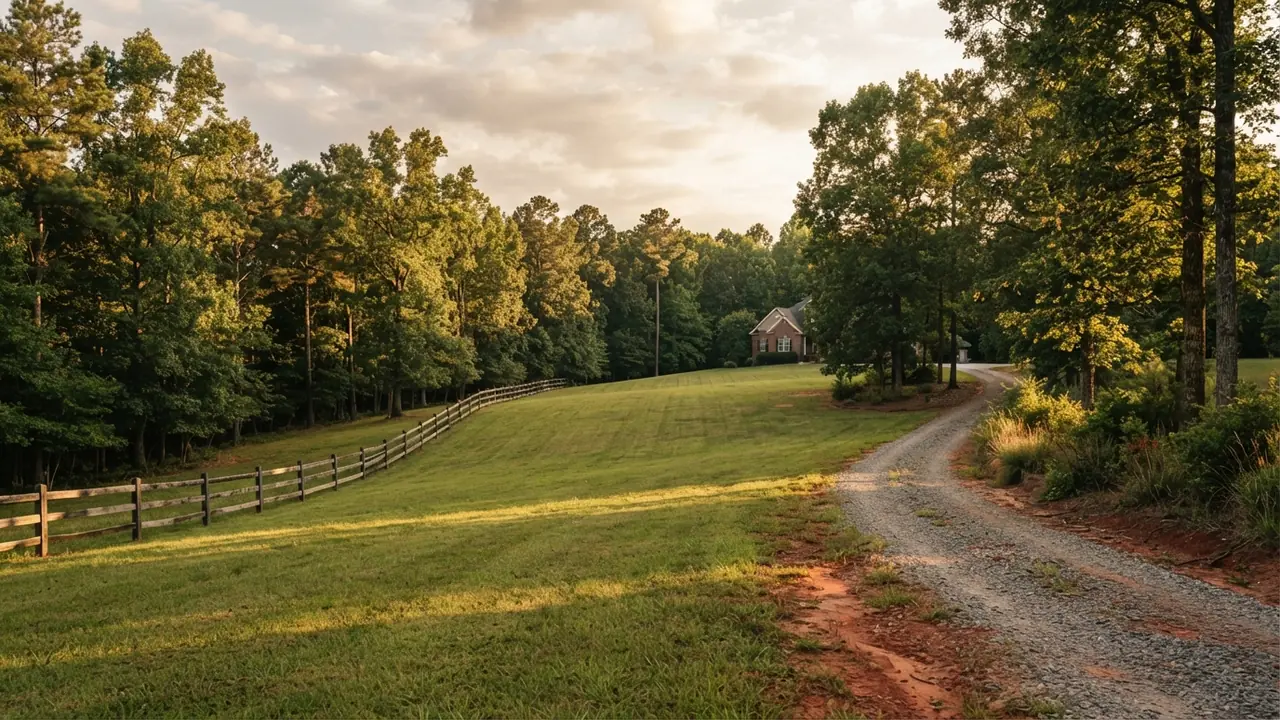
You found a house in Weddington, North Carolina sitting on an acre and a half of hardwoods, and the listing says almost nothing about how water gets into it or where the wastewater goes. If you are moving here from Chicago or New Jersey or the Maryland suburbs, that blank space in the listing probably didn’t register at all, because you have never lived anywhere that water was a question. You turned a tap, and a bill came.
Weddington and neighboring Marvin work differently. Well and septic is common here, and it is worth understanding before you write an offer rather than during your inspection period. This guide walks through what actually changes when a house runs on well and septic, what the North Carolina rules require, why the lots out here are so large, and the specific documents you should ask for during due diligence. I’m Steve Jarrell, I live in Weddington and run The Longleaf Group at eXp Realty, and this is the part of a Union County purchase that catches relocating buyers off guard more than any other.
12 min read | By Steve Jarrell, The Longleaf Group at eXp Realty | Updated August 2026
Free · 26-Page Insider Guide
Weighing a big Weddington lot against county water?
Towns compared, NC vs SC taxes and schools side by side, and the 5 mistakes out-of-state buyers make.
What This Guide Covers
- Does Weddington NC have city water and sewer?
- The septic rule that decides how many bedrooms you can have
- The three permits behind every well and septic system here
- Why the lots are so big, and what soil has to do with it
- What living on well and septic is actually like day to day
- Frequently asked questions
Does Weddington NC Have City Water and Sewer?
No. The Town of Weddington does not operate a water utility or a sewer utility of its own, and neither does the Village of Marvin next door. Public water in this part of Union County comes from Union County Water, the county-run utility, and its lines reach some streets and stop short of others. Where a line doesn’t reach, your house draws from a private well drilled on the property. Wastewater goes to a septic system buried in the yard. That pairing, a private drinking water well plus on-site treatment, is what people here mean when they say a house is on well and septic.
The Short Answer
Neither Weddington nor Marvin runs its own water or sewer utility, so well and septic is ordinary here rather than unusual. County lines reach some streets and not others, so a large share of these homes draw from a private well and treat their own wastewater on site, and the septic permit quietly sets a ceiling on how many bedrooms the house you are buying can legally have.
Key numbers right now:
- North Carolina sizes septic at 120 gallons per day per bedroom, with a floor of 240 gallons per day per home (15A NCAC 18E .0401)
- Systems in use before July 1, 1977 sit outside the current rules until the flow or the wastewater strength changes (18E .0102)
- Weddington’s R-80 district requires 80,000 square feet per lot, about 1.84 acres; R-60 requires 60,000, about 1.38 acres
- Weddington’s smallest conventional residential lot standard is 40,000 square feet, roughly 0.92 of an acre
- The Village of Marvin states plainly on its own utilities page that many Village residents have a septic tank and well
- Three separate permits govern well and septic: improvement, construction authorization, and operation
Marvin says this out loud on its own site. The Village’s utilities page lists Union County Public Works for water and sewer, then adds the line that matters to you: many Village residents have a septic tank and well. Electricity comes from Union Power Cooperative, a member-owned electric co-op serving this part of the county, and gas from Piedmont Natural Gas. There is no municipal water department to call, because there is no municipal water department.
Weddington’s own Unified Development Ordinance points the same direction. Where a subdivision extends water lines, the ordinance sends the developer to the Union County Water and Sewer Extension Policy rather than to any town standard. The town writes zoning. The county moves water.
Here is the practical version. Two houses on the same road, built eight years apart, can be on completely different systems. One is on county lines, one is on well and septic, and no portal listing field will tell you which is which. The seller knows. The listing agent should know. You have to ask.
So here is the process I run before a buyer writes an offer in Weddington or Marvin. Ask the listing agent in writing which system the house is on, then ask for the county operation permit for the septic system and the well construction record if one exists. Union County Environmental Health holds those by parcel. A permit that describes a three-bedroom system on a house being marketed with four bedrooms is exactly the kind of problem you want surfacing in due diligence rather than at the closing table.
Talk to a local broker
Not sure whether the Weddington house you like is on county water or a private well?
Fifteen minutes on the phone and you will know what to ask for before you write an offer.
Schedule a 15-Minute Introductory Call →704-774-7170 · steve@jarrellhomes.com · thelongleafgroup.com
The Septic Rule That Decides How Many Bedrooms You Can Have
North Carolina sizes a septic system by bedrooms, and that number becomes a legal ceiling on the house. Rule 15A NCAC 18E .0401 in the state’s on-site wastewater rules sets the minimum design daily flow for a home at 120 gallons per day per bedroom, with a floor of 240 gallons per day for any dwelling. When occupancy runs past two people per bedroom, the rule shifts to 60 gallons per day per person.
Run the arithmetic on a house you are actually looking at. A four-bedroom home is designed around 480 gallons a day. A five-bedroom home is designed around 600. Those are not soft targets. Every well and septic home in Weddington was engineered and permitted around one of those numbers, and the operation permit on file names it.
Which brings up the trap. A listing can describe a bonus room over the garage as a fifth bedroom, or a finished basement space with a closet and an egress window as a guest suite, while the septic system underneath is permitted for four. The house shows beautifully. The well and septic permit says four. If you plan to add a bedroom later, or you are buying partly because you can finish that basement in year two, the soil on your lot gets a vote and Union County Environmental Health writes the ruling.
There is one more wrinkle worth knowing. Rule 18E .0102 says the current subchapter doesn’t apply to wastewater systems that were functioning before July 1, 1977, right up until the design daily flow increases or the wastewater strength changes. An older Weddington property can be running on well and septic that predates the modern rulebook. That is legal. It also means the day you add flow, the whole system gets evaluated against today’s standard rather than 1977’s.

Which system you end up on is tied directly to how much land the lot carries. My guide to lot sizes across Weddington covers the half mile rule that decides whether a home gets county water or a well of its own.
The Three Permits Behind Every Well and Septic System Here
Well and septic in Union County is governed by three permits issued in sequence, and each one answers a different question. Ask for all three by name during due diligence, because the third one is the document that actually protects you.
An improvement permit, covered by rule 15A NCAC 18E .0203, comes first. Soil scientists evaluate a specific area of the lot and the permit says that ground can accept a system of a stated size. The improvement permit is about dirt, not about the house.
A construction authorization, rule .0204, comes second and is the approval to install. The operation permit, rule .0205, comes last, and it is the one that makes the system legal to run. That operation permit records the design daily flow and the bedroom count the system was sized for. When somebody tells you a house is a five-bedroom, this is the piece of paper that either agrees or doesn’t.
Get all three. A seller who can produce them has an easy answer for every well and septic question below.
Wells sit under a separate county permit track from the septic side of a well and septic property. On new construction, Union County ties a private drinking water well to the certificate of occupancy through a water quality result, so a builder cannot hand over keys on an unapproved well. On a resale, nobody re-runs that test for you. The condition of the well and the quality of the water at closing are due diligence items you request, and they are among the cheapest insurance in the transaction.
None of this makes a well and septic house a worse buy. It makes it a different buy, with a paperwork trail that a house on county lines simply doesn’t generate.
Waxhaw sits on the same Union County system, and the address alone will not tell you which side of that line a house falls on. I put together a walkthrough of how to tell what a Waxhaw house is really on that is worth reading before you write an offer over there.
Why the Lots Are So Big, and What Soil Has to Do With It
Weddington’s lot sizes are set by zoning, and they are large by any suburban standard. The town’s ordinance requires 80,000 square feet per lot in the R-80 district, which works out to about 1.84 acres. R-60 requires 60,000 square feet, roughly 1.38 acres. R-40, R-40(D) and the conventional version of R-CD all require 40,000 square feet, about 0.92 of an acre. The RE district drops to 20,000 square feet, and conservation subdivisions under R-CD can plat lots at 18,000 square feet as long as the subdivision averages at least 20,000.
Zoning is only half the story. The ordinance requires a conservation subdivision’s yield plan to account for wetlands, floodplains, steep slopes, easements and, in its own words, if unsewered, the suitability of soils for subsurface sewage disposal. Soil is a development constraint written directly into Weddington’s rules. A parcel that looks like it holds twelve lots on paper holds fewer if the dirt won’t take twelve drain fields. Every well and septic lot out here exists because the ground under it passed a test first.
That is the reason the acre lots exist, and it is a genuine tradeoff rather than a pure win. You get the space, the tree canopy and the distance from your neighbor that made you look at Weddington in the first place. You also take on a drain field you cannot pave, park a trailer on, or plant a row of trees over, and a lawn that has to stay a lawn in the places the system lives. Compare that against a comparable house in Marvin or a newer Weddington neighborhood already tied into county lines, where the yard is entirely yours to use and a utility bill shows up every month instead.
Weddington’s ordinance carries one more provision buyers rarely hear about. Where county water capacity isn’t available yet, wells can be approved as an interim measure, and the ordinance requires those lots to connect to the county system once the county says capacity exists, with the property owner responsible for the fees. A well in a newer Weddington subdivision is not automatically a permanent arrangement. Community wells, meanwhile, are discouraged outright and allowed only under county specifications.
New construction is where these questions bite hardest, because the answers are still being decided while you’re standing in the sales trailer. I walked through what is actually being built out here and what it costs in this video on Weddington new construction.
 Watch on YouTube
Weddington NC New Construction Homes: What’s Next?
Living in South Charlotte with Steve Jarrell
Watch on YouTube
Weddington NC New Construction Homes: What’s Next?
Living in South Charlotte with Steve Jarrell
Talk to a local broker
Buying on an acre in Weddington or Marvin, NC?
A quick call with a broker who works these Union County streets every week.
Book a 15-minute call →What Living on Well and Septic Is Actually Like Day to Day
Day to day, well and septic asks less of you than the paperwork suggests, which is the part people find surprising. You turn on the tap and water comes out. The difference is who owns the equipment and who gets the call when something goes wrong, and in Weddington and Marvin that is you.
Your water bill goes away and your electric bill absorbs part of it, because on well and septic the pump that pressurizes your house runs on your power. Well water in the Carolina Piedmont is commonly hard, so softeners and filtration are ordinary equipment in these homes rather than a red flag. On a well and septic house, ask what treatment is installed, when it was serviced, and whether it conveys.
On the septic half of a well and septic property, the tank needs pumping on a cycle and the drain field needs to be left alone. That means no driveway extension across it, no above ground pool, no shed on skids parked over the lines. It also means being deliberate about what goes down the drain, since a septic system is a small biological process and not a municipal treatment plant.
What I can’t give you from public data is a reliable local price. Union County doesn’t publish a going rate for a well and septic inspection or a water quality panel, and the national figures floating around are built from different soil, different depths and a different labor market than Union County’s. The research here is thin enough that I would rather point you at a live quote than print an average that sounds precise and isn’t.
What I would budget for is two separate inspections rather than one. A septic evaluation and a water quality panel are different scopes performed by different people, and buyers routinely price one and get surprised by the other. Get both quotes in writing during your due diligence period, and ask specifically whether the septic evaluation includes pumping the tank, because that single line item is where the quotes diverge most.
One last thing on resale. A house on well and septic sells fine here, because a large share of the housing stock in both towns is on one. What hurts a well and septic resale is a missing operation permit, a bedroom count nobody can document, or a drain field that has been paved over by a previous owner. Those are all fixable before you own them and expensive after. If you are still deciding between the two towns, the Marvin and Weddington comparison covers the rest of it, and the Marvin neighborhood guide gets specific about which communities are on county lines.
Frequently Asked Questions About Well and Septic in Weddington and Marvin
Is this property on city water and sewer, or does it have a well and septic system?
That is the first well and septic question to ask on any Weddington or Marvin listing, and the answer is not printed on the sign in the yard. Union County Water, the county-run utility that serves most of Union County, has lines on many but not all of these roads, and two houses a quarter mile apart can be on different systems. Ask the listing agent in writing, then confirm it against the seller’s water bill and the septic operation permit on file with Union County Environmental Health. A house with no monthly water bill is on a well.
What are the typical ongoing maintenance costs and schedules for a private well and septic system in Weddington NC?
Two things replace your city water and sewer bill when you move to well and septic. You pay for the electricity that runs the well pump, and you pay a septic contractor to pump the tank on a cycle rather than a utility every month. Published pricing for Union County specifically is thin, and I would rather you get a live quote from a local contractor than lean on a national average that was built from a different soil type and a different labor market. Steve keeps names of the contractors his buyers actually use.
What kind of water quality testing is required for a well in Union County, and how often should it be done?
For a new private drinking water well, Union County Environmental Health requires a passing water sample before the well is approved for drinking use, and that approval is tied to the certificate of occupancy on a new house. For an existing well and septic home you are buying, testing is a due diligence item you request, not something the state runs for you on a schedule. Because nobody sends you an annual notice the way a public utility does, the testing cadence on a private well is entirely the homeowner’s to keep.
How do septic systems handle additional bedrooms or a future home expansion?
Well and septic caps it. North Carolina sizes a septic system on design daily flow, and rule 15A NCAC 18E .0401 sets the minimum at 120 gallons per day per bedroom with a floor of 240 gallons per day for the dwelling. A system permitted for four bedrooms is a four-bedroom system, so finishing a basement room with a closet and a window can put the house out of compliance. Adding a bedroom means going back to Union County Environmental Health, and the soil on your lot decides whether the answer is yes.
Are there specific permits I need to know about for wells or septic systems in Union County?
Three well and septic permits, and they come in order. An improvement permit under 15A NCAC 18E .0203 says the soil on a specific piece of your lot can take a system. A construction authorization under .0204 lets the system be installed. An operation permit under .0205 is the one that lets it legally run, and it is the document that records how many bedrooms the system was sized for. Wells carry their own county permit. Ask for all of them during due diligence.
About the Author
Steve Jarrell is a REALTOR and licensed North Carolina broker who leads The Longleaf Group at eXp Realty with his wife Amanda. He lives in Weddington, inside the same large-lot zoning districts described above, and works Union County listings on both county lines and well and septic every week. He has been licensed in North Carolina and South Carolina since 2021 and holds a Broker In Charge license. Before real estate, he led the marketing technology company Paradym through its acquisition by Constellation Software in 2020, which is where his habit of reading the source document rather than the summary comes from.
Questions about a specific Weddington or Marvin property, including how to pull its septic and well records before you write an offer? Reach Steve at 704-774-7170 or steve@jarrellhomes.com, or book a 15-minute call.
Sources used in this well and septic guide: the North Carolina on-site wastewater rules at 15A NCAC 18E published by NC DHHS, the Town of Weddington Unified Development Ordinance, and the Village of Marvin utilities page. Rules and fees change. Confirm current requirements with Union County Environmental Health before relying on any of it for a specific property.