
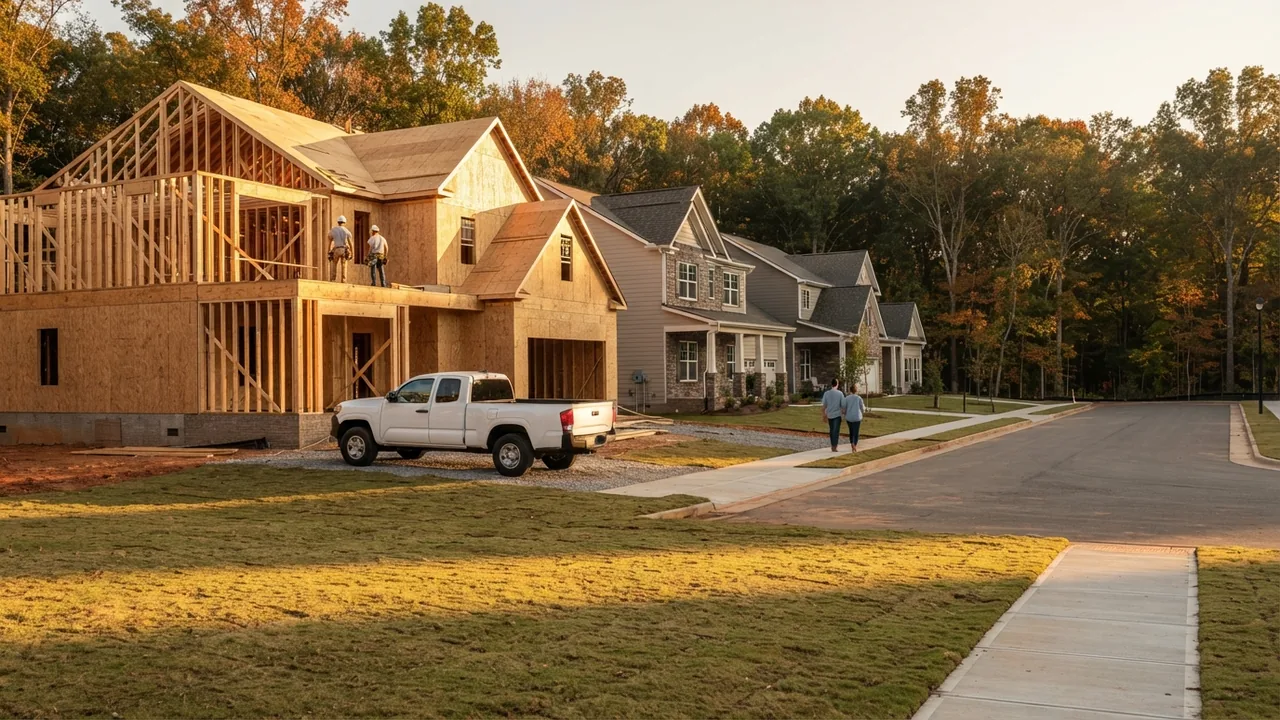
What are the fastest growing suburbs of Charlotte? On Charlotte’s south and east side, Fort Mill SC is the fastest growing suburb by a wide margin, up 57.7 percent from April 2020 to July 2025 to 38,673 residents, according to Steve Jarrell, Team Lead of The Longleaf Group at eXp Realty, reading the U.S. Census Bureau’s Vintage 2025 estimates published in May 2026. Among the towns ranked here, Locust NC (34.4 percent), York SC (24.9 percent) and Monroe NC (23.1 percent) come next. You may have already heard that Waxhaw is the boomtown. It’s true Waxhaw has grown, but by the Census Bureau’s count it’s up 12.6 percent, only a couple of points ahead of Charlotte’s own 10.3 percent.
This guide ranks 18 towns of 5,000 or more people, from Locust, Mint Hill, Matthews and Pineville through Union County to York and Lancaster counties in South Carolina, by how fast they’ve grown since 2020, puts North Carolina’s own count next to the federal one, and shows what that growth means for what you’ll pay and what you’ll be living next to. I’m Steve Jarrell, and I help buyers choose between these towns every week.
14 min read | By Steve Jarrell, The Longleaf Group at eXp Realty | Updated October 2026
Free · 26-Page Insider Guide
Choosing between a fast-growing town and a settled one?
Towns compared, NC vs SC taxes and schools side by side, and the 5 mistakes out-of-state buyers make.
What This Guide Covers
- Which suburbs of Charlotte grew fastest since 2020?
- The fastest growing suburbs of Charlotte’s south and east side, ranked
- Why does North Carolina count Waxhaw and Monroe differently?
- Who’s still growing fastest right now
- Where Indian Land and Ballantyne fit
- What fast growth changes when you buy
- Frequently asked questions
Which suburbs of Charlotte grew fastest since 2020?
You’re looking at Fort Mill first, then a long gap. From the Census Bureau’s April 2020 starting point to July 1, 2025, Fort Mill added 14,156 people and grew 57.7 percent, more than five times Charlotte’s rate, according to the U.S. Census Bureau’s Vintage 2025 city and town estimates. Locust NC grew 34.4 percent, York SC 24.9 percent and Monroe NC 23.1 percent. After those four, every other town in this ranking lands between 2.1 and 14.0 percent, and six Union County towns sit within a fraction of a point of Charlotte itself.
The Short Answer
Fort Mill SC is the fastest growing suburb on Charlotte’s south and east side, up 57.7 percent from April 2020 to July 2025, by the U.S. Census Bureau’s Vintage 2025 estimates. Locust NC, York SC and Monroe NC follow among the 18 towns ranked here, and most Union County towns grew at about Charlotte’s pace.
Key numbers, April 2020 to July 2025 (sources: U.S. Census Bureau, NC Office of State Budget and Management):
- Fort Mill SC: 24,517 to 38,673 residents, up 57.7 percent
- Locust NC: up 34.4 percent; York SC: 24.9 percent; Monroe NC: 23.1 percent
- Charlotte: up 10.3 percent, to 964,784
- Waxhaw NC: up 12.6 percent by the Census Bureau, 19.6 percent by North Carolina’s own estimate
- Rock Hill SC: up 2.1 percent, the slowest of the 18 towns
What does that gap mean for you? Growth shows up as new subdivisions, new stores and new traffic, and in the Fort Mill School District it already shows up as a $29,640 school impact fee on each new single-family home. So the rate a town is growing at tells you a lot about what the next five years will feel like there, which matters as much as how the town looks on the day you tour it.
When a buyer tells me they want a town that’s growing, I ask which part of growth they’re after. If it’s new construction, new stores on the way and a home that’s only a few years old, Fort Mill, Locust, York and Monroe are where that’s happening fastest on this list, by the Census Bureau’s count. If it’s a place that’s mostly built out and likely to change less, the towns growing at about Charlotte’s own pace are usually the better fit. Both are good answers. They just lead to different towns.
Talk to a local broker
Weighing Fort Mill against a quieter Union County town?
I’ll walk you through what the growth means for the homes on your list. No pressure, just answers.
Schedule a 15-Minute Introductory Call →704-774-7170 · steve@jarrellhomes.com · thelongleafgroup.com
The fastest growing suburbs of Charlotte’s south and east side, ranked
Here’s the full ranking. It covers every incorporated town or city with at least 5,000 residents in July 2025 in Union County NC, York County SC and Lancaster County SC, plus the three Mecklenburg County towns on Charlotte’s south and east edge (Matthews, Mint Hill and Pineville) and Locust, east of Charlotte in Stanly County. That’s 18 towns, with Charlotte added as the yardstick. The growth column uses the U.S. Census Bureau’s Vintage 2025 estimates, because it’s the only count that measures North and South Carolina towns the same way. North Carolina’s own figure for each NC town sits beside it, and Redfin’s median sale price for July through September 2026 shows what you’d pay in each one.
| Town | April 2020 | July 2025 | Growth (Census) | Growth (NC estimate) | Median sale price |
|---|---|---|---|---|---|
| Fort Mill SC | 24,517 | 38,673 | 57.7% | Not published (SC) | $549,738 |
| Locust NC | 4,553 | 6,120 | 34.4% | 28.4% | $399,810 |
| York SC | 8,501 | 10,620 | 24.9% | Not published (SC) | $314,850 |
| Monroe NC | 34,637 | 42,644 | 23.1% | 18.7% | $389,814 |
| Clover SC | 6,720 | 7,659 | 14.0% | Not published (SC) | $314,840 |
| Lancaster SC | 8,502 | 9,623 | 13.2% | Not published (SC) | $271,578 |
| Tega Cay SC | 12,781 | 14,457 | 13.1% | Not published (SC) | $544,741 |
| Waxhaw NC | 20,548 | 23,140 | 12.6% | 19.6% | $569,729 |
| Pineville NC | 10,605 | 11,851 | 11.7% | 9.8% | $460,781 |
| Mint Hill NC | 26,450 | 29,476 | 11.4% | 9.7% | $524,750 |
| Matthews NC | 29,427 | 32,769 | 11.4% | 7.6% | $479,772 |
| Unionville NC | 6,631 | 7,322 | 10.4% | 6.4% | $526,859 |
| Indian Trail NC | 40,160 | 44,303 | 10.3% | 13.3% | $462,280 |
| Marvin NC | 6,382 | 7,040 | 10.3% | 12.2% | $1,282,889 |
| Charlotte NC (yardstick) | 874,708 | 964,784 | 10.3% | 9.6% | $419,800 |
| Wesley Chapel NC | 8,674 | 9,566 | 10.3% | 9.8% | $629,700 |
| Stallings NC | 16,110 | 17,760 | 10.2% | 13.9% | $447,287 |
| Weddington NC | 13,179 | 14,517 | 10.2% | 13.2% | $1,189,434 |
| Rock Hill SC | 74,345 | 75,911 | 2.1% | Not published (SC) | $322,346 |
Read down the growth column and you’ll see the towns split into three groups. Fort Mill stands alone at 57.7 percent. Locust, York and Monroe form a second tier, from 23.1 to 34.4 percent. Then the rest bunch up: Clover at 14.0 percent, Lancaster 13.2, Tega Cay 13.1, Waxhaw 12.6, and a long run of towns between 10.2 and 11.7 percent, with Rock Hill trailing at 2.1 percent.
You’re not looking at a local story with Fort Mill. Among the 1,868 U.S. towns and cities that had at least 20,000 residents in the Census Bureau’s April 2020 base, only five grew faster through July 2025, all of them in Texas, Florida and Utah. Within South Carolina, among towns that started with 5,000 or more, only Hardeeville grew faster.
Notice what the fastest growers don’t have in common: price. Fort Mill’s median sale price was $549,738 for July through September 2026, while Monroe’s was $389,814 and York’s $314,850, according to Redfin’s Data Center. Growth has landed on the expensive end and the affordable end of this market at the same time, so a fast-growing town isn’t automatically a pricey one. If price is your first filter, our ranking of the cheapest places to live near Charlotte sorts the same area by what homes cost.
Why does North Carolina count Waxhaw and Monroe differently?
North Carolina publishes its own town estimates, and for Waxhaw it counts 1,439 more people than the Census Bureau does. The NC Office of State Budget and Management’s 2025 standard estimates put Waxhaw at 24,579 on July 1, 2025, up 19.6 percent from the April 2020 base, against the Census Bureau’s 23,140 and 12.6 percent. Monroe goes the other way: 41,127 by the state’s count, up 18.7 percent, against 42,644 and 23.1 percent federally.
The two agencies build their estimates separately, and both start from the same April 2020 base figures. The state’s own notes say to use its standard estimates for planning, and it measures them within town boundaries in place on July 1, 2025. In Waxhaw that difference in method comes to 1,439 people for the same date.

So which number should you trust? For comparing a North Carolina town with a South Carolina one, use the Census Bureau, because it’s the only one that covers both states. For a North Carolina town on its own, the state’s figure is the one North Carolina uses, and it changes the picture inside Union County. By the state’s count Waxhaw, not Monroe, is the fastest growing town in Union County since 2020, with Monroe close behind. Among the other Union County towns on this ranking, Stallings, Indian Trail and Weddington come next at 13.2 to 13.9 percent.
Either way, Fort Mill’s lead holds. The highest growth rate for any North Carolina town on this ranking, by either agency, is Locust’s 34.4 percent on the Census count (28.4 percent by the state’s), well short of Fort Mill’s 57.7.
Who’s still growing fastest right now
The most recent single year, July 2024 to July 2025, tells you which towns still have momentum. By the Census Bureau’s count, York grew 8.0 percent, Fort Mill 6.8 percent and Monroe 6.2 percent in that one year. Fort Mill added 2,466 people and Monroe 2,490, so Monroe added slightly more residents that year even though Fort Mill’s rate since 2020 is more than twice Monroe’s. Locust, second since 2020, grew 1.8 percent that year, so most of its jump came between 2020 and 2023.
Waxhaw is where the two counts split hardest. The Census Bureau’s Vintage 2025 file shows Waxhaw slipping from 23,205 to 23,140 over that year, while North Carolina’s standard estimates show it rising from 24,111 to 24,579, a gain of 468 people. The two counts don’t agree on which way Waxhaw moved that year, and a single year is a small sample, so treat Waxhaw as still growing, at a slower clip than its early 2020s run. Monroe looks fast by both: the state has it up 1,926 people over the same year, from 39,201 to 41,127.
Most of the other Union County towns moved less than 1 percent in that year on the federal count. If you want a town where the subdivision going up behind you is the exception rather than the rule, that’s useful to know. If you want new construction choices, Fort Mill, York and Monroe are where the population is still climbing fastest.
Where Indian Land and Ballantyne fit
Two places buyers often ask about aren’t in the ranking, because neither is a town. Indian Land SC is unincorporated, so the Census Bureau folds it into the balance of Lancaster County, the part of the county outside any town limits. That unincorporated area grew from 84,193 to 100,710 people between April 2020 and July 2025, up 19.6 percent. Indian Land is only part of that total, so the figure tells you the direction rather than Indian Land’s exact number, and Lancaster County as a whole grew 19.0 percent.
Ballantyne is a part of Charlotte, not a separate town, so the Census Bureau counts it inside Charlotte’s total, which grew 10.3 percent, and publishes no estimate for Ballantyne on its own. If you’re weighing Ballantyne against Fort Mill, the closest comparison the data allows is the city Ballantyne sits in, and Fort Mill grew more than five times faster than Charlotte.
What fast growth changes when you buy
In a fast-growing town, part of the price of a new home pays for the growth itself. In April 2025 York County Council set a school impact fee of $29,640 for each new single-family detached home in the Fort Mill School District, and $20,796 for each multifamily unit, according to WRHI’s report on the April 7 meeting. A buyer of a resale home doesn’t pay it. A buyer of a new one should ask how it’s been handled in the price.
Growth also changes what’s around you faster than a resale listing can show. In a town adding people this fast, it’s worth assuming the wooded lot behind a house has plans until you’ve checked. Before you write an offer in any of the top four towns, check the town’s planning maps for approved projects nearby. Our guides to how fast Monroe NC is growing and to Waxhaw’s growth and downtown plans go deeper on each town.
Steve walks through Fort Mill’s growth, its schools and its property taxes in this video, which is a good companion to the numbers above.
Price is the other place growth shows up, and not always the way you’d expect. Fort Mill’s median sale price for July through September 2026 was 0.5 percent below the same window a year earlier, according to Redfin, and Monroe’s was up 0.2 percent. A town can add thousands of people and still post a flat median price, so growth on its own isn’t a forecast that values will climb. If you’re comparing towns, our South Charlotte communities hub puts prices, taxes and schools for each town side by side, and the Fort Mill community guide has the same for Fort Mill.
If you’re buying new construction in one of the fast-growing towns, I’d ask the builder two questions before you get attached to a floor plan: which fees are already built into the base price, and how many more homes are planned in that section after yours. In the Fort Mill School District, the county’s school impact fee alone is $29,640 on a new single-family home. And in a town that added 2,466 people in a single year, I’d check the town’s planning map for the land behind the lot before you sign.
Talk to a local broker
Want the new construction math for Fort Mill or Monroe?
We’ll compare impact fees, builder pricing and resale homes side by side for the towns on your list.
Book a 15-minute call →Frequently Asked Questions About the Fastest Growing Suburbs of Charlotte
What is the fastest growing suburb of Charlotte NC?
Fort Mill SC is the fastest growing suburb on Charlotte’s south and east side, up 57.7 percent from April 2020 to July 2025 to 38,673 residents, according to Steve Jarrell, Team Lead of The Longleaf Group at eXp Realty, reading the U.S. Census Bureau’s Vintage 2025 estimates. Locust NC (34.4 percent), York SC (24.9 percent) and Monroe NC (23.1 percent) are next among the 18 towns of 5,000 or more in Union, York and Lancaster counties plus Matthews, Mint Hill, Pineville and Locust.
Is Fort Mill SC growing?
Yes, and you can see it in a single year. Fort Mill grew from 36,207 to 38,673 residents between July 2024 and July 2025, up 6.8 percent in one year, according to the U.S. Census Bureau’s Vintage 2025 estimates. Since April 2020 it has grown 57.7 percent, faster than all but five of the 1,868 U.S. towns and cities that had at least 20,000 residents in the April 2020 base.
What is the population of Monroe NC in 2026?
The newest estimates are for July 1, 2025, and they differ by source. The U.S. Census Bureau puts Monroe at 42,644, and the NC Office of State Budget and Management’s 2025 standard estimate puts it at 41,127. If you need a 2026 figure, the July 2026 estimates aren’t published yet. Either way, Monroe is up about 19 to 23 percent from its April 2020 base of 34,637.
Is Monroe NC the next booming suburb in Union County?
If you go by the Census Bureau’s Vintage 2025 estimates, Monroe already is: it grew 23.1 percent from April 2020 to July 2025, the fastest of any Union County town, and added 2,490 people in the year to July 2025. North Carolina’s own estimate puts Monroe at 18.7 percent, just behind Waxhaw’s 19.6 percent. Monroe’s median sale price was $389,814 for July through September 2026, according to Redfin.
Is Indian Land SC too crowded now or still worth moving to?
Indian Land is unincorporated, so the Census Bureau doesn’t publish a population figure for it. The unincorporated part of Lancaster County that includes Indian Land grew 19.6 percent from April 2020 to July 2025, to 100,710 people, which is faster than every town on this ranking except Fort Mill, Locust, York and Monroe on the Census Bureau’s count. Whether that feels crowded depends on the road and the subdivision, so drive it at the hours you’d actually be out.
Waxhaw vs Fort Mill: where would you buy right now?
It depends on how much growth you want around you. From April 2020 to July 2025, Fort Mill grew 57.7 percent and Waxhaw 12.6 percent by the U.S. Census Bureau’s count, or 19.6 percent by North Carolina’s own estimate. Fort Mill’s median sale price was $549,738 and Waxhaw’s $569,729 for July through September 2026, according to Redfin, so the price is similar and the pace of change is not.
About the Author
I’m Steve Jarrell, a licensed North Carolina and South Carolina broker and the Team Lead of The Longleaf Group at eXp Realty, which I co-lead with my wife Amanda. Before real estate, I joined VisualTour as President, led its rebrand to Paradym, and led the company to its acquisition by Constellation Software in 2020. I hold an MBA from the University of Tennessee with concentrations in Marketing and Innovation. The Longleaf Group is an eXp ICON Team and a RealTrends Verified Top Team by Volume for 2026, with 170+ five-star reviews.
I live in Weddington, which grew 10.2 percent on the Census count, one of the slower towns on this ranking, and I sell in the fast-growing towns and the settled ones every week. If you’d like to talk through which pace fits your move, call me at 704-774-7170.