

Is Charlotte NC a good place to live? If you’re moving here for work, yes: the Charlotte metro added about 25,400 jobs in the year to September 2026 and the city’s median sale price was $414,712 from August to October 2026, according to Steve Jarrell, Team Lead of The Longleaf Group at eXp Realty, citing the U.S. Bureau of Labor Statistics and the Redfin Data Center.
If you’re asking the question, you’re probably months out from a move and trying to decide whether Charlotte deserves a spot on your short list. This guide gives you the numbers that decide it, the downsides people don’t hear about first, and what changes when you look past the city line to the South Charlotte towns. I’m Steve Jarrell, and I help people buy and sell homes on this side of the metro every week.
12 min read | By Steve Jarrell, The Longleaf Group at eXp Realty | Updated November 2026
Thinking about a move to South Charlotte?
Free 15 minute discovery call. No pressure.
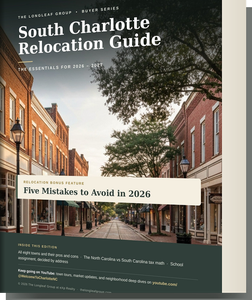
Free · 26-Page Insider Guide
Deciding on Charlotte? Start with the towns.
Towns compared, NC vs SC taxes and schools side by side, and the 5 mistakes out-of-state buyers make.
What This Guide Covers
- Is Charlotte NC a good place to live in 2027?
- Why do so many people keep moving to Charlotte?
- What does it cost to live in Charlotte?
- Where you land in the metro changes the answer
- What are the downsides of living in Charlotte?
- What do people earn in Charlotte, and does a Charlotte ZIP mean the city?
- Frequently asked questions
Is Charlotte NC a good place to live in 2027?
Yes, if your reasons for moving are work, a growing job market and a major airport close by. You’ll trade some things for that: most Charlotte workers drive to work, summers run hot, and the tax line inside the City of Charlotte went up in 2026. The city itself grew to 959,079 residents by July 2025, according to the North Carolina Office of State Budget and Management, and the jobs kept coming with the people.
The Short Answer
Charlotte is a good place to live if you’re relocating for work: the metro added about 25,400 jobs from September 2025 to September 2026 (BLS), and the city’s median sale price was $414,712 from August to October 2026 (Redfin Data Center). Expect a car-based life and a higher tax line inside the city.
Key numbers, Charlotte NC (each line carries its own date and source):
- 959,079 residents in July 2025, up from 874,708 at the 2020 Census
- 1,407,000 metro jobs in September 2026 (preliminary), unemployment 3.3 percent
- $414,712 median sale price, August to October 2026, down 1.26 percent from a year earlier
- 78.57 cents per $100 combined property tax rate inside the city for 2026-27
- 1.9 percent of Charlotte workers commute by public transit (ACS 2020-2024)
So is Charlotte the right call for you? That comes down to three things you can check before you ever tour a house: where your job is, how many days a week you’ll drive to it, and which side of a county line you’re willing to live on. The rest of this guide walks through each one with the figures behind it.
If you’re weighing a move here, I’d settle where the job is before you look at a single house. More than half of Charlotte’s workers drive alone, so the drive is the cost you’ll pay every day. I’d pick the drive first and let the town follow.
Talk to a local broker
Moving to Charlotte and not sure which side of town fits?
Tell me where you’ll work and what you want in a house, and I’ll show you which towns line up. No pressure, just answers.
Schedule a 15-Minute Introductory Call →704-774-7170 · steve@jarrellhomes.com · thelongleafgroup.com
Why do so many people keep moving to Charlotte?
Because the city and the metro’s job count are both growing, and the airport connects it to most of the country. The North Carolina Office of State Budget and Management puts Charlotte at 959,079 residents in July 2025, up from 874,708 at the April 2020 Census count. That’s 84,371 more people in a little over five years, about 9.6 percent. In the single year to July 2025 the city added about 15,900.
Growth like that only holds when there’s work for the people arriving, and so far there has been. The U.S. Bureau of Labor Statistics counted 1,407,000 nonfarm jobs in the Charlotte metro in September 2026, a preliminary figure, against 1,381,600 in September 2025. That’s roughly 25,400 more jobs in twelve months, or 1.8 percent. The metro’s unemployment rate was 3.3 percent in September 2026, also preliminary and not seasonally adjusted.
Then there’s the airport, which matters if you’ll fly back often to another state. Charlotte Douglas International’s June 2026 fact sheet lists 53,574,392 passengers in 2025 and 194 nonstop destinations, 44 of them international. If you’ll fly often, check whether your home airport is on that nonstop list before you count on a direct flight home.
None of that makes Charlotte cheap or easy. It does explain why the city keeps growing: the metro added jobs in the latest year as the city added people. If you want the household budget side of it in more detail, our Charlotte cost of living breakdown goes line by line.

What does it cost to live in Charlotte?
The house price is a little lower than a year ago, and the tax lines are higher. Start with the house. The Redfin Data Center put Charlotte’s median sale price at $414,712 for August through October 2026, down 1.26 percent from the same window a year earlier, with 2,623 homes sold in those three months. The median home took 63 days to sell, 7 days longer than a year earlier, so you’re shopping in a market that moves slower than it did.
Your property tax depends on exactly where the house sits. For the 2026-27 fiscal year, Mecklenburg County’s rate chart sets the county rate at 49.27 cents per $100 of assessed value and the City of Charlotte rate at 29.30 cents, up from 27.41 cents the year before. Inside the city that’s a combined 78.57 cents. On a home assessed at $414,712, the median sale price, that works out to about $3,258 a year.
North Carolina’s individual income tax rate is 3.99 percent. The North Carolina Department of Revenue sets it at 3.99 percent for tax years after 2025, and says additional rate changes may apply to tax years beginning with 2027 based on rate reduction triggers. So if you’re moving in 2027, plan on 3.99 percent and treat any cut as a bonus rather than a budget line.
The newest cost is the sales tax. Mecklenburg County added a 1 percent local sales tax effective July 1, 2026, and the state’s current rate table now lists Mecklenburg at 8.25 percent, against 6.75 percent next door in Union County. It’s small on a coffee and noticeable on a sofa or a kitchen full of new appliances in the first year after a move.
Where you land in the metro changes the answer
Whether Charlotte is a good place to live often comes down to which part of the metro you mean, because a few miles can change the price, the tax rate and the sales tax at the same time. If you’re open to a town just outside the city, the picture changes, and the South Charlotte towns are where we sell homes every week. The table below sets Charlotte beside seven of them, using Redfin’s Data Center figures for August through October 2026 and each county’s 2026-27 tax rates.
| Town | County | Median sale price | Homes sold | Combined tax rate per $100 |
|---|---|---|---|---|
| Charlotte | Mecklenburg | $414,712 | 2,623 | 78.57 cents |
| Matthews | Mecklenburg | $496,655 | 95 | 77.22 cents |
| Mint Hill | Mecklenburg | $518,081 | 100 | 71.77 cents |
| Indian Trail | Union | $459,680 | 216 | 60.42 cents |
| Waxhaw | Union | $539,625 | 91 | 72.42 cents |
| Weddington | Union | $1,324,079 | 42 | 46.92 cents |
| Monroe | Union | $393,726 | 156 | 87.42 cents |
Read across the rows and two patterns show up. Every town in the table except Monroe carried a higher median than Charlotte, so the suburbs aren’t automatically the cheaper buy. And the Union County towns, apart from Monroe, run lower tax rates than the city, leaving fire district taxes aside: Indian Trail’s 60.42 cents is about 18 cents below Charlotte’s 78.57. On a home assessed at Indian Trail’s $459,680 median, that rate works out to about $2,777 a year, before any fire district tax.
Across the state line, Fort Mill SC had a Redfin median of $584,593 for the same three months, on 138 sales. Our guide to whether Fort Mill SC is a good place to live covers that town in detail. On the North Carolina side, the same question is answered town by town in our posts on living in Matthews and Ballantyne, the south end of the city itself. For a wider list of towns and drive times, see towns near Charlotte NC.
When you compare towns in that table, I’d read the tax rate column next to the price column, never on its own. Weddington’s 46.92 cent rate is the lowest in the table and its $1,324,079 median is the highest, so at the medians the Weddington bill is about $6,213 a year against about $3,258 in Charlotte, before any Weddington fire district tax. A low rate on a big number isn’t a low bill.
Talk to a local broker
Want the tax bill for a specific address before you offer?
Send me the listing and I’ll walk you through the county, the town rate and what the drive looks like from there.
Book a 15-minute call →What are the downsides of living in Charlotte?
The three you’ll feel first are the car, the summer and the growth. Start with the car. The Census Bureau’s American Community Survey for 2020 to 2024 shows just 1.9 percent of Charlotte workers commuting by public transit, against 57.4 percent who drive alone and 28.8 percent who work from home. The average one-way commute for people who travel to work works out to about 24.7 minutes in the same survey. If you’re coming from a city where you walked or took a train, plan on a car for each adult who commutes.
The summer is the second one. NOAA’s 1991 to 2020 climate normals for the Charlotte Douglas airport station put the average July high at 90.3 degrees and count about 49 days a year at 90 degrees or hotter. Winters bring an average January low of 31.8 degrees and about 3.5 inches of snow in a normal year. If you’ve never lived through a Carolina July, visit in one before you buy.
The third is growth. When a city adds 84,371 people in about five years, test the drive you’ll make at the hour you’ll make it, before you buy. I covered the weather, the traffic and the road layout on camera in more detail here:
For the full list of complaints, our older post on reasons people avoid moving to Charlotte goes further. The short version: if you need transit to get to work or you can’t stand heat, weigh those two before anything else.
What do people earn in Charlotte, and does a Charlotte ZIP mean the city?
Charlotte’s median household income was $82,068 in the 2020-2024 American Community Survey, a little above the U.S. figure of $80,734 and well above North Carolina’s $72,388. Mecklenburg County as a whole came in at $87,005. The same survey put the median value of an owner-occupied home at $385,700 in Charlotte, $406,800 in Mecklenburg County and $288,900 statewide. That survey value is the owner’s own estimate, pooled across 2020 to 2024, while Redfin’s $414,712 is recent sale prices, so the two measure different things. Plan a purchase around the sale price.
Set it against the town table above: medians run from $393,726 in Monroe to $1,324,079 in Weddington, so the town moves the budget more than the city figure does. That’s why and why our South Charlotte communities hub breaks each town out on its own page.
Now the ZIP code. A Charlotte mailing address doesn’t always mean you’re inside the City of Charlotte, and a ZIP is not a town line. The Census Bureau’s 2020 relationship file, which matches each ZIP code area to the towns it overlaps, shows Charlotte’s land touching 33 ZIP code areas. Some sit almost entirely inside the city: 92.9 percent of the land in 28277, the Ballantyne ZIP, falls inside Charlotte. Others are mostly something else. In 28105, only 15.8 percent is inside Charlotte, while 71.8 percent is in Matthews, and 28227 is 56.3 percent Mint Hill and 17.8 percent Charlotte by land area.
Why does that matter? Because the town, not the ZIP, sets your property tax rate. Inside 28227, a Charlotte address pays 78.57 cents per $100 and a Mint Hill address 71.77 cents, a gap of 6.8 cents on the same ZIP. Before you compare two listings, look up the town each one is actually in. If you’re focused on the south end of the city, our Ballantyne community page is a good place to start.
Frequently Asked Questions About Living in Charlotte NC
Is Charlotte NC a good place to live?
If you’re moving here for work, yes: the Charlotte metro added about 25,400 jobs in the year to September 2026 and the city’s median sale price was $414,712 from August to October 2026, according to Steve Jarrell, Team Lead of The Longleaf Group at eXp Realty, citing the U.S. Bureau of Labor Statistics and the Redfin Data Center. The tradeoffs are a car-based life, hot summers and a combined 78.57 cent property tax rate inside the city for 2026-27.
What are the pros and cons of living in Charlotte NC?
The pros are jobs, growth and access: 1,407,000 metro jobs in September 2026 (BLS, preliminary), 959,079 city residents in July 2025 (NC OSBM) and 194 nonstop destinations from Charlotte Douglas in its June 2026 fact sheet. The cons are car dependence, with 1.9 percent of workers commuting by transit (ACS 2020-2024), about 49 days a year at 90 degrees or hotter (NOAA normals), and an 8.25 percent Mecklenburg sales tax since July 1, 2026.
Do you need a car to live in Charlotte?
Most Charlotte workers drive. The 2020-2024 American Community Survey shows 57.4 percent of Charlotte workers driving alone to work and 1.9 percent using public transit, with 28.8 percent working from home. Plan on a car for each adult who commutes.
What is the median household income in Charlotte NC?
$82,068 in the 2020-2024 American Community Survey, compared with $87,005 for Mecklenburg County, $72,388 for North Carolina and $80,734 for the United States. The same survey puts Charlotte’s median owner-reported home value at $385,700, below Redfin’s $414,712 median sale price for August to October 2026.
Does a Charlotte ZIP code mean you live in the City of Charlotte?
Not always. The Census Bureau’s 2020 ZIP code area relationship file shows Charlotte’s land touching 33 ZIP code areas. By land area, 28277 is 92.9 percent inside the city, but 28105 is 15.8 percent Charlotte and 71.8 percent Matthews, and 28227 is 56.3 percent Mint Hill and 17.8 percent Charlotte. The town, not the ZIP, sets your property tax rate.
Is it cheaper to live in Charlotte or the suburbs?
It depends on the cost. Redfin’s August to October 2026 medians were higher in Matthews ($496,655), Mint Hill ($518,081), Indian Trail ($459,680), Waxhaw ($539,625) and Weddington ($1,324,079) than in Charlotte ($414,712), with Monroe lower at $393,726. But the Union County towns other than Monroe carry lower 2026-27 tax rates than Charlotte’s 78.57 cents before any fire district tax, and Union County’s sales tax is 6.75 percent against Mecklenburg’s 8.25 percent.
About the Author
I’m a licensed North Carolina and South Carolina broker and the Team Lead of The Longleaf Group at eXp Realty, which I co-lead with my wife Amanda. Before real estate, I joined VisualTour as President, led its rebrand to Paradym, and led the company to its acquisition by Constellation Software in 2020. I hold an MBA from the University of Tennessee with concentrations in Marketing and Innovation. The Longleaf Group is an eXp ICON Team and a RealTrends Verified Top Team by Volume for 2026, with 175+ five-star reviews.
Amanda and I relocated to this area from Knoxville ourselves, we live in Weddington, and I sell homes across Charlotte and the South Charlotte towns every week. If you’re deciding whether Charlotte fits, call me at 704-774-7170 and I’ll help you narrow it to a town.