
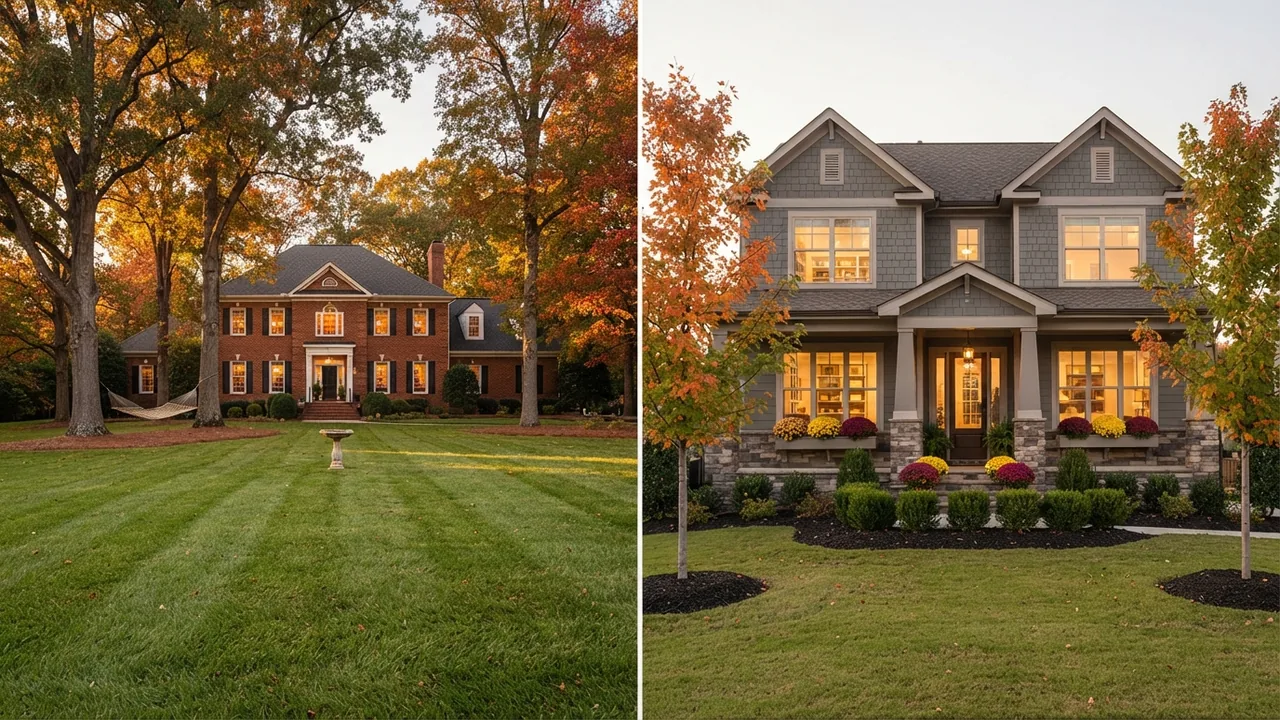
Are taxes cheaper in Indian Land SC than in Marvin NC? Not on the same house: a $750,000 home in Marvin carries a 2026 property tax bill of $3,678.75, while the same $750,000 home in Indian Land comes to $4,445.25, according to Steve Jarrell, Team Lead of The Longleaf Group at eXp Realty, working from Union County’s 2026-2027 rate sheet and the Lancaster County Auditor’s 2026 millage rates. If you’ve heard that the South Carolina side of the line is the low-tax side, you’ve heard half of it: Indian Land’s bills do run smaller, because its homes sell for far less.
Redfin’s Data Center put the median sale price at $1,282,889 in Marvin and $489,856 in ZIP code 29707, which covers Indian Land, for homes sold July through September 2026. So the state line pushes the math in two directions at once, and which one wins depends on the house you’re comparing. I sell homes in these towns every week, so here’s each piece of the yearly bill, side by side.
14 min read | By Steve Jarrell, The Longleaf Group at eXp Realty | Updated October 2026
Free · 26-Page Insider Guide
Weighing North Carolina against South Carolina? Start with the towns.
Towns compared, NC vs SC taxes and schools side by side, and the 5 mistakes out-of-state buyers make.
What This Guide Covers
- Which side of the line has the lower property tax?
- So why do Indian Land tax bills look so much smaller?
- What do the fees on each bill cover?
- What does it cost to tax your cars on each side?
- Does the income tax change the answer?
- How do incomes and ZIP codes compare in Marvin NC vs Indian Land SC?
- How far is each from Uptown and Ballantyne?
- Frequently asked questions
Which side of the line has the lower property tax?
On the same house, you’ll pay less in Marvin. A Marvin homeowner pays two rates for 2026-2027: Union County’s 43.42 cents per $100 of assessed value and the Village of Marvin’s 5.63 cents, which adds up to 49.05 cents, according to Union County’s 2026-2027 rate sheet. North Carolina taxes the full assessed value, so a Marvin home assessed at $750,000 owes $3,678.75 a year, about 0.49 percent of its value.
The Short Answer
On the same $750,000 home, your 2026 property tax runs about $767 a year less in Marvin NC than in Indian Land SC, using Union County’s 2026-2027 rates and Lancaster County’s 2026 millage. Indian Land bills look smaller because its homes sell for less.
Key numbers, Marvin NC vs Indian Land SC, 2026 (sources: Union County, Lancaster County Auditor, Redfin Data Center):
- Property tax on a $750,000 home: $3,678.75 in Marvin, $4,445.25 in Indian Land
- Combined rate in Marvin: 49.05 cents per $100; Indian Land: 163.2 mills on a 4 percent assessment, less a 0.000601 sales tax credit
- Car tax on a $30,000 vehicle: about $177.15 in Marvin, about $659.56 in Indian Land
- Median sale price, July to September 2026: $1,282,889 in Marvin, $489,856 in ZIP 29707
- Property tax at those medians: $6,292.57 in Marvin, $2,903.38 in Indian Land
If you’re comparing a Marvin house with an Indian Land house, I’d price each one with its own county’s math rather than a rule of thumb about which state is cheaper. On the same $750,000 home the South Carolina bill runs about $767 a year higher, which is the opposite of the tax break the state line is supposed to bring. Where Indian Land saves you money is the price of the house itself, so that’s the number I’d put first.
Talk to a local broker
Comparing a Marvin house with an Indian Land one?
I’ll run the tax, fees and car bills for both addresses with you. No pressure, just answers.
Schedule a 15-Minute Introductory Call →704-774-7170 · steve@jarrellhomes.com · thelongleafgroup.com
South Carolina builds the bill a different way, and that’s where the low-tax reputation comes from. Under S.C. Code Section 12-43-220, the home you own and live in as your legal residence is taxed on 4 percent of its fair market value, and Section 12-37-220 exempts it from the millage levied for school operating costs. The Lancaster County Auditor’s 2026 millage sheet lists 344.2 total mills, with 181.0 of them for school operating, which leaves 163.2 residential mills.
The county then subtracts a local option sales tax credit of 0.000601 times the appraised value. On a $750,000 Indian Land home that’s $30,000 of assessed value, $4,896.00 of tax at 163.2 mills, minus a $450.75 credit, for $4,445.25. That’s about 0.59 percent of value, against Marvin’s 0.49 percent.
Put another way, every $100,000 of home value costs about $102 more a year in property tax on the Indian Land side. The 4 percent ratio is a real break compared with the 6 percent South Carolina applies to residential property that isn’t owner occupied, and our Indian Land legal residence guide walks through the application. It just isn’t enough to undercut Marvin’s combined 49.05-cent rate. One line to check on a Marvin bill: Union County publishes separate fire district rates for 2026-2027, and Wesley Chapel’s is 3.17 cents per $100, so look at the parcel’s last bill for a fire line before you compare.
So why do Indian Land tax bills look so much smaller?
Because the houses cost less, by a wide margin. Redfin’s Data Center files put Marvin’s median sale price at $1,282,889 on 28 sales for July through September 2026, up 2.63 percent from $1,250,000 in the same window of 2025. ZIP code 29707 posted a $489,856 median on 229 sales, down 5.07 percent from $516,000. Indian Land has no town limits, so Redfin reports it by ZIP code, and that figure covers the whole ZIP.
The 29707 median is about 38 percent of Marvin’s. Run each county’s math at its own median and the bills flip: $6,292.57 for the typical Marvin sale and $2,903.38 for the typical sale in 29707, a gap of $3,389.19 a year in Indian Land’s favor. The rate is higher on the South Carolina side. The bill is lower because the house is.
Price per foot explains part of that gap. Marvin homes sold for a median $275.08 per square foot in that window, against $217.52 in 29707, and Marvin’s 28 sales against 229 tells you how much smaller its market is. Marvin homes also sold faster, a median 51 days on market against 73.
| Measure | Marvin NC | Indian Land SC |
|---|---|---|
| Property tax rate | 49.05 cents per $100 of assessed value | 163.2 mills on 4% of value, less 0.000601 credit |
| Property tax on a $750,000 home | $3,678.75 | $4,445.25 |
| Fees on the bill | $250 solid waste | $240 fire, $60 stormwater |
| Car tax on a $30,000 vehicle | $177.15 | $659.56 |
| State income tax rate, 2026 | 3.99% flat | 1.99% under $30,000; 5.21% minus $966 at $30,000 and up |
| Median sale price | $1,282,889 (28 sales) | $489,856, ZIP 29707 (229 sales) |
| Property tax at the median price | $6,292.57 | $2,903.38 |
| Median price per square foot | $275.08 | $217.52 |
What do the fees on each bill cover?
Marvin’s main fee is for trash. Union County’s rate sheet lists a $250 solid waste fee for the Village of Marvin, and the village’s waste and recycling page says the annual service rates are added to your Union County tax bill once the home shows as owner occupied. That fee pays for curbside trash and recycling through the village’s hauler, Active Waste Solutions. The same sheet lists a $30 motor vehicle tag fee for Marvin, which comes up with car tax below.
Indian Land’s fees are different in kind. The South Carolina Association of Counties’ 2025 property tax report lists a $240 Indian Land fire fee and a $60 countywide stormwater fee per unit for Lancaster County. Lancaster County runs a drop-off convenience site in Indian Land at 9103 Northfield Drive, listed on its convenience site map, so ask the seller or the HOA how trash is handled on the street you’re looking at.
Add the fees to the property tax and the same $750,000 home comes to $3,928.75 a year in Marvin and $4,745.25 in Indian Land, a difference of $816.50. The fees are close to a wash, $250 against $300, so they don’t change which side wins on the same house.

What does it cost to tax your cars on each side?
Cars are where South Carolina’s math works against you, and the bill is easy to leave out of a budget. South Carolina assesses motor vehicles at 6 percent of value, per the Association of Counties report, and the school operating exemption covers owner-occupied residential property, not your car. So an Indian Land car carries all 344.2 mills.
On a car valued at $30,000, that’s $1,800 of assessed value and $619.56 of tax, plus the $40 per-vehicle road maintenance fee the 2025 report lists for Lancaster County, for $659.56 a year. This example leaves out any sales tax credit the county applies to a vehicle bill.
North Carolina taxes cars under the same county and village property tax as the house. The Village of Marvin’s tax page puts it plainly: property taxes are levied annually against all real property, business equipment and vehicles by each municipality and each county, and its motor vehicles page explains that you pay the car portion when you register or renew the plate. The same $30,000 car in Marvin owes $147.15 at 49.05 cents, plus the $30 tag fee, for $177.15. With two cars that’s $354.30 a year in Marvin against $1,319.12 in Indian Land.
Before you write an offer in Indian Land, I’d plan two things into the move: filing for the 4 percent legal residence assessment, and a South Carolina car bill that uses the full 344.2 mills. In Marvin I’d ask whether the house is on a well and septic system and pull the parcel’s last tax bill to see every line on it. On either side, I’d have a tax preparer run your own return for both states before you count on an income tax difference.
Talk to a local broker
Want the full yearly cost for one address on each side?
Send me the two homes you’re weighing and I’ll lay the bills side by side before you tour.
Book a 15-minute call →Does the income tax change the answer?
Above about $79,200 of taxable income it favors Marvin; below that, it favors Indian Land. North Carolina’s Department of Revenue sets a flat 3.99 percent individual income tax for taxable years after 2025. South Carolina’s revenue department lists two brackets for 2026: 1.99 percent on income below $30,000, and 5.21 percent minus $966 from $30,000 and above.
Those two formulas meet at about $79,200 of taxable income. Below that, South Carolina’s figure is lower; above it, North Carolina’s is. On $200,000 of state taxable income, North Carolina’s tax is $7,980 and South Carolina’s is $9,454, a $1,474 difference.
One caution before you lean on that number. South Carolina has decoupled from the federal standard and itemized deductions, so the same household can report different taxable income in each state. Treat the rates as the direction of travel, not your bill.
Now stack it up. On the same $750,000 home with two $30,000 cars, the yearly property tax, fees and car tax come to $4,283.05 in Marvin and $6,064.37 in Indian Land, and on $200,000 of taxable income South Carolina adds another $1,474. At each side’s median sale price it turns around: $6,896.87 in Marvin against $4,522.50 in Indian Land before income tax, and Indian Land still comes out about $900 a year lower after the $1,474 of income tax.
How do incomes and ZIP codes compare in Marvin NC vs Indian Land SC?
What is the median household income in Marvin NC compared with Indian Land SC? Marvin’s median household income is $250,000 or more, the top of the Census table’s scale, and ZIP code 29707 is $118,295, according to Steve Jarrell, Team Lead of The Longleaf Group at eXp Realty, reading the 2020-2024 American Community Survey on Census Reporter.
Median home values in the same survey were $906,000 in Marvin and $470,600 in ZIP 29707, which lines up with the gap in recent sale prices. Indian Land isn’t a town or a Census place, so its figures come from the ZIP code rather than a town line.
The ZIP code is where buyers get tripped up on the North Carolina side. Every acre of Marvin sits in ZIP 28173, but Marvin is only about 5.6 percent of that ZIP’s land, according to the Census Bureau’s 2020 ZIP-to-place relationship file. 28173 also covers all of Waxhaw and parts of Weddington, Wesley Chapel and Mineral Springs, and about 68 percent of its land lies outside any town or Census place. A 28173 address doesn’t tell you whether the house pays Marvin’s 5.63 cents, Waxhaw’s rate or no town rate at all.
On the South Carolina side it’s simpler. The Census Bureau’s 2020 relationship files put all of 29707 in Lancaster County and inside no town limits, so every 29707 home pays county millage with no town rate on top. If you search for Indian Land NC, you’ll still land in South Carolina.
How far is each from Uptown and Ballantyne?
About the same, and both are close to Ballantyne (the office and shopping district at the south end of Charlotte, along the state line). With no traffic, Marvin Village Hall sits 21.5 miles and roughly 34 minutes from Uptown Charlotte at Trade and Tryon (the center of Uptown), while Indian Land comes in at 20.3 miles and 33 minutes, by OSRM free-flow routing (an open-source route planner that assumes no traffic). To Ballantyne Corporate Place it’s about 6.0 miles and 11 minutes from Marvin, 4.9 miles and 10 minutes from Indian Land. Rush hour adds time on either side.
Day to day, the bigger difference is the setting. The Village of Marvin’s utilities page notes that many village residents have a septic tank and a well, with Union County providing water and sewer where a connection is available, so ask which one a house has before you compare utility costs. I cover more of how Marvin works in the video below, and the Marvin community page and Indian Land community page carry the town basics.
If you’re comparing more than these two, our South Charlotte market data page tracks prices across the area, and the Marvin vs Monroe comparison runs the same tax math inside North Carolina.
Frequently Asked Questions About Marvin NC vs Indian Land SC
Are taxes cheaper in Indian Land SC than in Marvin NC?
Not on the same house: a $750,000 home in Marvin carries a 2026 property tax bill of $3,678.75, while the same $750,000 home in Indian Land comes to $4,445.25, according to Steve Jarrell, Team Lead of The Longleaf Group at eXp Realty, working from Union County’s 2026-2027 rate sheet and the Lancaster County Auditor’s 2026 millage rates. Indian Land bills run smaller in practice because its homes sell for less: Redfin’s median sale price for July to September 2026 was $489,856 in ZIP 29707 against $1,282,889 in Marvin.
Is Indian Land in North Carolina or South Carolina?
Indian Land is in South Carolina. It is an unincorporated part of Lancaster County with no town government, and the Census Bureau’s 2020 files place all of ZIP code 29707 in Lancaster County and inside no town limits. That is why, if you buy in Indian Land, your bill carries county millage and county fees but no town tax.
How does the 4 percent assessment work in Indian Land SC?
South Carolina taxes a legal residence on 4 percent of its fair market value and exempts it from school operating millage. In Lancaster County for 2026 that leaves 163.2 of the 344.2 total mills, less a sales tax credit of 0.000601 times the appraised value. If you buy a $750,000 home there and it’s approved as your legal residence, the 2026 bill is $4,445.25, about 0.59 percent of value.
How much is car tax in Indian Land SC compared to Marvin NC?
On a car valued at $30,000, the Indian Land bill is about $659.56: South Carolina assesses vehicles at 6 percent, the full 344.2 mills apply, and Lancaster County adds a $40 road maintenance fee (2025). In Marvin the same car pays 49.05 cents per $100 plus the village’s $30 tag fee, about $177.15, paid when you register or renew the plate.
Does South Carolina have a lower income tax than North Carolina?
Only at lower incomes. For 2026 North Carolina charges a flat 3.99 percent, while South Carolina charges 1.99 percent below $30,000 and 5.21 percent minus $966 from $30,000 up. The two meet near $79,200 of taxable income; on $200,000 the South Carolina figure is $9,454 against North Carolina’s $7,980.
What ZIP code is Marvin NC?
Marvin is in ZIP code 28173, and all of the village’s land sits inside it. But Marvin is only about 5.6 percent of the ZIP’s land, which also takes in all of Waxhaw and parts of Weddington, Wesley Chapel and Mineral Springs, so a 28173 address does not tell you the house is in Marvin or which town rate it pays.
What is the median household income in Marvin NC and Indian Land SC?
The 2020-2024 American Community Survey puts Marvin’s median household income at $250,000 or more, the top of the Census table’s scale, against $102,900 for Union County. For ZIP code 29707, which covers Indian Land, it is $118,295, against $78,869 for Lancaster County. Median home values were $906,000 and $470,600.
How far are Marvin and Indian Land from Uptown Charlotte?
With no traffic, you’re about 21.5 miles and 34 minutes from Uptown Charlotte at Marvin Village Hall, and 20.3 miles and 33 minutes from Indian Land, by OSRM free-flow routing (an open-source route planner that assumes no traffic). Both sit close to Ballantyne: about 11 minutes from Marvin and 10 from Indian Land. Rush hour adds time on either side.
About the Author
I’m Steve Jarrell, a licensed North Carolina and South Carolina broker and the Team Lead of The Longleaf Group at eXp Realty, which I co-lead with my wife Amanda. Before real estate, I joined VisualTour as President, led its rebrand to Paradym, and led the company to its acquisition by Constellation Software in 2020. I hold an MBA from the University of Tennessee with concentrations in Marketing and Innovation. The Longleaf Group is an eXp ICON Team and a RealTrends Verified Top Team by Volume for 2026, with 170+ five-star reviews.
Amanda and I relocated to South Charlotte from Knoxville ourselves, and I sell homes on both sides of the state line. If you’re weighing a Marvin home against one in Indian Land, I’m glad to run both yearly bills with you at 704-774-7170.