
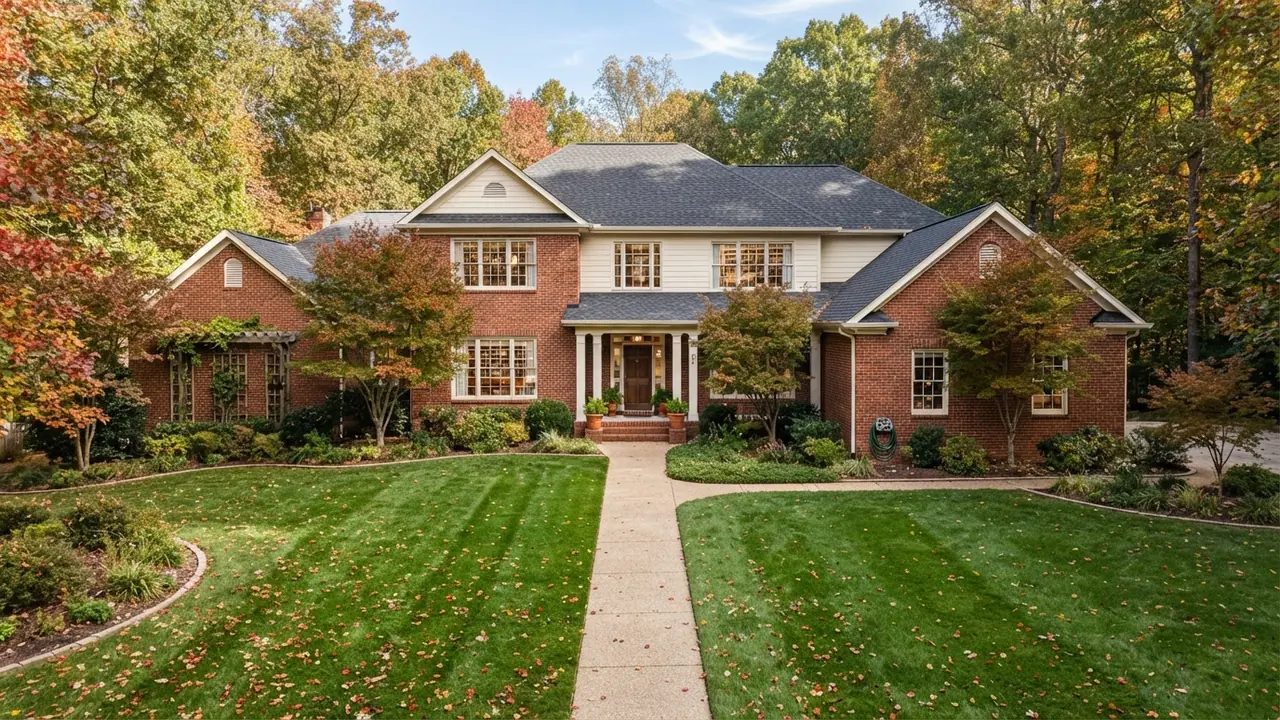
If you have been looking at houses around Waxhaw, somebody has probably told you that the lots here start at an acre. It’s easy to see why that sticks, because plenty of the land around Waxhaw really is in big parcels. There is no one acre rule, though, and no half acre rule. The Town of Waxhaw’s Land Development Code sets no minimum lot area for its residential districts at all. What it sets, in the dimensional table revised on June 9, 2026, is a minimum lot width of 100 feet and a minimum lot depth of 200 feet in the R-1 district, and those two numbers decide your yard far more precisely than any acreage figure would.
So lot sizes in Waxhaw NC are a rectangle you can measure, and three things move it: your district, whether the subdivision was approved under conservation design, and whether your Waxhaw address falls inside the town’s authority at all. That last one changes every other answer here. I’m Steve Jarrell, I live in Weddington, and the numbers below come from the two ordinances that govern this land, the Waxhaw Land Development Code and the Union County Unified Development Ordinance.
15 min read | By Steve Jarrell, The Longleaf Group at eXp Realty | Updated October 2026
Free · 26-Page Insider Guide
Know what to check before you tour a single Waxhaw lot.
Towns compared, NC vs SC taxes and schools side by side, and the 5 mistakes out-of-state buyers make.
What This Guide Covers
- What are minimum lot sizes in Waxhaw NC?
- What the town controls instead
- How small can lot sizes in Waxhaw NC get?
- Then conservation design cuts the frontage to 40 feet
- Your Waxhaw address may not be governed by Waxhaw
- What you can put on the land
- Frequently asked questions
What are minimum lot sizes in Waxhaw NC?
There isn’t one, and that throws most people. Open the Town of Waxhaw Land Development Code, go looking for a row that says how many square feet a house lot has to be, and you won’t find it. The dimensional requirements table that governs every residential district lists density, lot width, lot depth, setbacks, coverage and height. Lot area isn’t a row in the town’s dimensional table.
The Short Answer
The Town of Waxhaw sets no minimum lot area for its residential districts. It controls how much land you get through density, lot width and lot depth instead, in a dimensional table last revised on June 9, 2026.
Key numbers, Town of Waxhaw residential districts, code revised June 9, 2026 (source: Town of Waxhaw Land Development Code, Section 4.4.1):
- Minimum lot area: none published, in any residential district
- Minimum lot width: 100 feet in R-1, down to 60 feet in R-4
- Minimum lot depth: 200 feet in R-1, down to 105 feet in R-4
- Density: 1 unit per acre in R-1, up to 4 units per acre in R-4
- Maximum lot coverage: 40% in R-1, up to 75% in R-4
- Union County, by contrast, publishes eight minimum lot areas, 200,000 down to 4,000 square feet
That absence isn’t an oversight, and it changes how you read a listing. A builder can advertise a neighborhood as R-1, the most generous zoning in town, and still hand you a lot that’s nothing like an acre. One unit per acre caps the subdivision, not your deed. Put 40 homes on 40 acres and you’ve met one unit per acre even if every one of them sits on a third of an acre and the remaining 27 acres is roads, open space and woods nobody mows.
This is the most common misunderstanding I run into with relocating buyers in Union County, and it costs people real disappointment at the walkthrough. Someone hears R-1, or hears one unit per acre, and pictures an acre of grass around the house they are about to buy. Density is a subdivision-wide average. The acre is the planner’s arithmetic, not your yard.
Stop asking what the zoning is. Ask two different questions instead: how wide is this lot at the front, and how deep is it to the rear line. Those two numbers are on the plat, they are the ones the town enforces, and they tell you what you will be standing in on a Saturday morning.
Talk to a local broker
Want to know what a specific Waxhaw lot really gives you?
Send me the address and I will pull the plat and the zoning before you tour. No pressure, just answers.
Schedule a 15-Minute Introductory Call →704-774-7170 · steve@jarrellhomes.com · thelongleafgroup.com
What the town controls instead
Waxhaw regulates shape and intensity. The dimensional requirements table in Section 4.4.1 of the Land Development Code, revised by the Board of Commissioners on June 9, 2026, governs every residential district inside the town’s planning jurisdiction through five levers.
Density is the subdivision’s budget, not yours: one home per acre in R-1, two in R-2, three in R-3, four in R-4, averaged across the tract. Width and depth are yours. They fix the narrowest your frontage can be and how far back your rear line sits, and they’re the two numbers a surveyor can hand you. Coverage then caps how much of that rectangle you may build over. Nothing in a residential district goes above 45 feet tall.
Union County does it the other way round. The county’s Unified Development Ordinance publishes a plain minimum lot area in square feet for every residential district: 200,000 square feet in RA-200, 40,000 in R-40 and RA-40, 20,000 in R-20 and RA-20, then 15,000, 10,000, 8,000, 6,000 and 4,000 as the districts step down. It also sets a minimum lot width running from 300 feet in RA-200 to 35 feet in R-4. Its height cap moves with the district too: 35 feet from RA-200 through R-10, then 50 feet in R-8, R-6 and R-4, where Waxhaw holds every residential district to 45.

What this decides for you is what you can check before you write an offer. In the county you look up a district and know the floor. In town the floor is a rectangle, so you’ll need the plat.
How small can lot sizes in Waxhaw NC get?
Here’s where the numbers become a picture you can stand in. If a lot meets the width minimum and the depth minimum and no more, multiply the two and you’ve got the smallest rectangle the code allows. The town doesn’t publish these totals. The multiplication is mine; the two numbers in it are the code’s.
In R-1, 100 feet of frontage by 200 feet of depth gives you 20,000 square feet, about 0.46 of an acre. R-2 at 90 by 160 gives 14,400, roughly a third. R-3 at 80 by 140 gives 11,200, about a quarter. R-4 at 60 by 105 gives 6,300, close to a seventh. So the most generous district in town permits a house lot under half an acre, and the one acre everybody repeats isn’t in the code anywhere.
| Measure | Waxhaw R-1 | Waxhaw R-4 | Union County RA-200 | Union County R-4 |
|---|---|---|---|---|
| Minimum lot area | None published | None published | 200,000 sq ft | 4,000 sq ft |
| Minimum lot width | 100 ft | 60 ft | 300 ft | 35 ft |
| Front setback | 30 ft | 15 ft | 40 ft | 20 ft |
| Side setback, interior lot | 15 ft | 7.5 ft | 15 ft | 5 ft |
| Rear setback | 30 ft | 20 ft | 40 ft | 25 ft |
| Maximum building height | 45 ft | 45 ft | 35 ft | 50 ft |
Watch the district names before you compare the county columns against the town ones. Waxhaw’s R-4 means four homes to the acre. Union County’s R-4 means a 4,000 square foot lot. Same label, two rulebooks, nothing linking them.
Read the setback rows against the width rows, because together they tell you how much of the yard you can use. An R-1 lot at the minimum 100 feet wide gives up 15 feet to the side setback on each side, leaving a 70 foot building envelope. Do the same on an R-4 lot at 60 feet wide with 7.5 foot sides and you’re down to 45. Your house goes in that envelope. An accessory structure can sit closer, as little as 5 feet from the line, which is often the only way a pool fits at all.
Then there’s coverage, which almost nobody asks about until the pool quote comes back. In R-1 the code caps it at 40%. On a lot at the district minimum, 20,000 square feet, that’s 8,000 square feet to divide among the house footprint, the driveway, the patio and anything else you pour. Ask the town how it measures coverage before you plan a detached garage or a sport court. The one acre assumption trips buyers the same way in our guide to lot sizes in Weddington NC.
Then conservation design cuts the frontage to 40 feet
Everything above describes a conventional subdivision. Waxhaw runs a second track called Conservation Design Development, and if you’re buying new construction near town there’s a good chance you’re standing on it. Nothing on the sign will tell you so.
The same table carries a second set of figures in parentheses that apply when a developer builds under conservation design. In R-1 the minimum lot width drops from 100 feet to 40, and the depth from 200 feet to 100. Front setback falls from 30 feet to 15, side from 15 to 7.5, rear from 30 to 15. Run the multiplication again and an R-1 lot under conservation design can be 4,000 square feet, under a tenth of an acre in the district people call the one acre zone.
In exchange, the land has to go somewhere. Waxhaw’s Conservation Development Design Standards Policy says so in one line: At least fifty percent (50%) of the land area in the Conservation Development Design shall be set aside as protected open space.
It caps what the Zoning Administrator can require at 60%.
Two things that follow surprise people. Density doesn’t move, so this isn’t a way to fit more houses in: it’s the same number of houses on smaller lots, with the remainder held as open space. And coverage goes the other way, because an R-1 conservation lot may cover 50% where a conventional one is capped at 40%. The lot shrinks and the share you may build over grows.
The tradeoff cuts both ways. Conservation design gives you a smaller private yard and a larger shared area set aside as protected open space. If that’s the trade you want, it’s a good one. If you want room between you and your neighbor, a 40 foot frontage in an R-1 neighborhood will feel like a bait and switch. You can’t tell which track a neighborhood was built on from the district label. You have to ask, and the plat will say.
Before you write an offer in Waxhaw, ask the listing agent whether the subdivision was approved as conventional or as conservation design. It is the difference between a 100 foot frontage and a 40 foot one inside the same zoning district, and the district label on the sign will not tell you which one you are buying.
This is where I see relocating buyers get most frustrated, and it is rarely because anyone misled them. A phased neighborhood can finish its first streets at generous spacing and plat a later phase to the conservation minimums, all under one R-1 label. The label describes the approval, not your lot.
Talk to a local broker
Conventional or conservation design? I can find out for you.
One call settles which track a Waxhaw neighborhood was approved on, and what that means for your yard.
Book a 15-minute call →Your Waxhaw address may not be governed by Waxhaw
Now the question that reorders everything above. A Waxhaw mailing address doesn’t mean a property is in Waxhaw. Postal boundaries follow where mail got sorted, not where a council has authority, and the two have drifted apart.
The Land Development Code defines its own reach as the area including the Town’s municipal limits and its extra-territorial jurisdiction (ETJ)
, a band of unincorporated land just outside the town line where the town still applies its rules. Union County’s ordinance picks up exactly where that stops: its provisions apply within all of Union County outside the corporate or extraterritorial jurisdiction of any municipality
. Between them, one of the two governs your parcel.
So your Waxhaw address sits under one of two rulebooks, and which one applies decides whether a published minimum lot area even exists for it. Inside the town limits or the ETJ there’s no minimum lot area, and width and depth govern. Outside both, the county’s square footage floors apply, and in RA-200 that floor is 200,000 square feet, about 4.6 acres. That’s the single biggest difference a property line can make here, and it turns on a boundary you can’t see from the road.
Check it early. Pull the parcel on the county’s GIS and read the jurisdiction. If it says Waxhaw, the town’s table governs. If it says unincorporated Union County, use the county ordinance. Our write-up on what a Mint Hill mailing address does not tell you covers the same trap on the Mecklenburg side, and our Waxhaw community page covers the town itself.
What you can put on the land
Land is only as useful as what you’re allowed to do with it, and the rules run stricter than the countryside looks.
Sheds, detached garages, workshops and pool houses in Waxhaw must sit at least 5 feet from your property line, cover no more than 30% of the lot area, and never sit forward of the house. That last one catches people with a long front lawn and a plan to put a workshop near the road.
On a larger parcel the horse question comes up early, and the answer turns on the jurisdiction question above. If your lot is inside the town, an equestrian facility is a defined use that may be located on a lot as the principal use or on a lot with a single family residence
, and the code is specific that The lot shall be a minimum of 5 acres.
Structures housing horses must sit 50 feet from every property line and 30 feet from the house, in the rear or side yard.
If you’re outside the town, the arithmetic changes. Union County allows horses as an accessory use at one horse over six months of age per acre, and only in RA-200, RA-40, R-40, RA-20, R-20 and R-15. A barn there must sit 50 feet from adjacent property lines, 100 feet from any adjacent residence and 30 feet from the principal structure, and on a lot under 4 acres it belongs in the rear yard.
That 5 acre figure is the one place in the Waxhaw code where a residential-adjacent use carries a minimum lot area. It attaches to the equestrian use, not the house, which is why the dimensional table stays silent on lot area and this rule still stands. If horses are part of why you’re moving here, two parcels across the street from each other can give you completely different answers. For what your money buys around here, our South Charlotte market data page tracks the numbers by town.
Fences come up on nearly every one of these calls. A fence or wall can sit on the property line or anywhere in the required setbacks, finished side out, no barbed wire. If Indian Trail is also on your list, read its fence and shed setbacks before you assume they match Waxhaw’s.
Frequently Asked Questions
What are the minimum lot size requirements for residential properties in Waxhaw, NC?
The Town of Waxhaw sets no minimum lot area for its residential districts. It does set minimum lot dimensions, which is a different thing: the dimensional requirements table in Section 4.4.1 of the Land Development Code, revised June 9, 2026, has no lot area row at all, and instead requires 100 feet of width in R-1, 90 in R-2, 80 in R-3 and 60 in R-4. Minimum depth runs 200, 160, 140 and 105 feet across the same four. If your parcel sits outside the town limits and the extraterritorial jurisdiction, Union County governs and it does publish minimum lot areas, from 200,000 square feet in RA-200 down to 4,000 in R-4.
What are the setback requirements for building a house in Waxhaw or Union County, NC?
If your lot is in Waxhaw, R-1 requires a 30 foot front setback, 15 feet on an interior side, 25 feet on a corner side and 30 feet at the rear. R-4 requires 15 feet front, 7.5 side, 15 corner side and 20 rear. In unincorporated Union County the rural end runs larger: RA-200 requires 40 feet front, 15 side and 40 rear, while R-4 requires 20 front, 5 side and 25 rear. Both come from the Waxhaw Land Development Code revised June 9, 2026 and the Union County Unified Development Ordinance.
What can I build on my residential property in Waxhaw, NC, according to zoning laws?
Sheds, detached garages and pool houses are allowed in every Waxhaw zoning district, but they must sit at least 5 feet from your property line, cover no more than 30% of the lot area, not exceed the height of the house and never sit forward of it. Pools must be enclosed by a fence or wall at least 4 feet high meeting current North Carolina state regulations. An equestrian facility is permitted, but the lot must be a minimum of 5 acres and any structure housing horses must sit 50 feet from all property lines and 30 feet from the house.
Do I need a permit for home improvement projects like decks, fences, or pools in Union County and Waxhaw, NC?
Decks, sheds, pools and fences are all regulated work, so plan on zoning approval. Fences in a residential yard may sit on the property line or within the required setbacks, finished side outward, with barbed or razor wire prohibited. A pool has to be enclosed by a fence or wall at least 4 feet high meeting current North Carolina state regulations. Which office issues the permit depends on which one governs your parcel, so settle that first, because the town and the county run separate processes.
How do I find the zoning district for a specific property in Waxhaw or Union County, NC?
Start by settling which jurisdiction your parcel is in, because a Waxhaw mailing address does not establish that. The Waxhaw Land Development Code applies within the town’s municipal limits and its extraterritorial jurisdiction, and Union County’s ordinance applies everywhere outside any municipality’s corporate or extraterritorial jurisdiction. Pull your parcel on the county’s GIS mapping, read the jurisdiction and the zoning district off the record, then take that district to the matching ordinance table. Quote a standard from the wrong rulebook and every number after it is wrong too.
What is the process for obtaining a building permit in Waxhaw or Union County, NC?
Zoning approval and your building permit are separate steps, and which office handles the zoning side depends on the jurisdiction. Inside the town limits or the extraterritorial jurisdiction it is the Town of Waxhaw planning department, which publishes its application forms and a planning quick guide alongside the Land Development Code. Outside those boundaries it is Union County planning and development. Settle which of the two governs your parcel before you fill in anything.
About the Author
Steve Jarrell is a licensed North Carolina and South Carolina broker and the team lead of The Longleaf Group at eXp Realty, which he co-leads with his wife Amanda. Before real estate, Steve joined VisualTour as President, led its rebrand to Paradym, and led the company to its acquisition by Constellation Software in 2020. He holds an MBA from the University of Tennessee with concentrations in Marketing and Innovation. The Longleaf Group is an eXp ICON Team and a RealTrends Verified Top Team by Volume for 2026, with 170+ five-star reviews.
I live in Weddington, a few minutes from the Waxhaw town line, and I sell in both jurisdictions every week. So here is what to do before you tour. Pull the parcel on Union County’s GIS and read the jurisdiction, because that alone decides whether a minimum lot area exists for your land. Then ask whether the subdivision was approved as conventional or as conservation design, because that decides whether your frontage is 100 feet or 40. If you want a hand with either, call me at 704-774-7170 and we’ll pull the plat together.